

I’ve been spending time reading into Walrus Protocol, and honestly, it feels relevant for very grounded, practical reasons. Right now, capital isn’t really chasing stories anymore. It’s moving toward systems that are actually being used. From what I can tell, Walrus isn’t trying to sell permanence or big promises. It’s focused on something much more immediate: keeping applications running reliably when real demand shows up.
When you look at how the network is being used, the pattern feels different from hype-driven projects. There’s less random experimentation and more data that sticks around because real applications depend on it. That kind of usage usually doesn’t come from speculation. It comes from builders who need infrastructure that works consistently, not just during quiet periods.
One thing that stood out to me while digging deeper is how redundancy is handled. The system is clearly designed with failure in mind. It assumes parts of the network will go offline and plans around that reality. Because of this, operators don’t need extreme rewards just to stay afloat, which helps reduce constant sell pressure. That said, there’s a tradeoff worth watching. If the network gets extremely busy, rebuilding data after failures could introduce delays. It’s not a flaw, but it’s a cost that only shows up at scale.
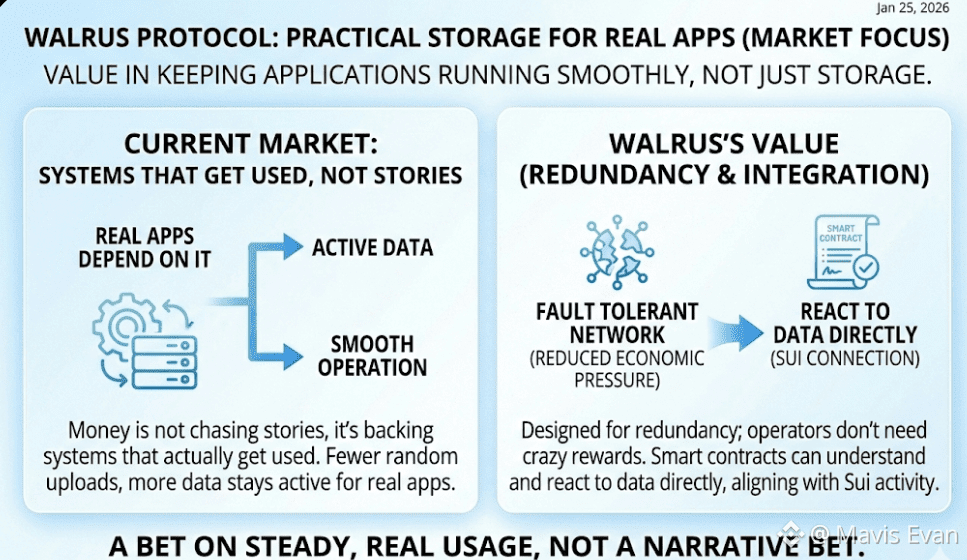
The connection with Sui also makes sense when you look closely. Applications on Sui tend to generate uneven, bursty data patterns. Walrus seems built for exactly that kind of behavior. What’s interesting is that storage usage appears to grow alongside real Sui activity, not price movements. That alignment is rare and usually healthier over time.
I also don’t think comparing Walrus to big cloud providers really captures what it’s doing. This isn’t about replacing Amazon or Google. It’s about allowing smart contracts to understand, manage, and react to data directly. That’s why developers are willing to tolerate some early inefficiencies. The main risk is straightforward. If adoption slows too much, the network has to rely heavily on organic Web3 demand to sustain itself.
As for WAL, it doesn’t feel like a trader’s token. It feels designed to stay steady while usage grows. That might seem boring short term, but structurally it’s healthier. In the end, Walrus doesn’t look like a narrative bet. It looks like a bet on consistent, real usage over time.
