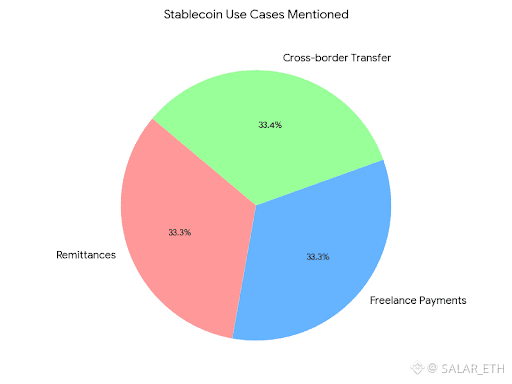
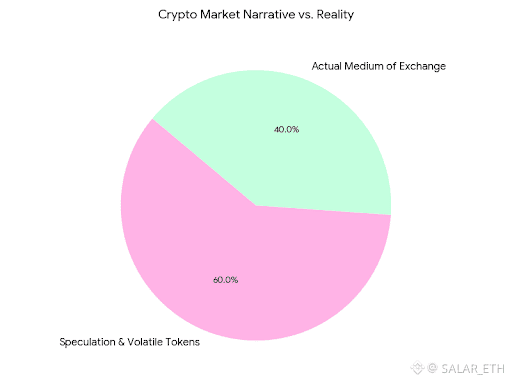
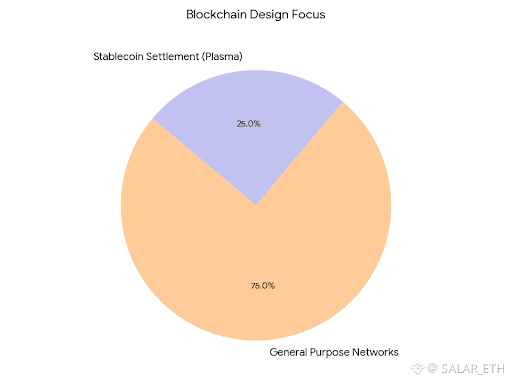
For years, stablecoins have quietly done the heavy lifting of crypto. While headlines focused on volatile tokens and experimental DeFi, stablecoins became the actual medium of exchange. People used them to send money home, to pay freelancers, to move value across borders when banks were slow or unavailable. Yet beneath that growth sat an uncomfortable truth: most blockchains were never built for this job. They were general-purpose networks trying to serve too many needs at once. Plasma begins with a different assumption. It starts by asking a simple question: what would a blockchain look like if stablecoin settlement were the main priority, not an afterthought?
The idea behind Plasma is shaped by everyday friction. Anyone who has tried to send a stablecoin on a busy network knows the feeling. You have the money, but you cannot move it because you lack the native token for gas. Or the transaction goes through, but finality feels fuzzy, forcing you to wait before trusting the payment is truly complete. Plasma is built to remove these small but persistent problems, the kind that matter deeply when crypto is used for real payments rather than experiments.
At its core, Plasma is a Layer 1 blockchain designed specifically for stablecoin transfers and settlement. Instead of pushing users to adapt to blockchain mechanics, it bends the mechanics toward users. The network supports full Ethereum compatibility through a modern Rust-based client, which means existing smart contracts and tools can run without modification. That choice is not just about convenience. It reflects a belief that developers should not have to abandon proven systems to gain better payment performance. Plasma wants to feel familiar under the hood while behaving very differently on the surface.
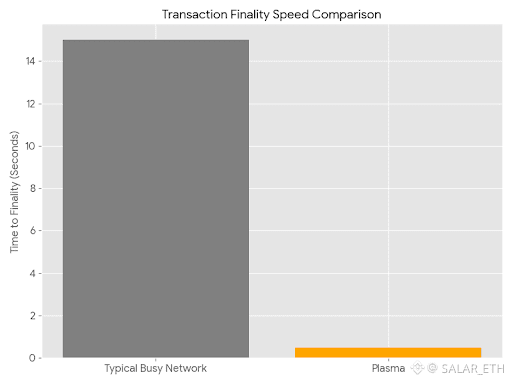
One of the most noticeable differences is speed paired with certainty. Plasma uses a consensus system designed to finalize transactions in well under a second. More importantly, that finality is deterministic. When a payment is confirmed, it is done. There is no mental math about how many blocks have passed or whether a reorganization might still occur. This may sound like a technical detail, but it changes behavior. Merchants can release goods immediately. Payment processors can settle balances without delay. Users do not hover over their screens waiting for reassurance. The system quietly does what it promises.
As the network moves value faster, it also removes friction from how that value is moved. Plasma introduces stablecoin-native gas mechanics that allow users to send USDT without holding or even thinking about a separate gas token. In many cases, transfers can be gasless altogether. This matters most in places where stablecoins are already woven into daily life. When people treat digital dollars like cash, being told they need another volatile asset just to move them feels unnatural. Plasma treats that friction as a design flaw rather than a user error.
There is also a philosophical layer to Plasma’s design that becomes clearer the longer you look at it. The project places strong emphasis on neutrality and resistance to control. To support this, Plasma is designed to anchor aspects of its security model to Bitcoin. Bitcoin’s role here is not about payments or smart contracts, but about settlement gravity. By tying itself to the most established and economically secure blockchain, Plasma aims to avoid becoming dependent on a single issuer, validator group, or jurisdiction. For institutions especially, this matters. Settlement layers need to feel boring, dependable, and difficult to influence.
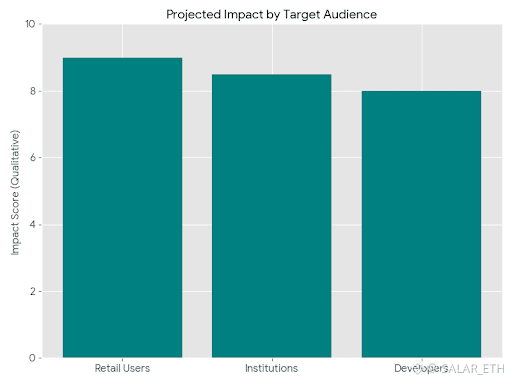
As these technical choices come together, a clearer picture of Plasma’s intended audience begins to form. This is not a chain chasing the latest trend. It is built for people who already rely on stablecoins every day. Retail users in high-adoption markets benefit from transfers that feel instant and intuitive. They do not need to understand blockchain mechanics to use the system effectively. Institutions see something different but equally important: predictable settlement, high throughput, and a structure that can integrate into existing financial workflows without constant exception handling.
Developers sit somewhere in between. Plasma does not ask them to abandon Ethereum or learn an entirely new programming model. Instead, it offers a familiar environment with fewer constraints around payment logic. Applications can be built with the assumption that users will not be blocked by gas complexity or slow confirmations. That freedom opens the door to better design choices, especially for payment apps, wallets, and financial infrastructure that must serve non-technical users.
Of course, Plasma does not exist in a vacuum. Any new Layer 1 faces the same test: adoption. Liquidity, exchange support, wallets, and merchant integrations all take time. There are also real questions around how cross-chain bridges and Bitcoin anchoring are implemented in practice, and how those systems hold up under stress. Plasma does not escape these challenges, but it approaches them with a narrower focus than most chains. By concentrating on stablecoin settlement rather than trying to be a universal platform, it reduces the surface area of risk.
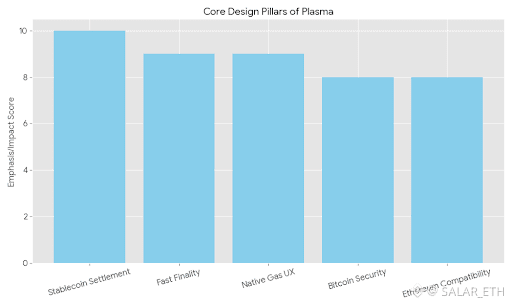
What makes Plasma interesting is not any single feature, but the consistency of its design decisions. Everything points back to the same use case. Fast finality supports payments. Stablecoin gas removes friction. Ethereum compatibility lowers adoption barriers. Bitcoin anchoring strengthens neutrality. None of these choices feel accidental. Together, they suggest a network built by people who have watched how stablecoins are actually used, not just how they are discussed online.
If stablecoins continue their quiet expansion into everyday finance, the infrastructure supporting them will matter more than ever. People will care less about flashy features and more about reliability. They will want systems that work the same way every time, even under pressure. Plasma is betting that the future of blockchain adoption will not be driven by speculation alone, but by settlement that simply works. If that bet pays off, Plasma may end up doing something rare in crypto. It may fade into the background, quietly moving value while users focus on everything else.