

Walrus Protocol: Why AI Workloads on Sui Require Proof-Based Data Resumeability Instead of Blind Storage Assumptions
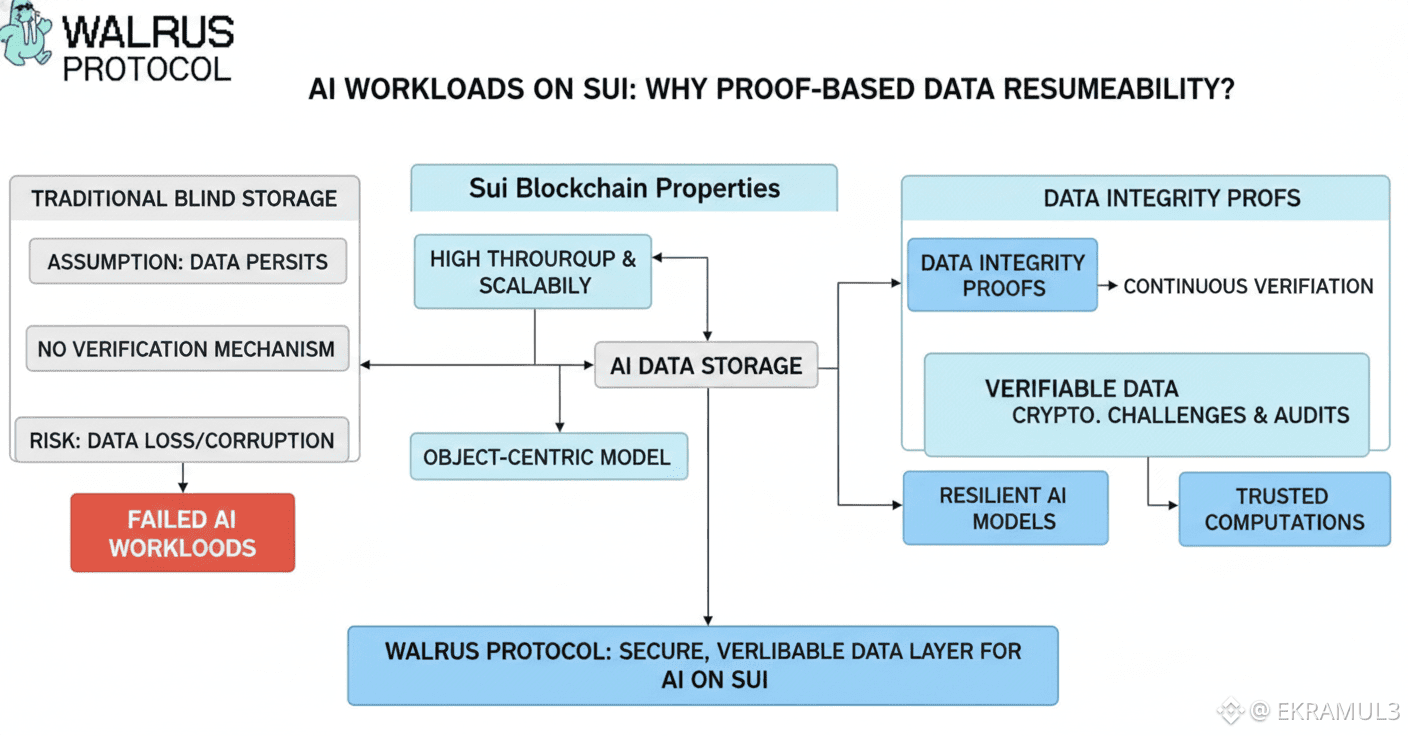 When people talk about AI meeting blockchains, they usually focus on compute: inference costs, model execution, and GPU markets. But real AI workloads are not compute-only they are storage-intensive and checkpoint-driven. Training pipelines depend on large datasets, intermediate artifacts, and model snapshots that need to be paused, resumed, and re-used later. On Sui, this exposes a gap that most chains never solved: AI workloads don’t just need storage; they need resumeability the ability to recover the exact state of a pipeline without assuming the data still exists somewhere off-chain.
Traditional decentralized storage solutions implicitly assume that if data was once uploaded, it will still be retrievable later. This assumption breaks under AI conditions. Checkpoints are large, expensive to re-compute, and sensitive to versioning mismatches. If even a single shard of a dataset or checkpoint is unavailable later, the pipeline collapses. Walrus introduces a different contract: instead of assuming storage, it proves availability through retrieval proofs anchored on Sui. Resumeability becomes a verifiable property, not a wish.
Proof-based resumeability matters because AI workloads operate over time, not just at the moment of upload. A model might train for hours, pause overnight, resume with new data, commit updated checkpoints, or branch into new fine-tuning paths. These cycles cannot rely on “best effort” storage guarantees. Walrus enforces availability using time-indexed leases and proof submissions. Operators must demonstrate that they still hold the fragments required to reconstruct blobs. If they fail, penalties and slashing introduce economic consequences instead of silent failure.
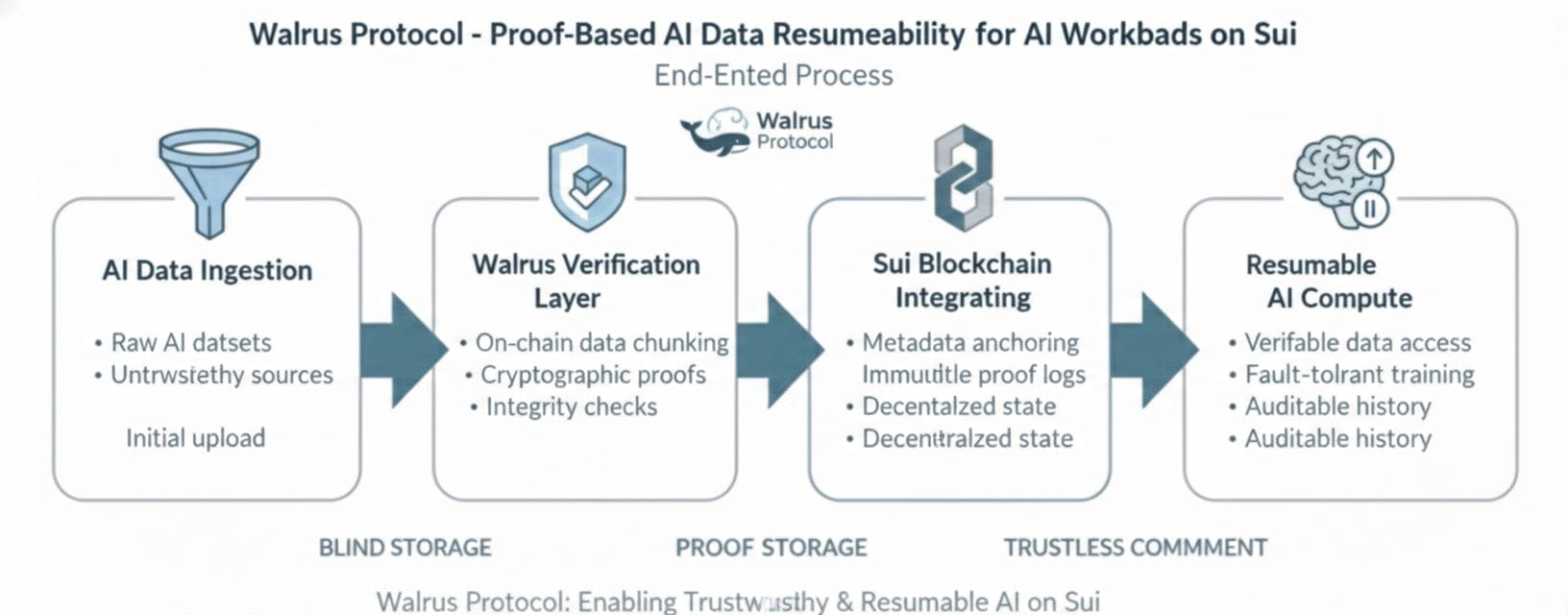 This design aligns naturally with Sui’s execution model. Sui provides high-throughput parallel execution and object-centric state transitions. Walrus extends that state model with a cold memory layer where blobs datasets, logs, training checkpoints become retrievable objects tied to verifiable retention contracts. Resumeability becomes an explicit interface: smart contracts can query data availability, trigger renewals, or orchestrate multi-epoch workloads without relying on centralized cloud services or opaque backend pipelines.
In cloud environments, storage is often treated as an open tab operators assume data will be there until they delete it. Walrus forces explicit retention decisions through leases. Data that remains relevant AI models, prompts, fine-tuning sets, inference logs keeps renewing. Data that no longer adds value expires naturally. This avoids the waste of global permanence and the fragility of temporary storage.
For AI developers on Sui, three constraints converge:
1. Temporal continuity — models train across time
2. Version continuity — checkpoints depend on specific data versions
3. Verification continuity — correctness cannot rely on trust
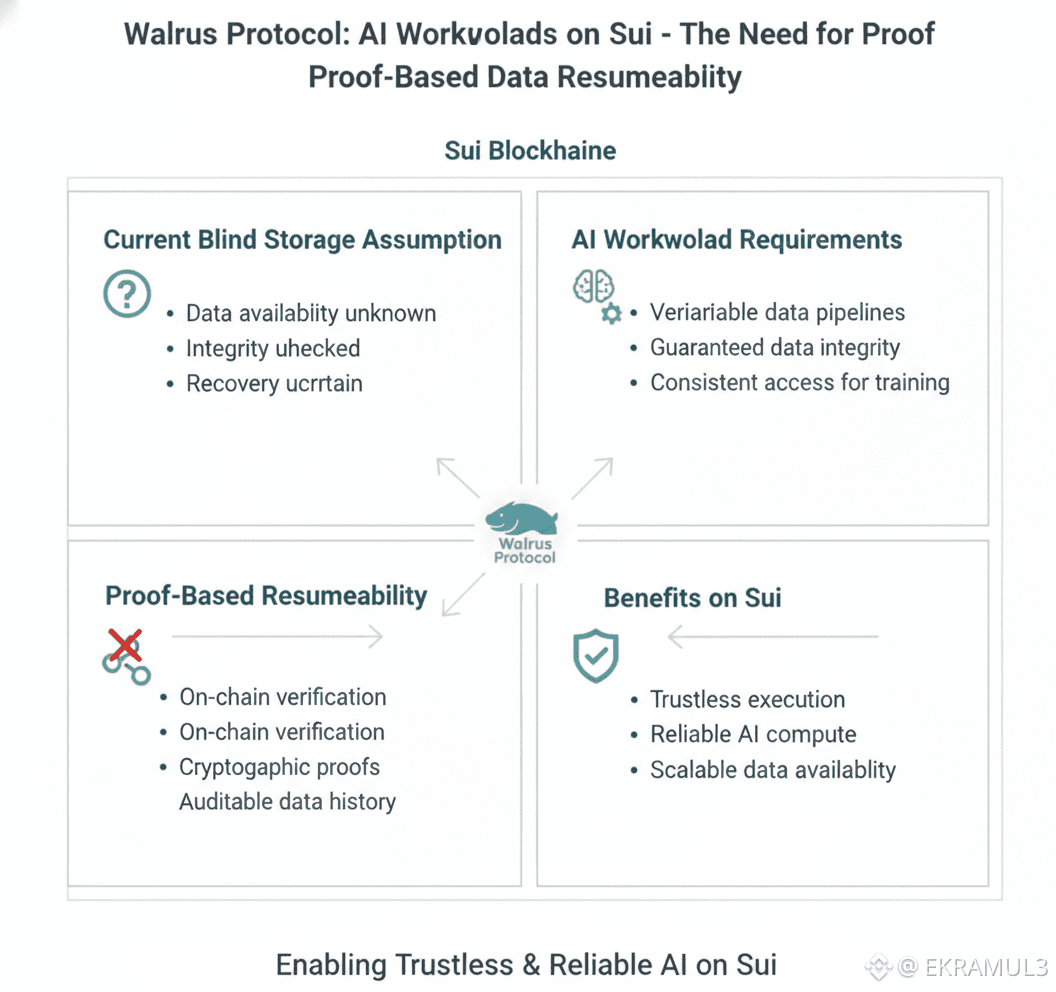 Walrus resolves all three through economic enforcement and cryptographic proofs. Operators cannot lie about holding data because they must demonstrate fragments during retrieval or during periodic verification windows. And they cannot abandon data early, because leases tie future revenue to continued storage obligations.
The broader implication is that AI-native workloads finally gain something they lacked in Web3 environments: a storage substrate that behaves like infrastructure instead of a guess. AI systems are notoriously unforgiving under uncertainty. A missing dataset or checkpoint can cost hours of compute or invalidate entire experiments. By making availability provable rather than assumed, Walrus lets AI systems treat Sui as a platform rather than as a coordination layer wrapped around centralized cloud buckets.
Most chains never reached this discussion because most chains never had execution environments where AI workloads made sense. Sui’s parallelism and object system change the economics of on-chain coordination. Walrus adds the complementary memory model required to support long-lived, restartable, and data-heavy pipelines.
This is why Walrus matters to AI not because it stores data, but because it introduces resumeability as an enforceable property. Compute is worthless if its intermediate states cannot survive time, audits, and failures. Blind storage assumptions collapse under the complexity of real AI. Proof-based resumeability is the missing infrastructure primitive that turns AI workflows on Sui from demos into products.