
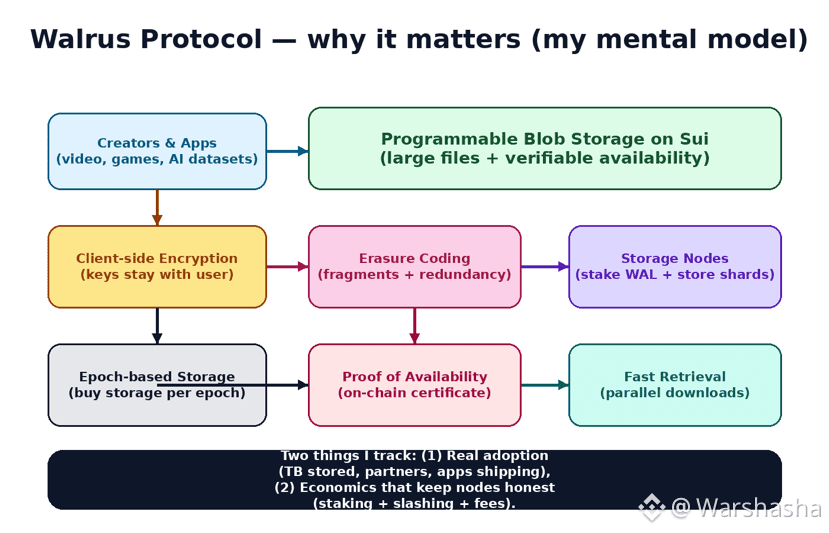
I’ve been watching storage narratives for years, and most of them either (1) over-promise permanence, or (2) ship something that works… but feels like a developer-only toy. @Walrus 🦭/acc is interesting because it’s pushing a very specific angle: programmable blob storage on Sui, built for the kind of heavy data the next wave of apps actually needs—video, game assets, AI datasets, archives—while still keeping availability verifiable and incentives enforceable.
What changed for me recently is that Walrus is starting to look less like “a cool idea” and more like “a protocol being trusted with serious weight.” The clearest example is Team Liquid moving ~250TB of content to Walrus (match footage, behind-the-scenes, brand content). That’s not a small pilot—this is the kind of data volume that forces a network to prove it can handle reality, not just theory.
The “why” is bigger than storage: Walrus is selling reliability as a primitive
If you strip away the buzzwords, Walrus is basically saying: “Apps can’t scale if their data layer can be rugged by uptime issues, censorship pressure, or a single vendor.” That’s the core value proposition. Not just decentralized storage for vibes—a data layer that’s designed to stay available even when nodes misbehave or disappear, and to do it efficiently using techniques like erasure coding and shard-based distribution.
The part I like is the protocol doesn’t ask you to “trust the network.” It leans into proofs and economics: storage providers commit, and the system has mechanisms to verify custody/availability and align rewards around doing the job properly.
The underappreciated design choice: epochs + predictable operating rhythm
One detail that matters more than people realize is how Walrus structures time in the protocol. On mainnet, Walrus runs with an epoch duration of 2 weeks, and the network is configured with 1000 shards plus a defined limit on how far out storage can be bought. That kind of structure is boring—but “boring” is exactly what production infrastructure needs. It gives builders predictability, and it gives node operators a clear cadence for commitments and accountability.
Recent updates that actually move the needle
A few recent signals made Walrus feel “more real” to me:
Jan 21, 2026 — Team Liquid migration (~250TB): real-world, high-volume content moving onto Walrus, which stress-tests availability and retrieval at scale.
Jan 8, 2026 — decentralization-at-scale focus: Walrus is actively messaging how it intends to stay decentralized as usage grows (this is where many networks quietly centralize).
Ongoing: Walrus continues positioning itself as AI-era storage, not just “IPFS but tokenized,” which matters because AI data workflows are massive and constant.
This combination—real adoption + explicit decentralization design—usually doesn’t show up together early. That’s why I’m paying attention.

Where $WAL fits
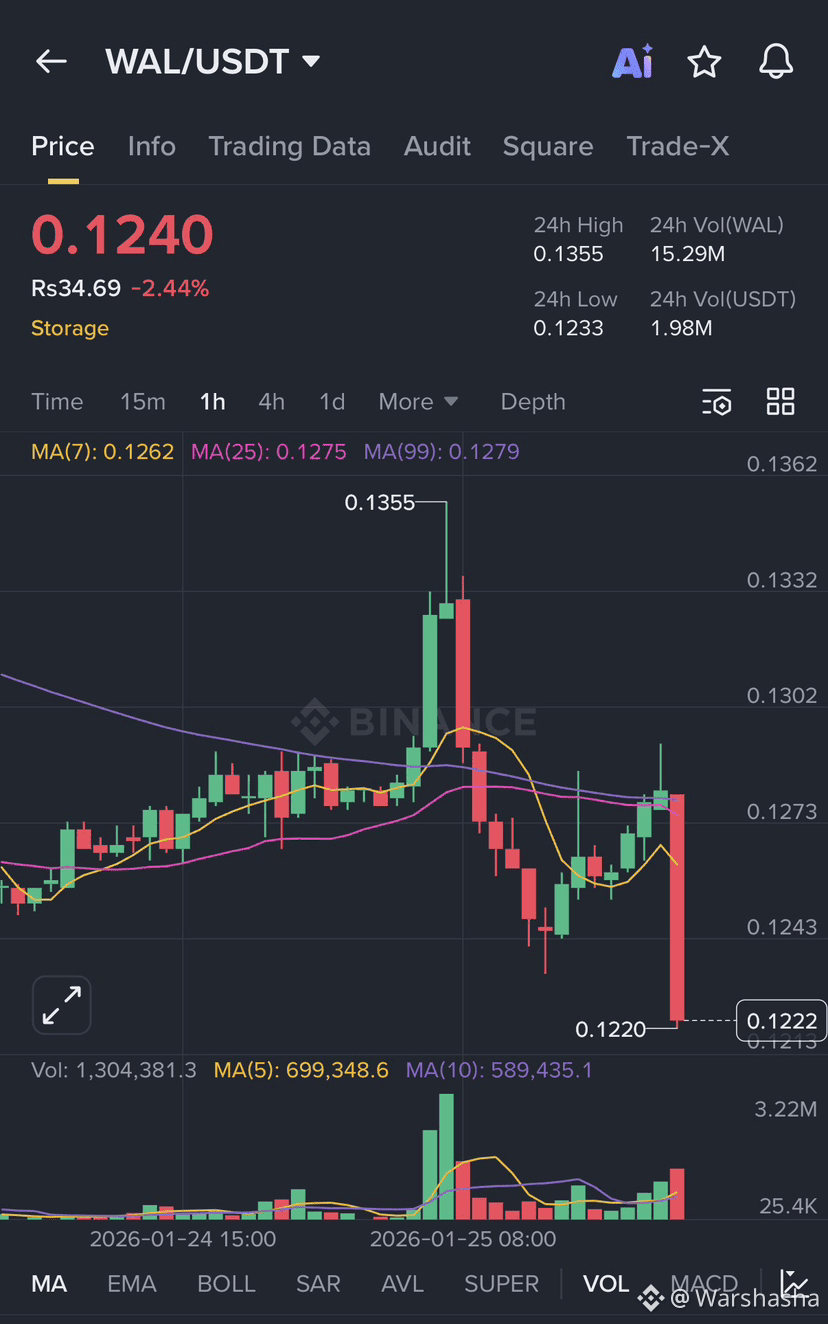
On Binance, $WAL is already tracked with full market stats (price, market cap, circulating supply, volume), and Binance also states the token’s role around paying for storage and rewarding node operators.
For me, WAL’s long-term “story” only works if two things keep compounding:
More apps store meaningful data (not just test files), and
Providers stay economically honest (staking/incentives keep availability strong).
If either side weakens—adoption slows, or reliability degrades—storage narratives get punished fast because users don’t forgive missing data.
My take: why Walrus could matter more than people think
Most crypto users only notice storage when something breaks—NFT media disappears, a dApp’s assets won’t load, a game can’t serve content globally, AI pipelines can’t verify datasets. Walrus is basically building for that “invisible” layer where the win is that nobody has to think about it—because it just works, at scale, without handing control back to a single platform.
If Team Liquid-sized integrations keep stacking, and the network keeps proving availability under real usage, #Walrus stops being a narrative and starts being infrastructure. And infrastructure—quietly—tends to outlast hype cycles.