


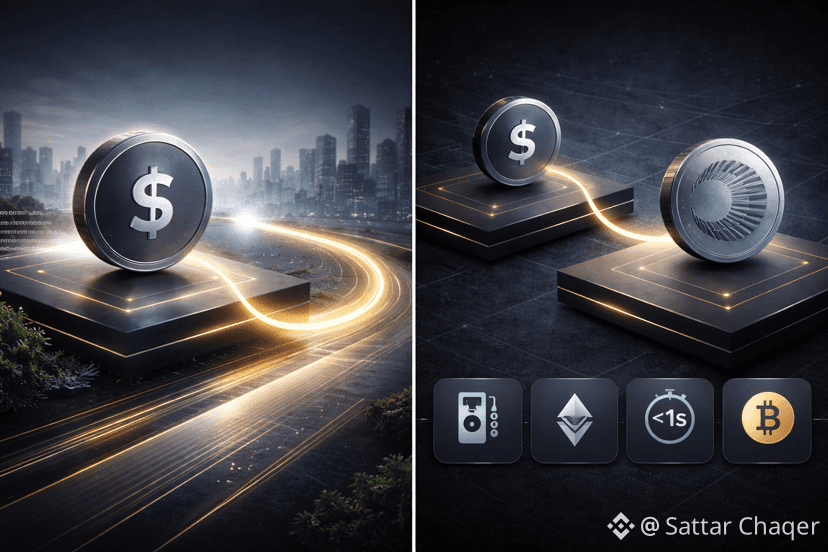
Stablecoins already move money for millions of people, yet the systems carrying them still behave as if speculation is the primary use case. Fees rise when markets become noisy. Finality is framed as probability rather than certainty. Users are asked to hold volatile assets simply to move value that is supposed to remain stable. None of this was designed to obstruct stablecoins. It is simply the residue of older assumptions.
Those assumptions matter more than they seem. They quietly decide who can use stablecoins comfortably and who cannot. They influence which businesses adopt them seriously and which treat them as a temporary workaround. Demand has never been the missing piece. Design has.
Plasma starts from a different place. It treats stablecoins not as applications living on top of a blockchain, but as the reason the blockchain exists in the first place. That single shift changes how the system behaves under pressure, how it feels to use, and what kinds of users it naturally serves.
Money does not behave like a speculative asset. It moves often, sometimes urgently, and usually without drama. People using it want consistency. They notice friction immediately and rarely tolerate it for long. Yet most blockchains were shaped by environments where friction was acceptable as long as upside existed.
This is where the tension becomes visible.
Stablecoins dominate transaction activity, but they rely on networks whose economics are driven by volatility. When attention rises, costs rise with it. Confirmation becomes something to wait for rather than something to assume. That experience may be familiar to traders, but it does not translate well to payroll, remittances, or routine settlement.
Plasma responds by narrowing its scope instead of expanding it. Rather than attempting to serve every possible use case reasonably well, it focuses on doing one thing properly. Settlement becomes the organizing principle rather than a side effect.
That choice shows up immediately in how value moves. Gasless stablecoin transactions remove the need to hold a separate, fluctuating asset just to pay fees. Costs are expressed in the same unit people are already sending. What disappears is not only complexity, but exposure. The transaction no longer depends on something the user never intended to interact with in the first place.
This is not a cosmetic improvement. It changes the risk profile of using the system at all.
Finality follows the same logic. In many networks, finality is treated as a performance benchmark. Faster numbers are advertised, comparisons are made, and charts are drawn. For payments, the question is simpler. Is the transaction done, or is it not. Plasma treats finality as an answer rather than a statistic. Sub-second settlement exists so downstream systems can rely on it without hesitation.
When settlement is clear, everything around it becomes easier. Reconciliation shortens. Accounting becomes cleaner. Trust shifts from expectation to procedure.
Importantly, none of this requires rebuilding the developer world from scratch. Plasma keeps full EVM compatibility, allowing existing tools and contracts to function without translation. This may look conservative, but conservatism has value when the goal is reliability. Familiar systems fail less often. Mature tooling reduces friction. Institutions notice these details even when they do not talk about them publicly.
Security choices follow the same pattern. By anchoring its assumptions to Bitcoin, Plasma opts for a form of neutrality that does not depend on constant governance adjustment. This is not an ideological move. It is a temporal one. Systems meant to last benefit from foundations that change slowly.
The result is infrastructure that does not ask for attention. It does not demand new habits or new narratives. It simply moves value in a way that feels unsurprising. For settlement systems, that is usually a sign they are working.
Plasma is not trying to compete for culture or visibility. It is not positioning itself as a social layer or a speculative playground. Its intended users are defined by behavior rather than identity. They include businesses, payment processors, and individuals who already rely on stablecoins and would prefer the underlying mechanics to stay out of the way.
In those environments, success rarely looks exciting. It looks quiet. Systems fade into the background once they work well enough.
General-purpose blockchains will continue to exist, and stablecoins will continue to run on them. But support is not the same as design. As usage matures, specialization tends to follow. Payments eventually demand rails that reflect how payments actually behave.
Plasma positions itself at that point in the curve. It does not promise transformation or dominance. It promises settlement. In financial systems, that promise often matters long after louder narratives have moved on.