

@Plasma When people say they want “programmable Bitcoin,” they usually mean they want the feeling of Bitcoin’s weight without the friction of Bitcoin’s pace. Plasma’s bridge is built around that emotional mismatch. It treats the act of moving BTC into an EVM world as a consent ceremony: you are not “wrapping” a symbol, you are making a trade with reality, locking something that cannot be faked so you can use it in a place where everything is composable and fast. That trade only works if the system can carry your fear with it—fear of hidden custody, fear of silent rehypothecation, fear that a button press can become a court case later.
Plasma has been unusually blunt about where the bridge stands today, and I respect that. The docs state the BTC bridge and the BTC-backed token issuance are still under active development and will not be live at mainnet beta, and that the architecture described is subject to change.That single sentence quietly shapes user behavior: it prevents premature trust. It also tells you something deeper about the culture here—Plasma would rather disappoint someone early than train them to rely on an illusion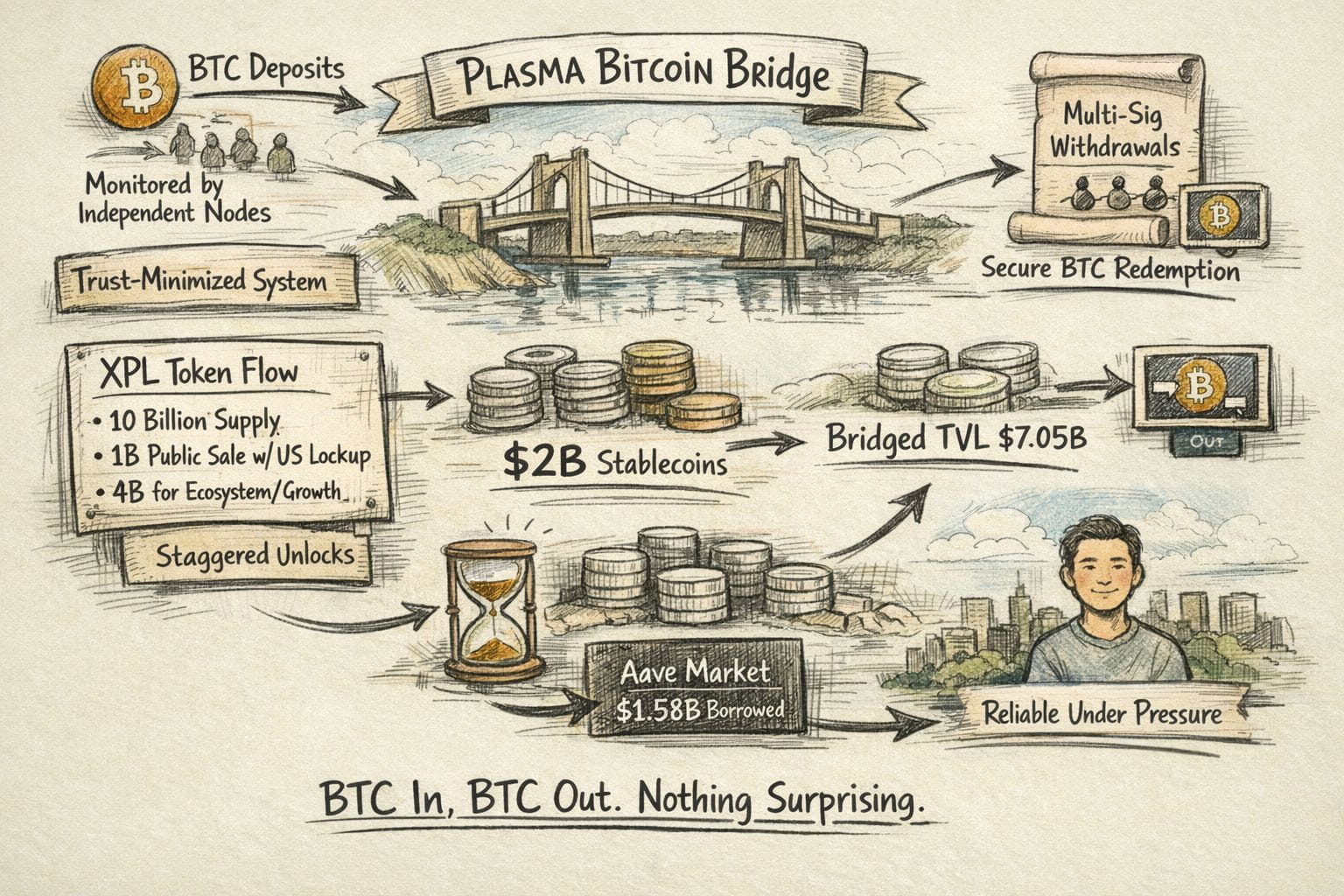
The intended shape of the bridge is not “trustless in a tweet” but trust-minimized in a systems sense. Deposits are observed by independent parties running their own Bitcoin nodes and indexers, and those parties attest to what they see before minting a BTC-backed representation inside Plasma. This matters because the failure mode of bridges is rarely technical in the narrow sense; it’s social. It’s the moment when one party claims a deposit happened and another party says it didn’t, and users are left staring at a stuck balance while markets move. Plasma’s approach is trying to make that disagreement legible and auditable, not merely “handled.”
Redemption is where people discover what they actually believe. When you withdraw, you are asking the system to sign a Bitcoin transaction back out into the world. Plasma’s stated design uses multi-party signing for withdrawals—so that no single operator can quietly decide where your BTC goes. That doesn’t eliminate trust; it spreads it across incentives and visibility. And psychologically, that shift is everything. Users don’t need perfection as much as they need to know where the risk lives, and who bears it when something goes wrong.
If you live inside Plasma long enough, you start to notice that the bridge is not an isolated “module,” even if people talk about it like one. It is meant to sit beside a chain that already thinks in stablecoins first, because stablecoin rails create constant demand for collateral that can survive volatility without becoming someone else’s liability. Plasma’s own announcements framed mainnet beta as arriving with very large day-one stablecoin liquidity—$2B active from day one and capital deployed across 100+ partners—because their thesis is that utility should exist immediately, not after a year of empty blocks. In that environment, BTC isn’t a mascot. It’s a stress test for whether value can move without permission while still behaving predictably in an application world.
The token sits underneath all of this like a quiet contract between strangers. XPL’s initial supply at mainnet beta is described as 10,000,000,000, with distribution split across public sale, ecosystem and growth, team, and investors. This is not just “tokenomics.” It’s governance by time. Plasma is telling you who will have influence early, who will have influence later, and how the system expects to keep paying for security and participation without letting inflation become a hidden tax.
Some of the most revealing numbers are the ones that force you to think about fairness under regulation pressure. Plasma’s public sale allocation is stated as 10% (1,000,000,000 XPL), with non-US purchasers unlocked at mainnet beta while US purchasers face a 12-month lockup, fully unlocking on July 28, 2026.That policy will frustrate people, and it will also protect the project from a different kind of chaos—the chaos where legal uncertainty becomes a liquidity shock. In my experience, networks don’t break only from hacks; they break from sudden, uneven exits that everyone pretends won’t happen.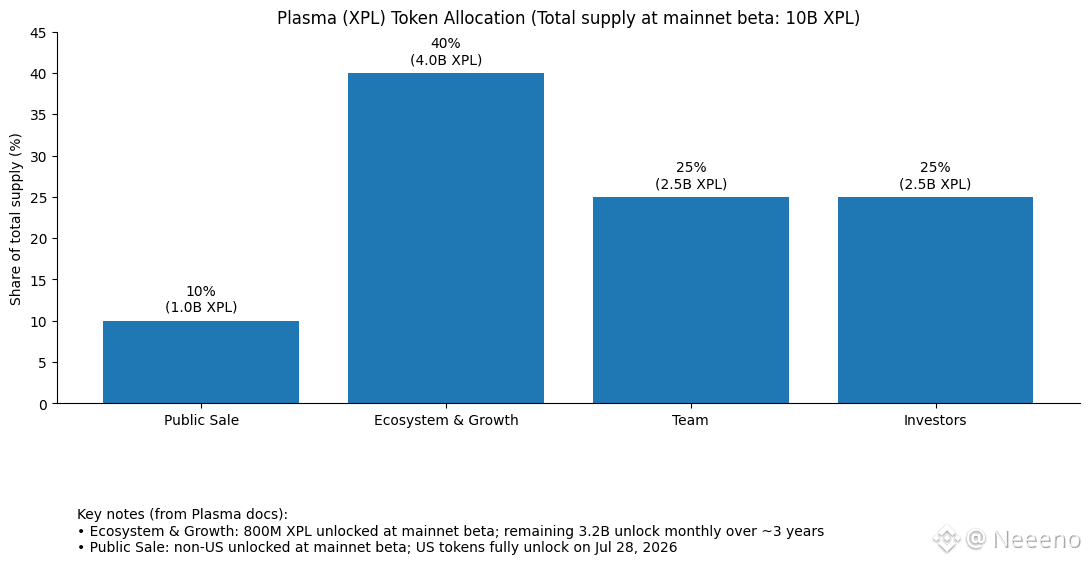
The ecosystem allocation is where you can see Plasma’s willingness to spend to achieve reliability. The docs describe 40% (4,000,000,000 XPL) for ecosystem and growth, with 800,000,000 XPL unlocked at mainnet beta and the remaining 3,200,000,000 unlocking monthly over three years.In practice, this schedule is a promise to builders and liquidity providers, but it’s also a promise to users: incentives won’t vanish overnight. The best bridges and money rails aren’t impressive when they work; they are steady when incentives shift and people try to game the edges.
If you want a snapshot of how Plasma is behaving in the wild right now, you can look at the chain-level numbers people actually use to judge safety. DefiLlama’s current view shows Plasma with about $1.922b in stablecoins circulating and about 80.49% USDT dominance, alongside a “bridged TVL” figure of about $7.057b and a “native” figure of about $4.714b. These aren’t trophies. They are load. Load reveals whether systems are honest, because honest systems keep their shape when they are busy.
Credit markets are where bridges earn their scars, because leverage turns small timing errors into liquidations. Plasma’s own writing about Aave on Plasma described that as of November 26, 2025, Plasma became the second-largest Aave market across chains, with about $1.58B in active borrowing, roughly 8.0% of Aave borrowing liquidity globally, and a reported 42.5% utilization rate among markets over $1B in TVL.When people borrow, they are not chasing novelty—they are betting that settlement, pricing, and withdrawals won’t betray them at 3 a.m. The bridge, when it goes live, will be forced to meet that same standard: it will need to behave calmly during panic, not just during demos.
And this is where the core topic becomes less about cleverness and more about responsibility. A trust-minimized BTC bridge inside Plasma is ultimately a machine for converting uncertainty into bounded risk. It takes messy inputs—reorgs, delayed confirmations, conflicting indexers, impatient users, market volatility—and it tries to produce one clean outcome: either the BTC is in, or it isn’t; either it’s redeemable, or it isn’t. Plasma’s decision to clearly label the bridge as not yet live at mainnet beta, while still publishing the intended architecture, is part of that responsibility. It’s an admission that trust is earned by restraint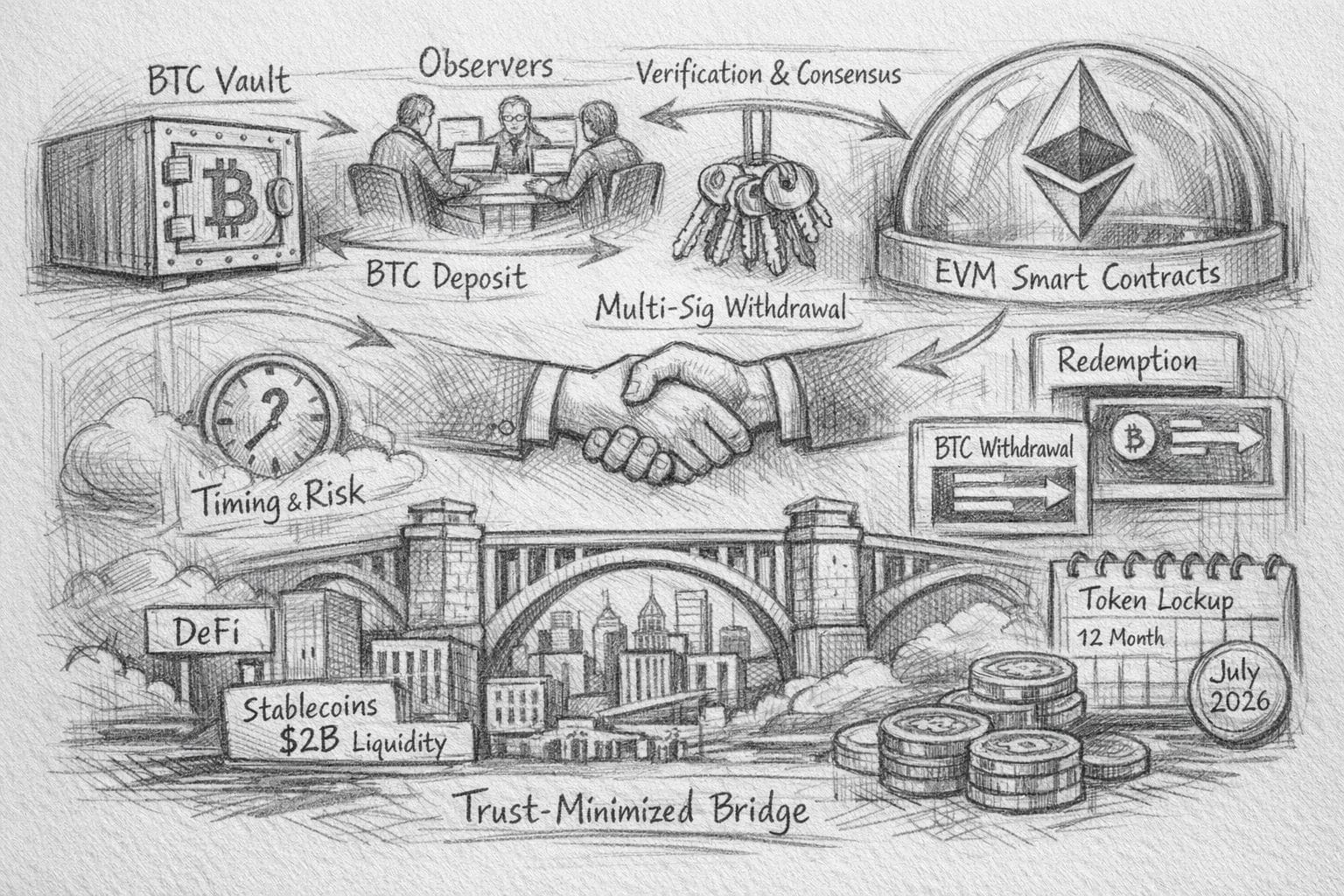
What I keep coming back to is how invisible this is supposed to feel when it’s done right. People will talk about programmable BTC, but most users won’t experience “programmability.” They’ll experience a payment clearing when they expected it to, collateral remaining redeemable when rumors are flying, and a withdrawal completing without a human permission slip. Plasma is building infrastructure that will rarely get credit for its best days, because the best day is the day nothing surprising happens. Quiet responsibility looks like that: shipping timelines that don’t force false certainty, token schedules that make incentives predictable, and a bridge design that assumes disagreement will happen and prepares for it anyway. Reliability matters more than attention, because attention is optional—reliability is what people build their lives on.
