

There are technologies that are born because something new becomes possible, and there are technologies that are born because something old refuses to work any longer. Dusk belongs to the second category. Its origin is tied not to excitement, but to friction. It grew out of the growing discomfort felt by institutions, developers, and regulators who saw the promise of blockchain but could not reconcile it with the realities of law, privacy, and responsibility. I’m not describing a single moment of invention. I’m describing a long realization that transparency alone was not enough.
To understand Dusk Network, it helps to forget the token and forget the market. The project did not begin with a discussion about price or adoption. It began with a fundamental contradiction. Blockchains made data public by default, yet most of the world’s economic activity depends on confidentiality. Contracts are private. Identities are protected. Financial positions are sensitive. If blockchain technology was ever going to move beyond experimentation and into real systems of value, that contradiction had to be resolved.
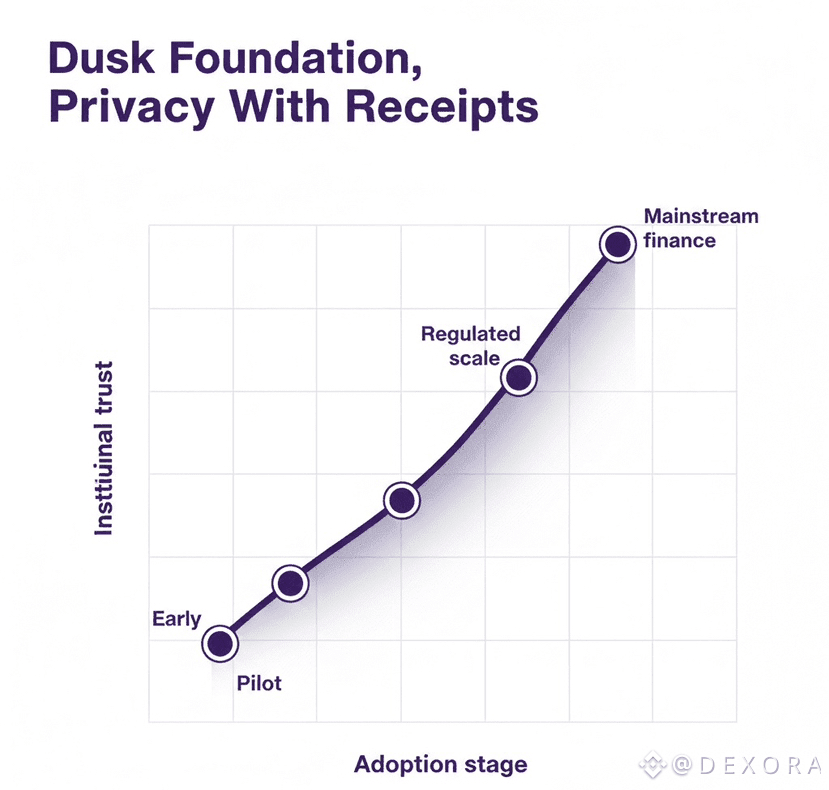
The earliest ideas behind Dusk emerged at the intersection of cryptography and regulation. The people involved were not asking how to bypass rules. They were asking how to encode them. Traditional compliance relies on intermediaries, audits, and selective disclosure. Blockchain replaces intermediaries with code, but code does not naturally understand discretion. Everything is visible or nothing is. Dusk was formed around the belief that this binary model was flawed, and that a more nuanced form of transparency was not only possible, but necessary.
In the beginning, Dusk was less a product and more a research effort. The team explored how zero knowledge proofs, encryption, and distributed consensus could be combined into a system where verification does not require exposure. This was not a trivial challenge. Privacy technologies had existed for years, but they were often fragile, slow, or difficult to integrate into programmable systems. Dusk’s early work focused on making privacy practical rather than theoretical.
One of the defining decisions made early on was philosophical rather than technical. Dusk rejected the idea that privacy and accountability were opposites. Instead, it treated them as complementary. In Dusk’s model, information can remain hidden while outcomes remain provable. A user can demonstrate eligibility without revealing identity. A transaction can comply with regulations without exposing its internal details. This approach aligns closely with how real-world systems operate, but it required rethinking how blockchains are designed at a fundamental level.
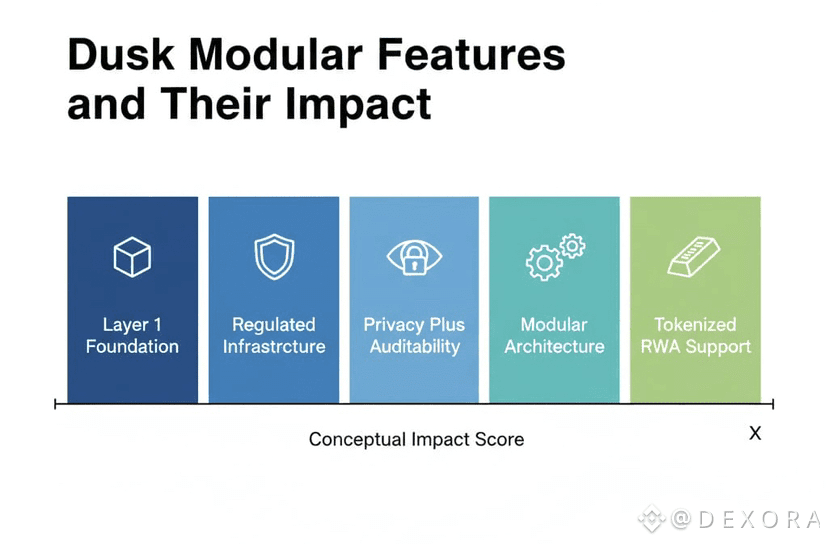
As the project moved from concept to architecture, the complexity of the task became clear. Building a privacy-first blockchain is not the same as adding privacy features to an existing chain. It requires redesigning everything from transaction structure to smart contract execution. Dusk chose to build its own stack rather than compromise on its core principles. This decision slowed early progress, but it also ensured coherence. They’re not patching privacy onto transparency. They’re building a system where privacy is native.
Consensus design became a critical focus during this phase. Dusk adopted a proof of stake mechanism optimized for predictable behavior and fast settlement. In regulated environments, unpredictability is risk. Financial systems need clarity around finality and governance. Dusk’s consensus model reflects this reality. It prioritizes stability and clarity over experimentation, reinforcing the project’s orientation toward serious, long-term use.
The introduction of the DUSK token followed naturally from this architecture. The token was designed to secure the network through staking, enable participation in governance, and support economic coordination. It was not positioned as a speculative instrument, but as a functional layer of the system. Its value is tied to the health and usage of the network rather than to narrative cycles. We’re seeing here a deliberate attempt to align incentives with responsibility.
As Dusk entered its early public phase, it attracted attention from a very specific audience. These were not users chasing novelty. They were builders exploring security tokens, compliant asset issuance, and regulated financial products. For these developers, most blockchains were unusable because of their transparency. Dusk offered an alternative. It provided a way to build decentralized systems that respected legal and ethical boundaries.
One of the most significant innovations introduced by Dusk was confidential smart contracts. Traditional smart contracts expose all inputs and logic. This makes them unsuitable for many real-world agreements. Dusk’s confidential contracts allow encrypted data to be processed while still producing verifiable results. This capability opened new possibilities for private voting, confidential lending, and regulated marketplaces. It also demonstrated that privacy does not have to limit programmability.
During this stage, Dusk’s development pace remained deliberate. Features were tested extensively before deployment. Audits and formal verification became routine rather than exceptional. They’re acutely aware that trust in privacy systems is fragile. A single flaw can undermine years of work. This cautious approach sometimes placed Dusk outside the spotlight, but it strengthened its foundation.
Community growth followed a similar pattern. Dusk did not attract a massive speculative following, but it cultivated a smaller, more focused community of developers, researchers, and long-term supporters. Education played a key role. Privacy technologies are difficult to explain, and misunderstandings can lead to mistrust. Dusk invested in documentation and outreach to ensure that users understood not just what the system does, but why it does it that way.
Governance became increasingly important as the network matured. Decisions about upgrades, parameter changes, and ecosystem support required structured processes. Dusk approached governance as an evolving system rather than a finished product. Token holders participate, validators contribute, and mechanisms are refined over time. This gradualism reflects an understanding that governance cannot be rushed without risking fragmentation.
As the broader blockchain landscape evolved, Dusk’s relevance began to shift. Regulatory clarity improved in many regions. Institutions started exploring tokenization and on-chain settlement. Suddenly, the problems Dusk was built to solve were no longer abstract. They were operational. We’re seeing how early design decisions made in relative obscurity began to align with mainstream needs.
Interoperability also became a growing focus. Regulated assets do not exist in isolation. They need to interact with other systems, liquidity pools, and settlement layers. Dusk’s architecture allows for controlled interaction with external networks while preserving confidentiality. This balance is essential for real-world adoption, where systems must integrate rather than replace.
Economic sustainability has been another ongoing consideration. Privacy systems can be resource-intensive. Dusk’s economic model is designed to support long-term operation without excessive cost burdens on users. Staking incentives encourage network security. Fees are structured to remain predictable. This economic stability is crucial for institutions that need to plan years ahead.
As time passed, Dusk’s narrative quietly evolved. It stopped being described as a privacy experiment and started being understood as infrastructure. This shift is subtle but important. Infrastructure is judged not by excitement, but by reliability. Dusk’s success is measured in uptime, correctness, and trust rather than headlines. They’re building something meant to last.
Looking toward the future, Dusk’s potential paths are shaped by forces larger than the project itself. Digital regulation is becoming more sophisticated. Data protection is increasingly prioritized. Financial systems are exploring programmability without abandoning compliance. These trends align naturally with Dusk’s design. The network does not need to pivot to stay relevant. It was built with this trajectory in mind.
There is also a cultural shift taking place. Privacy is no longer seen solely as a tool for secrecy, but as a condition for dignity and autonomy in digital systems. As users become more aware of how their data is used, demand for privacy-respecting infrastructure may grow. Dusk offers a model where privacy is not antagonistic to oversight, but supportive of it.
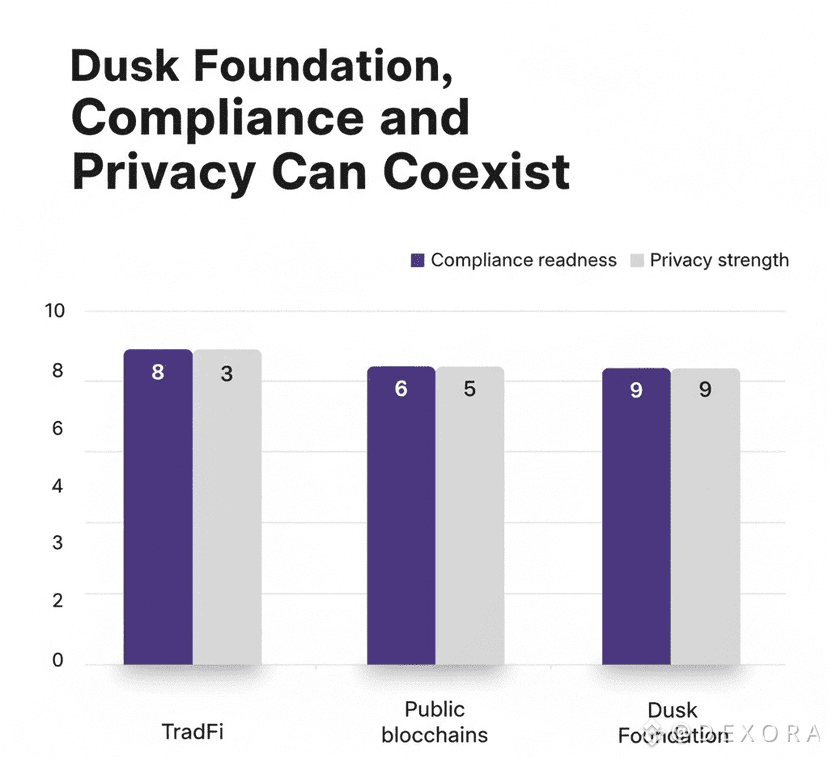
Challenges remain. Privacy-first systems must constantly prove themselves. They must earn trust repeatedly, not just once. Education, audits, and transparent communication will remain essential. Dusk’s conservative development culture suggests it understands this responsibility. If anything, it errs on the side of caution.
What makes Dusk particularly interesting is its refusal to simplify its message for short-term appeal. It does not promise revolution overnight. It does not frame itself as a replacement for everything that exists. Instead, it positions itself as a missing piece, a layer that allows decentralized systems to interface with reality rather than escape it.
As we step back and look at Dusk’s full lifecycle so far, a pattern emerges, even if it is not an obvious one. The project advances when the world catches up to its assumptions. What once seemed overly cautious now appears pragmatic. What once seemed niche now appears necessary. We’re seeing how patience can be a strategic advantage.
In the years ahead, Dusk may not be a household name. Many of the systems built on it may not advertise the fact. That is the nature of infrastructure. Its value lies in enabling others to function smoothly. If financial instruments settle privately, if identities are verified discreetly, if compliance becomes automated rather than intrusive, Dusk will have played its role.
The deeper question Dusk asks is not technical, but philosophical. Can we build systems that are both open and humane? Can decentralization respect privacy without sacrificing trust? Can code reflect the nuance of real-world relationships? Dusk does not claim to have final answers, but it offers a serious attempt.
As digital systems continue to merge with everyday life, the demand for quiet, reliable, privacy-aware infrastructure will grow. When that happens, projects built with restraint and foresight may matter more than those built with noise. Dusk’s journey suggests that the future of blockchain may not belong to the loudest networks, but to the ones that learned how to listen to reality early on.
And when that future arrives, it may not feel revolutionary at all. It may simply feel normal. Transactions that respect boundaries. Systems that prove what matters and hide what does not. Infrastructure that supports trust without demanding exposure. In that quiet normality, Dusk’s long, careful construction may finally reveal its purpose, leaving us to reflect on how progress often comes not from disruption alone, but from understanding what must be protected as we move forward.