

Crypto is very comfortable when nobody is asking hard questions. Things move fast. Systems go live. Users interact. Everything feels open and innovative.
Then real finance enters the picture.
That’s when the tone changes.
Suddenly it’s not just about speed or decentralization. It’s about responsibility. Someone asks where funds came from. Someone asks who approved a transaction. Someone asks whether activity can be reviewed without exposing private information.
Most blockchains were not designed for that moment. They were designed for openness or censorship resistance, not financial accountability.
Dusk feels like it was designed specifically for that moment.
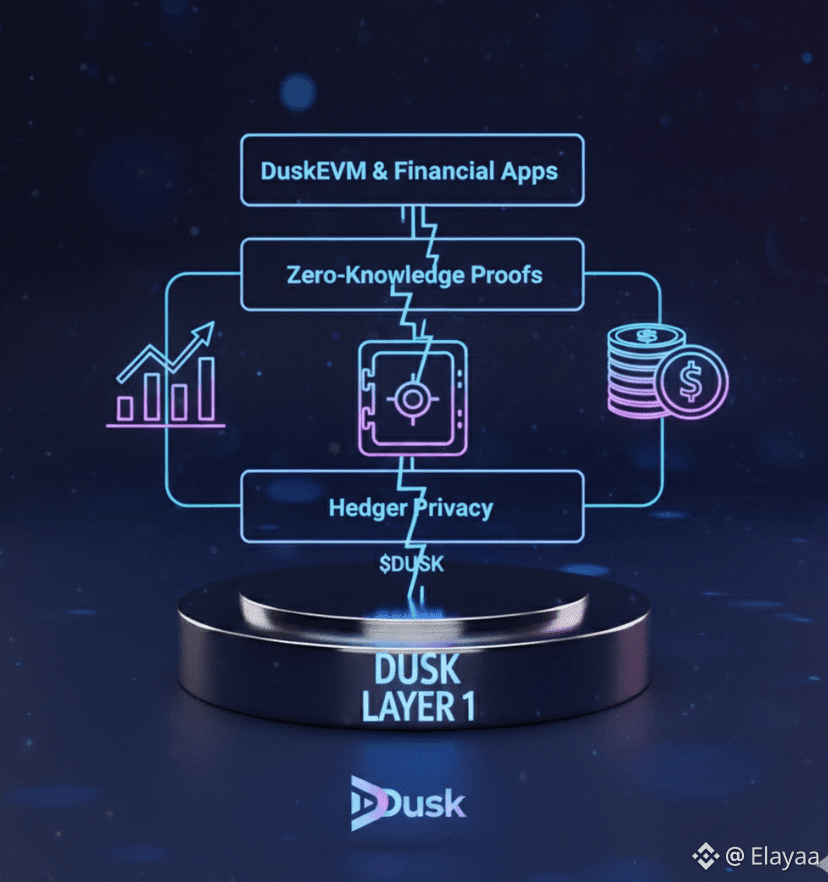
Dusk is a Layer 1 blockchain built for regulated financial infrastructure. That means it assumes oversight will happen. It assumes audits will happen. It assumes institutions will need systems that can be examined without breaking privacy.
Privacy on Dusk is not about hiding activity forever. It’s about controlling who sees what, and when. Transactions are confidential by default, but proofs can be produced when verification is required. This is closer to how real-world finance already works.
Banks don’t publish every transaction publicly. Regulators don’t monitor everything in real time. Information is disclosed under rules, not by default. Dusk mirrors this model using cryptography instead of paperwork.
This is especially important for real-world assets. Tokenized securities, regulated trading platforms, and compliant investment products cannot run on systems that expose sensitive data to everyone. At the same time, they cannot operate on systems that cannot be audited.
Dusk sits in the middle. Private by default. Verifiable when required.
Another important piece is Dusk’s modular architecture. Financial products don’t all follow the same rules. A marketplace for tokenized bonds works differently than a regulated exchange or a compliant DeFi protocol. Forcing them into one rigid structure usually creates problems later.
Dusk allows different applications to operate with different requirements while still settling on the same Layer 1. That flexibility is not flashy, but it is realistic.
$DUSK plays a key role here. It supports settlement, network security, and the mechanisms that allow proofs to be verified. It is part of the infrastructure that keeps the system functioning smoothly under pressure.
Most users will never think about these layers. They will just use platforms that don’t suddenly freeze, don’t run into legal walls, and don’t expose their financial data.
That quiet reliability is often invisible.
But in finance, invisible stability is usually the sign of good infrastructure.