

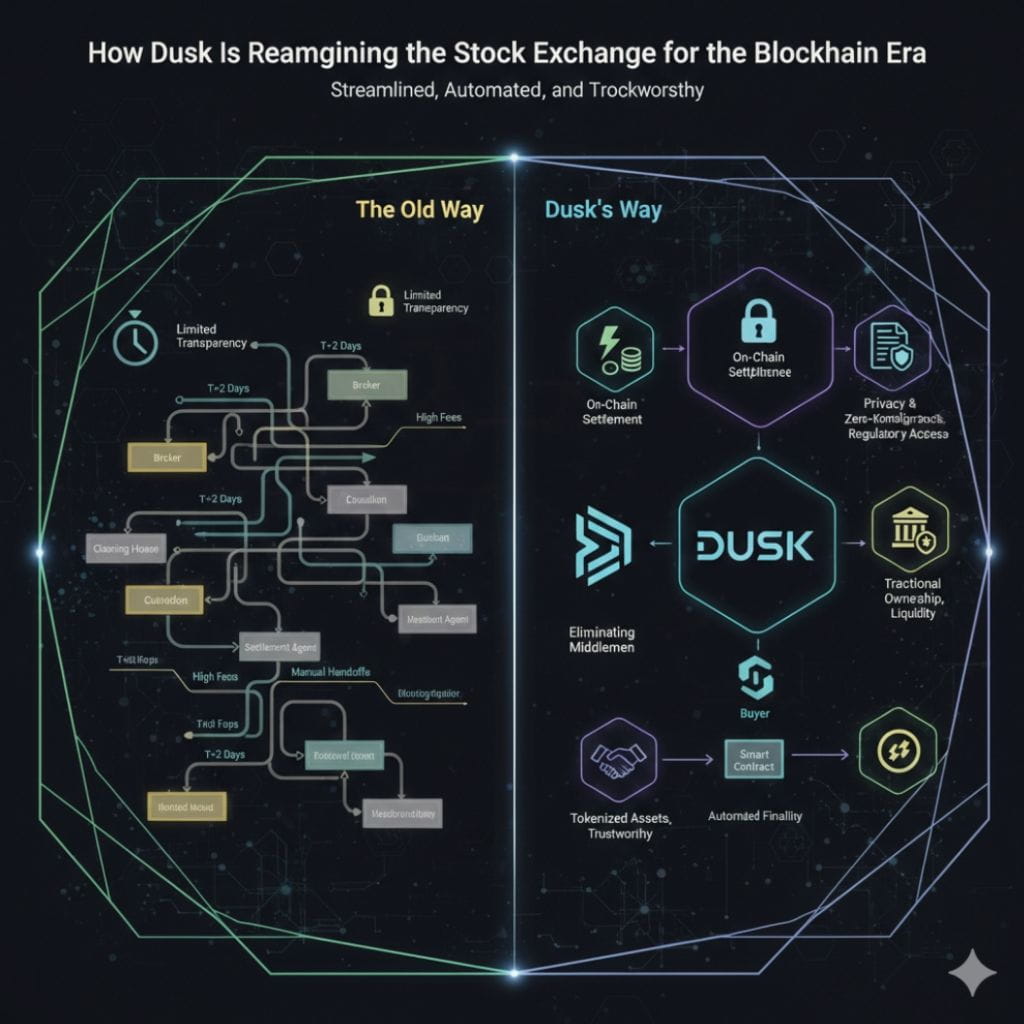
Let’s face it: at their core, stock exchanges have hardly evolved in decades. Sure, the trading floor has mostly gone digital, but the process of buying or selling a share still drags you through a long chain of intermediaries—brokers, clearing houses, custodians, and settlement agents—all adding complexity, cost, and time. Despite the high-tech veneer, the underlying process is slow, costly, and bogged down by paperwork and middlemen. There are delays at every step, plenty of room for errors to creep in, and, frankly, a frustrating lack of transparency for both investors and institutions.
Now imagine a different world—one where purchasing or selling a regulated asset felt as seamless and instantaneous as sending a secure email. This is the future Dusk envisions and is actively building. Dusk isn’t just another generic blockchain; it’s a purpose-built blockchain platform for regulated financial markets. It’s engineered to handle the maze of compliance requirements, privacy concerns, and trading complexities endemic to finance, but without dragging participants through an endless series of outdated steps and intermediaries.
Let’s break down exactly how Dusk stands apart from the legacy system and why this matters for the future of financial markets.
The Old Way: Layers, Delays, and Operational Friction
In traditional capital markets, every trade is subject to a complicated gauntlet: it passes from broker to clearing house to custodian and through various settlement systems. Each handoff introduces delays, extra fees, and new possibilities for mismatches or mistakes. You’re stuck with the industry-standard T+2 settlement—meaning that after a trade is executed, it takes two business days for the actual exchange of money and ownership to finalize. It’s a process reminiscent of sending a letter that has to pass through multiple sorting stations before it finally lands in the recipient’s hands.
This slow-moving system is a pain point for everyone involved. Investors want fast execution and certainty. Institutions crave transparency and operational efficiency. Regulators need assurance that compliance rules are followed to the letter. The old model is increasingly stretched to meet all these demands, resulting in a system that is both expensive and difficult to audit in real time.
Dusk’s Way: Streamlined, Automated, and Trustworthy
Dusk turns the traditional model on its head by leveraging blockchain technology in a way that fits the realities of regulated markets. Instead of layering compliance and operational procedures on top of each other, Dusk encodes the rules and logic directly into the blockchain using smart contracts. This allows the entire lifecycle of a trade—execution, verification, settlement, and reporting—to happen within a single, unified digital environment. No more bouncing information between fragmented systems and intermediaries.
Here’s a closer look at how Dusk brings these ideas to life:
1️⃣ On-Chain Settlement: Instant Finality, Reduced Risk
In the old world, you’re left in limbo after a trade, waiting days for the transaction to clear. Dusk’s on-chain settlement mechanism harnesses smart contracts to move both the asset and payment simultaneously, automatically, and almost instantly. You don’t have to worry about settlement risk or funds being tied up during lengthy clearing cycles. It’s as straightforward as handing over the car keys and receiving the payment on the spot—no waiting, no uncertainty, and no hidden operational risks tied up in pending settlements.
2️⃣ Privacy That Aligns With Regulatory Demands
Most public blockchains make every transaction visible to all, which simply doesn’t fly in the world of sensitive financial trading and private investor information. Dusk uses advanced cryptography, such as zero-knowledge proofs and confidential transactions, to keep transaction details private for market participants. Crucially, though, it also enables regulators to access the necessary data when required by law. This means genuine privacy for investors and institutions, but not a black hole that leaves authorities in the dark—striking a balance that’s been elusive in other blockchain networks.
3️⃣ Compliance: Built Into the Foundation
Unlike generic blockchains that treat compliance as an afterthought or bolt-on, Dusk is designed from the ground up for regulated markets. Financial institutions can issue tokenized securities, define and enforce ownership restrictions, automate dividend payments, and even handle corporate actions like voting—all through programmable rules embedded directly into the digital asset. This “compliance by design” approach eliminates the need for patchwork solutions and extra compliance layers, making regulatory adherence smoother and more reliable.
4️⃣ Eliminating Layers of Middlemen
With Dusk, asset ownership and settlement records live natively on the blockchain. Settlement, reporting, and reconciliation are automated through smart contracts, creating a single, tamper-proof source of truth. This radically reduces back-office workloads, minimizes human errors, and slashes the cost and complexity of post-trade processes. The result is a market infrastructure that’s leaner, faster, and more robust, where trust is established through technology rather than through layers of institutions.
5️⃣ Tokenization of Real-World Assets
From shares and bonds to investment funds and beyond, Dusk enables the issuance of real-world assets as programmable digital tokens. This opens up new possibilities: faster product launches, the ability to offer fractional ownership (enabling investors to buy just a slice of a bond or fund), and easier cross-border access to financial instruments—all while staying firmly within regulatory boundaries. Tokenization also enhances liquidity and accessibility, allowing a broader set of investors to participate in markets that were previously gated by high minimums or geographic restrictions.
Why Does This Matter?
Dusk isn’t about circumventing rules or undermining the role of regulation. It’s about architecting a smarter, faster, and more resilient foundation for the next generation of regulated financial markets. If Dusk’s approach proves out at scale, we’re looking at a world with dramatically shorter settlement times, lower transaction and compliance costs, greater transparency with real-time audit trails, and a market infrastructure that’s both flexible and secure.
The real significance of Dusk lies not in hype or speculative potential, but in delivering a long-overdue upgrade to the financial plumbing that underpins the global economy—an upgrade that reduces friction, improves trust, and brings efficiency and transparency to every participant in the ecosystem.
At the end of the day, traditional exchanges rely on trust built up through layers of intermediaries and legacy processes. Dusk is making a bet that cryptography, programmable automation, and privacy-enhancing technology can deliver the same level of trust—but with far less friction, risk, and operational drag.
It’s a fundamental rethink of how trust, compliance, and efficiency can coexist in the digital era, promising to reshape the way capital markets operate for decades to come.
Disclaimer Not Financial Advice