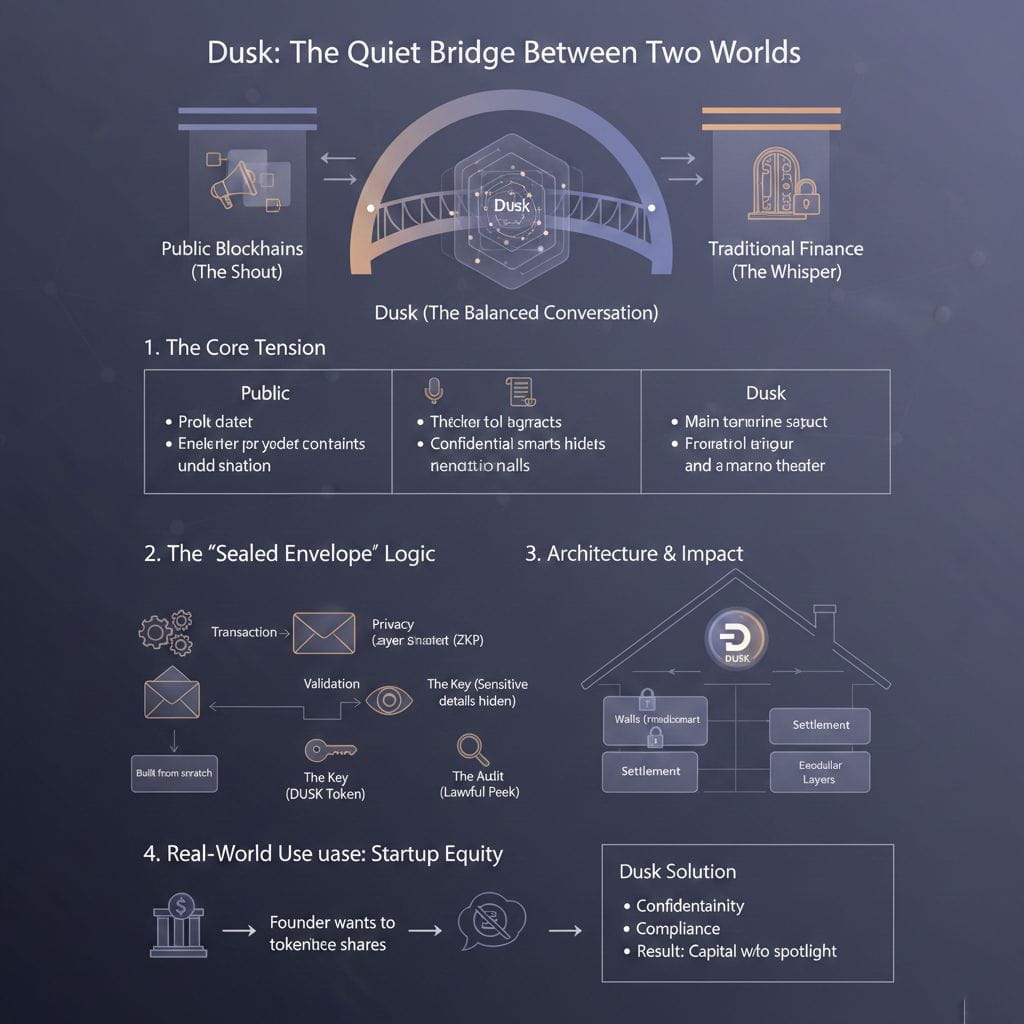
I still remember the first time I tried explaining blockchain to a friend who works in traditional finance. We were sitting on plastic chairs at a roadside café tea going cold and halfway through my explanation he leaned back and said “So… everyone can see everything?” That pause said it all. For a lot of people that’s where the magic of crypto turns into discomfort. Transparency is great until it’s too much. And that’s exactly where Dusk starts to feel interesting.
Dusk doesn’t burst into the room making noise. It’s more like someone who pulls up a chair lowers their voice and says “What if finance could be private but still honest?” Founded in 2018 Dusk was built with a very specific tension in mind—the tug-of-war between privacy and regulation. Most blockchains pick a side. Dusk decided to live in the uncomfortable middle and make it work.
Think about how money moves in real life. When you get paid your salary isn’t posted on a public noticeboard. When a company raises capital the details are shared with regulators and auditors not random strangers scrolling the internet at 2 a.m. Traditional finance has always worked this way—quiet controlled and accountable. Public blockchains flipped that model completely and while that openness unlocked innovation it also scared away institutions that need confidentiality to function.
Dusk’s big idea is simple to say but hard to build transactions should be private by default yet provable when needed. It uses zero-knowledge cryptography to pull this off which is a fancy way of saying the network can confirm something is valid without exposing the sensitive details. I like to explain it using the “sealed envelope” analogy. The network knows the letter inside makes sense even if it never opens it. If a regulator needs to peek inside later there’s a lawful way to do that. No shouting across the room. Just a quiet confirmation.
What really makes Dusk feel different though is how intentionally it’s designed for regulated finance. This isn’t a blockchain hoping banks will show up someday. It’s one that was built with banks asset issuers and compliance teams already sitting at the table. Tokenized real-world assets—things like shares bonds or real estate—aren’t an afterthought here. They’re the point.
I once spoke to a startup founder who wanted to tokenize equity in her company but froze when she realized that public blockchains would expose investor activity to competitors. That kind of transparency might be fine for memes and NFTs but it’s a deal-breaker for serious capital. On Dusk those transactions can stay confidential while still being legally sound. Ownership transfers happen. Dividends get distributed. Audits can be performed. And yet the sensitive data doesn’t leak into the void.
There’s also something refreshing about Dusk’s modular mindset. Instead of forcing everything into one rigid system it separates responsibilities into layers. Settlement here. Execution there. Privacy woven in deliberately not awkwardly bolted on. It reminds me of renovating an old house versus designing one from scratch. Dusk chose the latter. If something needs upgrading you don’t knock down the whole structure. You improve the room that needs it.
And yes it’s technical under the hood. It has its own smart contract model designed specifically for confidential assets. It explores consensus mechanisms that try to balance speed security and privacy without making trade offs feel painful. But what stands out isn’t the jargon it’s the intent. Everything feels aimed at answering one question “Can blockchain work in the real financial world without breaking it?”
The token DUSK plays the usual roles securing the network paying fees enabling participation but it never feels like the headline. That’s another quiet signal. This isn’t about hype cycles or flashy promises. It’s about infrastructure. The kind people don’t notice until it’s missing.
Of course none of this is effortless. Privacy tech adds complexity. Institutions move slowly. Trust takes time especially when money and regulation are involved. But there’s a maturity in Dusk’s approach that’s hard to ignore. It doesn’t try to replace the system overnight. It tries to upgrade it gently piece by piece.
Sometimes I imagine the future of finance not as a loud revolution but as a gradual lowering of voices. Less exposure. Fewer leaks. More respect for context. Dusk fits neatly into that picture. It’s not trying to make finance anonymous or chaotic. It’s trying to make it discreet compliant and finally comfortable enough for serious players to step on-chain without feeling like they’re standing under a spotlight.
If public blockchains are a crowded town square Dusk is the quiet meeting room just off to the side. The door is closed. The conversation is focused. And for the first time in a while everyone in the room feels like they can speak honestly.