

Walrus begins with a simple but powerful idea: data should belong to the people who create it, not to silent servers hidden behind corporate walls. In a digital age where information is everywhere yet control is concentrated, Walrus rises as a calm but unstoppable force, reshaping how storage, privacy, and ownership work in the decentralized era.
Walrus is not built for noise or hype. It is built for endurance. At its core, Walrus is a decentralized storage and data infrastructure protocol designed to securely handle massive amounts of information while preserving privacy, efficiency, and long-term accessibility. Instead of trusting centralized cloud providers, Walrus allows data to live across a distributed network, where no single entity can censor, delete, or monopolize it.
What makes Walrus different is how naturally it blends deep technology with real human needs. The protocol runs on the Sui blockchain, using it as a coordination layer rather than a storage bottleneck. Large files such as media, application data, AI datasets, and digital assets are stored off-chain, while ownership, access rights, and availability are managed on-chain. This balance allows Walrus to scale without sacrificing security or speed.
Rather than copying files again and again across servers, Walrus uses advanced data splitting techniques that break files into encoded fragments and spread them across independent storage providers. Only a portion of these fragments is needed to recover the original file, meaning data stays available even if multiple nodes disappear. This approach dramatically reduces cost while increasing resilience, creating a system that feels both lighter and stronger than traditional storage models.
Walrus transforms storage into something programmable. Data is no longer passive. It can be controlled, extended, transferred, or governed directly through smart logic. Developers can build applications where storage reacts to rules, time, ownership, or community decisions. This turns raw data into a living component of decentralized applications rather than an external dependency.
At the heart of the ecosystem is the WAL token. WAL is not designed as a speculative ornament but as the economic engine that keeps the network alive. It is used to pay for storage, secure the protocol through staking, reward reliable storage providers, and give the community a voice in governance. Every action within Walrus flows through WAL, aligning incentives between users, builders, and infrastructure operators.
The network itself is maintained by independent storage operators who commit resources and reliability in exchange for rewards. Those who perform well earn more. Those who fail to meet standards risk penalties. This quiet economic pressure ensures that the system improves over time without central oversight. Trust is not requested. It is enforced by design.
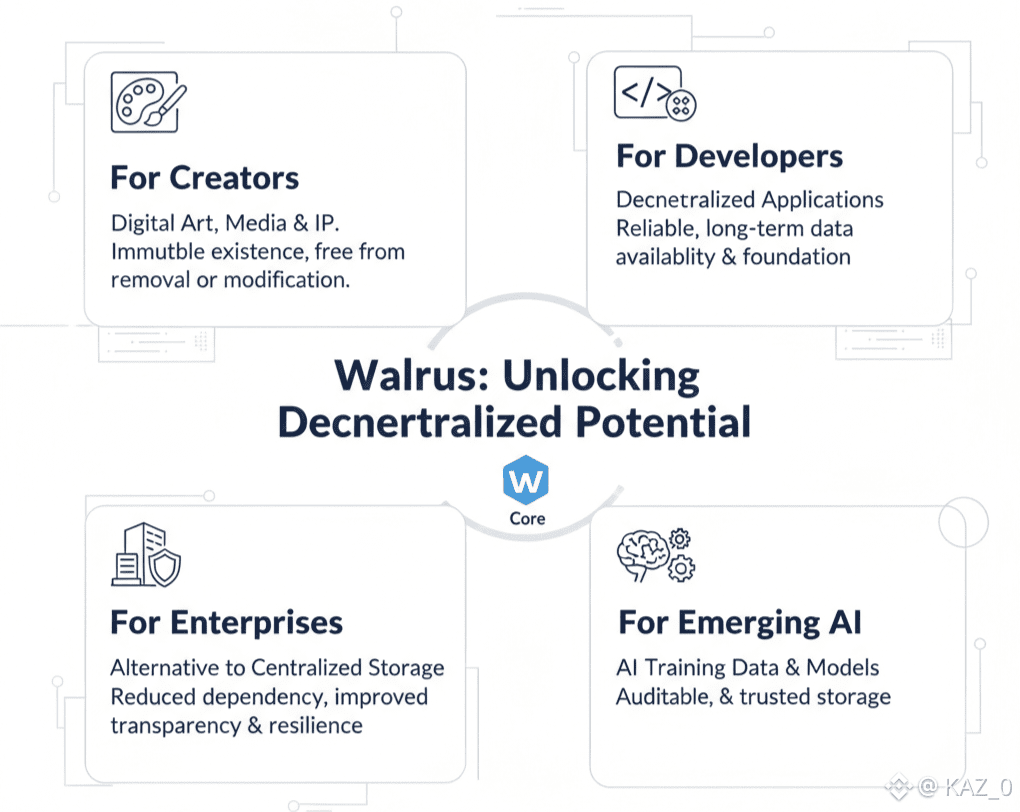
Walrus opens doors across multiple worlds. For creators, it means digital art, media, and intellectual property can exist without fear of removal or silent modification. For developers, it offers a foundation for decentralized applications that need reliable, long-term data availability. For enterprises, it provides an alternative to fragile centralized storage, reducing dependency while improving transparency. For emerging AI systems, Walrus offers a way to store and verify training data and models in a way that can be audited and trusted.
Even decentralized websites find a home here, where content lives independently of traditional servers and remains accessible as long as the network exists. This creates a version of the internet that does not forget, does not bend easily, and does not answer to a single authority.
The long-term vision of Walrus is not to replace everything overnight, but to quietly become the backbone that others rely on. Its design favors sustainability over shortcuts, and resilience over speed alone. As adoption grows, integrations expand, and builders experiment with programmable storage, Walrus positions itself as critical infrastructure rather than a passing trend.
In a world obsessed with constant motion, Walrus chooses stability. In an industry full of noise, it moves with patience. And in a digital landscape where data is often treated as disposable, Walrus treats it as memory, value, and identity.
Walrus is not chasing the future. It is building the ground it will stand on.