

@Plasma When you build payment rails for the real world, you learn quickly that “sending money” is the smallest part of the job. The harder part is what happens around it: the uncertainty before the transfer, the anxiety during it, and the accounting after it. Plasma has always felt like it was designed by people who have sat in those tense moments and decided that the chain should carry some of that weight for the user. Not with theatrics, but with a kind of quiet seriousness that shows up when the system is stressed, when support tickets pile up, when markets get loud, and the only thing the user wants is for their dollars to arrive intact and on time.
The story became much more concrete when Plasma tied its mainnet beta to a specific promise: stablecoin settlement that can start at scale, not “someday.” The project set September 25, 2025 (8:00 AM ET) as the moment the network would go live, alongside the launch of XPL. On that same day, Plasma said about $2 billion in stablecoins would be active from day one, framing the network as already meaningful in stablecoin liquidity the moment it opened its doors. That kind of launch doesn’t just change market perception; it changes user psychology. If there’s real money on the rails immediately, the rail has to behave like a rail immediately. There’s no gentle “beta energy” excuse when someone’s payroll, treasury, or merchant float is in motion.
Inside the ecosystem, you start to notice that the design goal isn’t to impress you with novelty. It’s to remove decision fatigue. People using stablecoins for real payments do not want ten toggles and a philosophy lesson. They want fewer moments where they could make a mistake. They want fewer hidden costs. They want fewer surprises at the edge of the system, where it touches banks, invoices, refunds, chargebacks, and compliance. That’s where trust is either earned or lost—usually in silence. When a transfer settles as expected, nobody writes a post about it. When it doesn’t, everyone does. Plasma’s temperament feels built around that asymmetry: the chain can’t rely on gratitude, so it has to rely on repeatable behavior.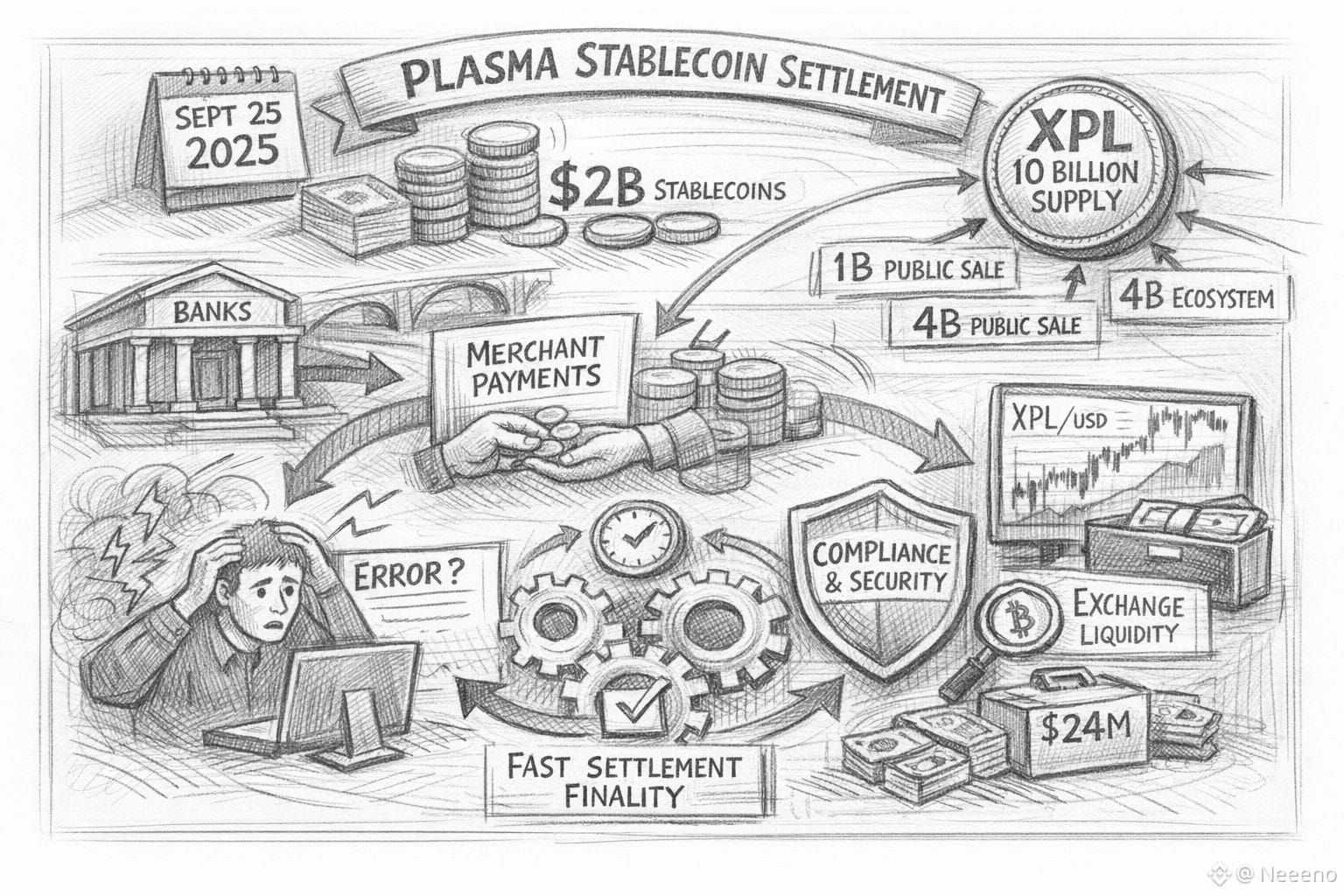
XPL is part of that behavior, not as a poster, but as the system’s internal discipline. Plasma anchors its token story to a clear number: a total supply of 10,000,000,000 XPL. From there, it lays out allocations that are blunt and readable—10% for a public sale (1,000,000,000 XPL), 40% for ecosystem and growth (4,000,000,000 XPL), and 25% for the team (2,500,000,000 XPL), with the remainder attributed to investors and partners in the broader framework described across Plasma’s materials.The detail that stuck with many builders is the “day-one reality” embedded in the unlock schedule: Plasma states that 8% of total supply—800,000,000 XPL—would be immediately unlocked at mainnet beta launch for early liquidity needs, integrations, and growth activity.Love token schedules or hate them, the early numbers change the vibe. Liquidity is like air—too little and the market struggles, too much craziness and everything can spiral out of control.
That’s the part outsiders often miss: token design isn’t only economics, it’s stress management. In a payments ecosystem, volatility doesn’t just mean “price goes down.” It means a support queue fills with people asking if something is wrong, merchants pausing withdrawals, teams delaying launches, and operators quietly rationing risk. Plasma’s choice to articulate allocations and early unlock intentions in its own writing isn’t about winning an argument on social media; it’s about giving builders something stable to plan around, and giving users a clearer story when they ask, “Why does this feel different today than it did yesterday?”
The other thing you feel, once you live around stablecoin settlement, is how often “truth” is messy. A payment can be “sent” in one system and “not received” in another. A merchant dashboard can show a balance that a bank partner hasn’t credited yet. A customer can insist they paid while your internal ledger shows a mismatch. In those moments, the chain is not a magic judge; it’s one of several sources that must be reconciled. Plasma’s decision to make stablecoins the center of the network is, in a strange way, an admission that reconciliation is the real work. Stablecoins are where disputes, refunds, and timing differences actually hurt people. The rail has to be predictable enough that humans can resolve disagreements without guessing what the infrastructure is doing.
That’s also why compliance becomes emotional, not just legal. Plasma has leaned into the idea that stablecoin rails have to be compatible with the world as it is, which increasingly means audit trails, monitoring, and shared standards with institutions that don’t tolerate ambiguity. Around the mainnet beta launch window, Elliptic announced a partnership with Plasma focused on powering compliance at scale, explicitly tying the relationship to Plasma’s stablecoin liquidity at launch. This is one of those things that changes how a payments operator sleeps. When something goes wrong—fraud, sanctions risk, a suspicious flow—you don’t want the “compliance moment” to be a frantic scramble for tooling. You want it to be boring. Not painless, but boring in the sense that the process exists, it’s understood, and it doesn’t depend on heroics.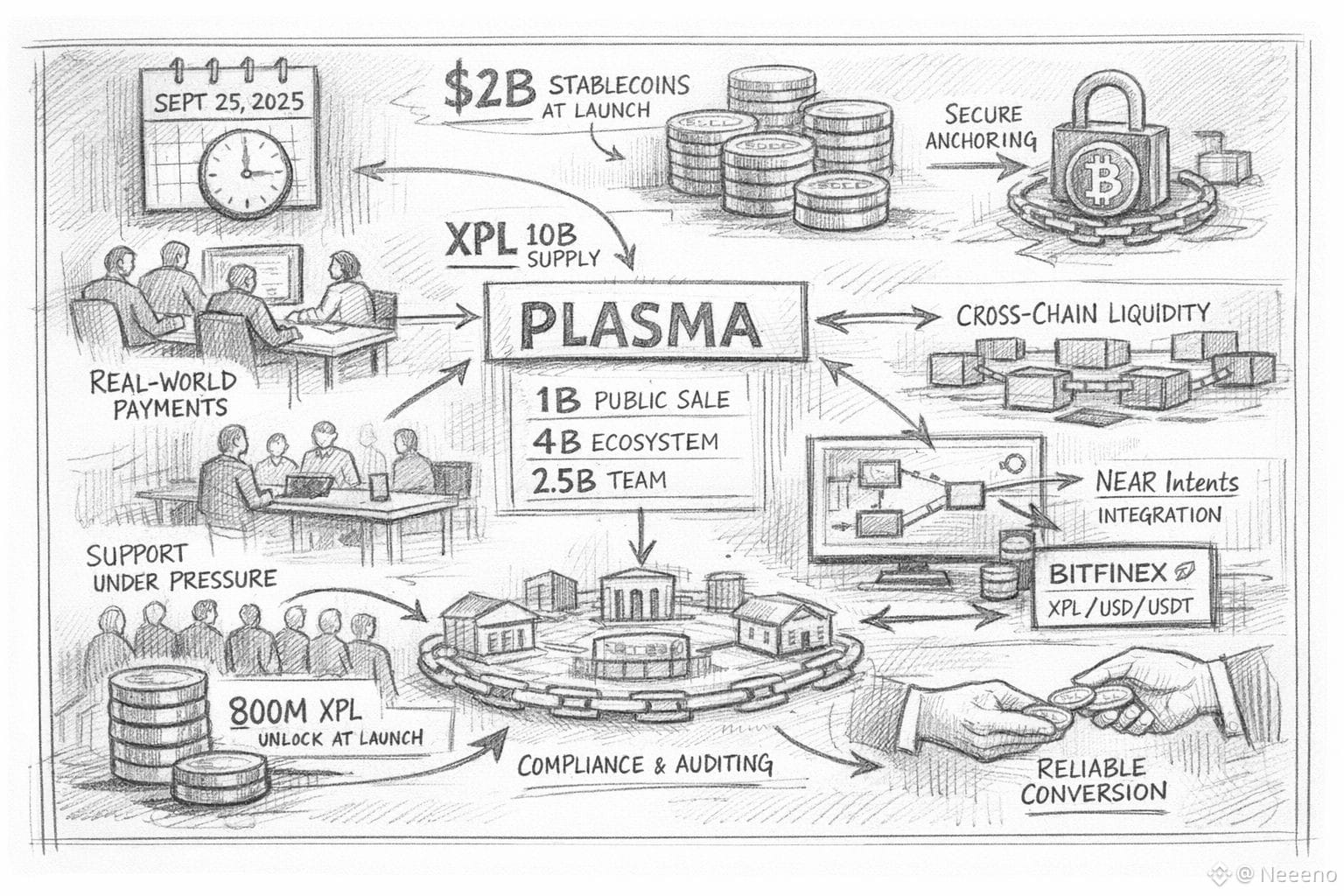
Under the hood, Plasma describes a consensus design that aims for fast finality while keeping safety guarantees typical of BFT-style systems, implemented in Rust and optimized for quicker commits.I’m not interested in the name of the approach as much as the intention behind it: payments don’t tolerate “maybe.” People accept many things in life, but they don’t accept probabilistic money. Even small doubt changes behavior. When settlement feels uncertain, users overpay for speed, operators add buffers, and merchants become less fair because they have to protect themselves. Reliability isn’t only technical; it’s what allows people to be generous in business instead of defensive.
Plasma also speaks about borrowing confidence from outside itself by anchoring state to Bitcoin, a choice it frames as an extra layer of security and neutrality rather than an ornamental narrative. For builders inside the ecosystem, this doesn’t feel like a philosophical statement. It feels like an insurance posture. You may never “use” the anchor in a daily workflow, but the existence of that external reference point changes how you think about long-term integrity—especially when you imagine disputes months later, when a counterparty claims history was rewritten or a system behaved inconsistently. In payments, credibility often arrives long after the payment is done, when records are audited and memories are contested.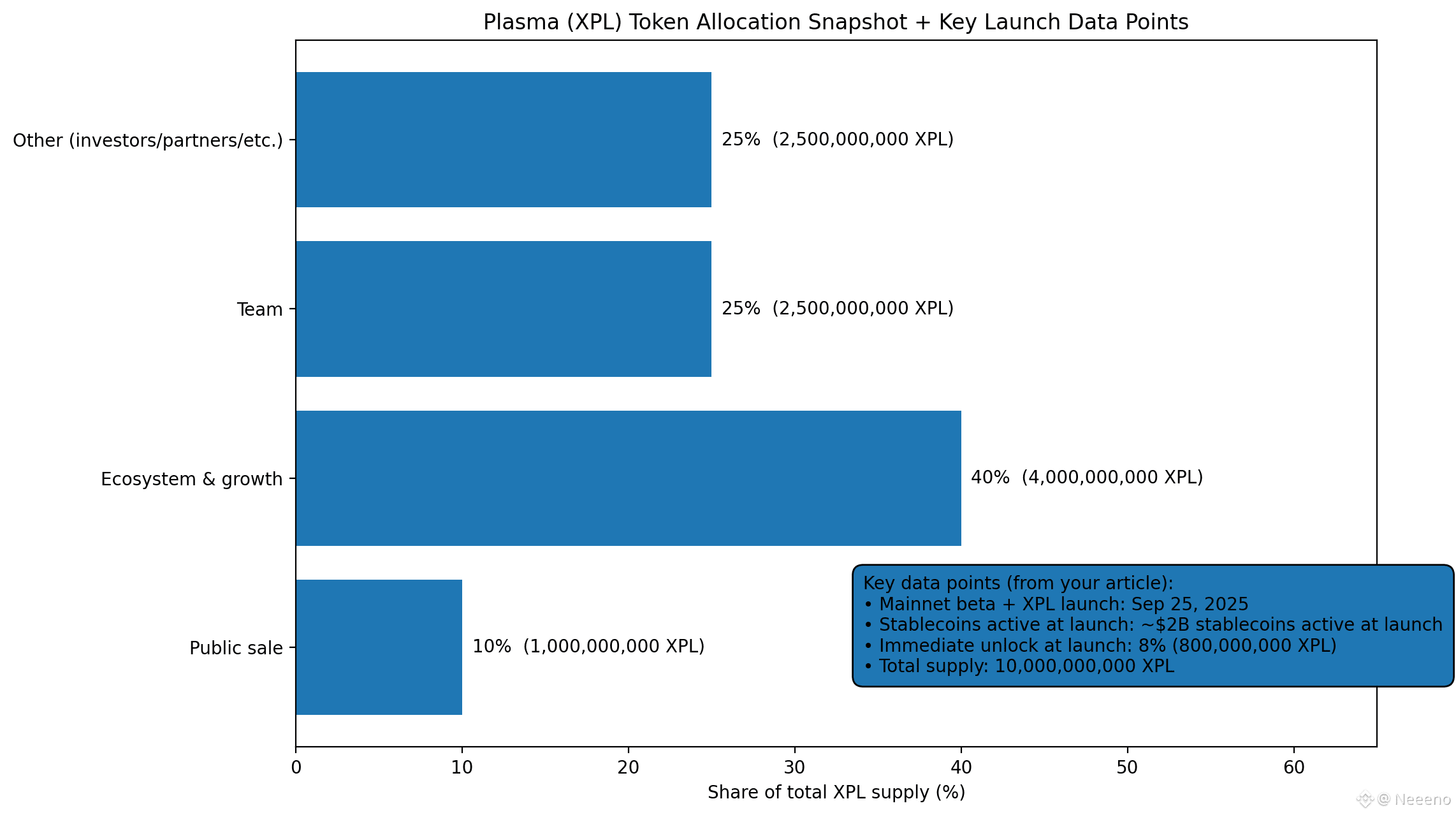
Recent updates have been pushing Plasma toward something that matters in practice: reducing the friction of moving stablecoin liquidity across contexts without making users feel like they’re walking through a maze. On January 23, 2026, coverage described Plasma integrating with NEAR Intents, placing XPL and USDT0 into a broader “chain-abstracted” liquidity environment and positioning it for cross-chain settlement flows that look closer to a single experience than a patchwork.The reason this matters is not “interoperability” as a slogan. It’s that payment rails become more emotionally safe when users don’t have to understand every intermediate step. Confusion is where mistakes happen, and mistakes are where trust leaks out of the system.
The ecosystem surface area is growing in a way that feels oriented toward real operators rather than spectators. Plasma’s own dashboard presents an ecosystem map that includes payments and infrastructure providers alongside analytics and bridging tools, which signals a focus on the supporting cast that real payment flows require.The presence of that cast matters because no chain settles money alone. The rails are only as dependable as the routers, the monitoring, the on-ramps, the reporting, and the interfaces that people actually touch. When the system is under pressure, those edges are where confidence either holds or collapses.
Funding history can be a distraction in crypto, but in payments it sometimes functions as a proxy for operational runway. Plasma announced it raised $24 million across seed and Series A, naming participants that sit close to stablecoin liquidity and market structure, and Fortune and Axios both covered the raise in February 2025. That doesn’t guarantee execution, but it signals something important: the team is not building a weekend project. Real payment rails demand patience, audits, integrations, and an appetite for unglamorous work. The economics of honest behavior in payments are never purely on-chain. They’re also in whether a team can afford to say “no” to shortcuts when shortcuts would create future harm.
Even exchange listings can be read as operational milestones rather than trophies. Bitfinex announced it would list XPL with deposits opening around September 24, 2025 and trading planned for September 25, 2025, pairing against USD and USDt.That matters because liquidity access is not only for traders; it’s for participants who need predictable conversion and hedging pathways to manage business risk. A payments rail that can’t connect cleanly to liquidity venues forces operators into awkward workarounds. Workarounds are where hidden fees and human error breed.
If you zoom out, Plasma’s clearest pattern is that it tries to build for the ugly parts of money movement: the moments when records disagree, when people are scared, when a merchant is underpaid and angry, when a regulator asks questions nobody wants to answer, when markets swing and everyone suspects the infrastructure will break.Very simple, clean Plasma shares a lot of specific numbers. .
Short, punchy, still clear Plasma is putting numbers upfront: Sept 25, 2025 for mainnet beta, ~$2B in stablecoins at launch, and a 10B XPL supply. The split is 1B public sale, 4B ecosystem/growth, 2.5B team. Plus 800M XPL unlocked right away, explained as needed for liquidity and early integrations.
It pairs those numbers with relationships that fit a payments reality—compliance tooling, exchange access, and, now, a January 2026 integration aimed at making cross-context liquidity movement less fragile.
In the end, I don’t think Plasma’s real ambition is to be admired. Payment rails aren’t supposed to be admired. They’re supposed to be trusted, and trust is a quiet form of responsibility. The most honest compliment you can give a stablecoin settlement network is that people stop talking about it—not because it disappeared, but because it became predictable enough to fade into the background. If Plasma keeps earning that kind of invisibility, it won’t be because it shouted louder. It will be because, in the moments when things went wrong, it behaved like infrastructure that respects the human beings depending on it.
