
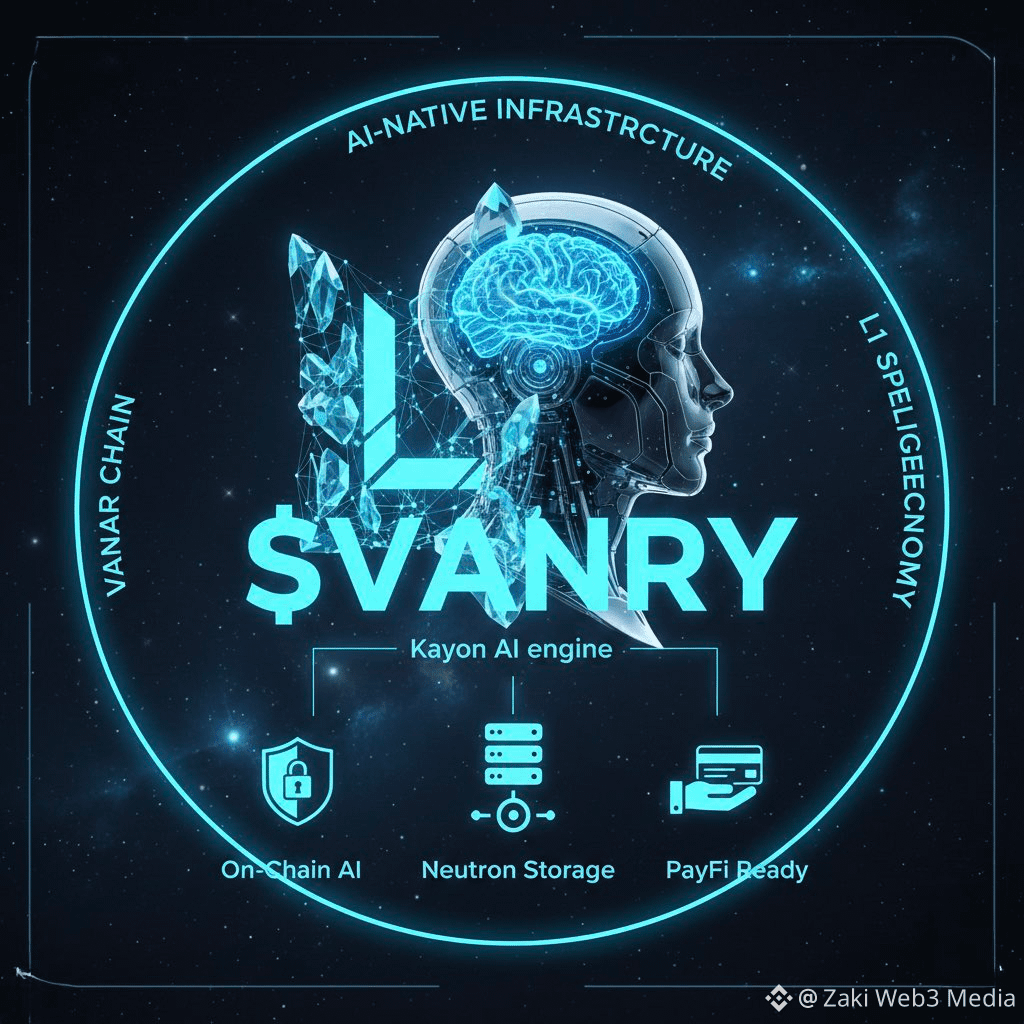
Blockchains began as financial instruments wearing the disguise of networks. Bitcoin encoded scarcity. Ethereum generalized programmable money. The early years of Web3 revolved around ledgers, liquidity, and the engineering of trustless markets. Yet as the technology matures, a quiet pivot is underway. The frontier is shifting from purely financial coordination to digital experience itself. Games, media, identity, and interactive worlds are becoming the new proving grounds. In this transition, chains built primarily for speculation confront a different challenge: can they serve as infrastructure for everyday digital life?
Vanar, a self-developed Layer-1 blockchain oriented toward gaming and entertainment, enters the conversation at precisely this inflection point. Its proposition is not to outcompete general-purpose chains on abstract decentralization metrics, nor to dominate the DeFi arena. Instead, it advances a narrower but ambitious thesis: that mass adoption of blockchain technology will be mediated through consumer experiences, and that those experiences require a different architectural balance than finance-first systems. Vanar positions itself as part of a blueprint for the internet of value that extends beyond capital markets into culture and play.
The Structural Gap Between Web3 Finance and Web3 Experience
To appreciate the relevance of Vanar’s focus, one must examine the structural mismatch between current blockchain design and the needs of large-scale interactive applications. Financial protocols operate on relatively low-frequency, high-value transactions. Precision and security dominate; latency is tolerable within reason. Games and entertainment systems operate under the opposite constraints. They demand speed, fluidity, and invisibility of infrastructure. A delay of seconds, acceptable in a token swap, is jarring in a real-time digital environment.
This tension has shaped the evolution of the broader ecosystem. We now inhabit a mesh of chains, each exploring different trade-offs between throughput, decentralization, and programmability. Some chains federate around financial primitives, others around data availability, and still others around privacy or compliance. Gaming-focused networks represent another strand in this federated landscape. They ask whether blockchains can serve not just as settlement layers but as substrates for persistent digital worlds.
Vanar’s architectural stance reflects this question. By building as an independent Layer-1, rather than as an application layer on a general-purpose chain, it seeks greater control over performance characteristics, fee structures, and user experience flows. The goal is not maximal theoretical decentralization but a calibrated equilibrium where security, scalability, and usability converge at a point suitable for mass-market applications. This is a pragmatic posture, one that implicitly acknowledges that different domains of the internet of value may require different infrastructural blueprints.
Invisible Infrastructure and the Consumer Abstraction Layer
One of the most consequential ideas emerging from gaming-oriented chains is that blockchain must recede from the user’s conscious experience. The early Web3 ethos celebrated explicit interaction with wallets, keys, and gas fees as rites of sovereignty. Yet these mechanics remain alien to mainstream users. If decentralized systems are to host millions of players, viewers, or social participants, complexity must be abstracted.
Vanar’s design philosophy leans into this abstraction layer. The chain is framed not as an end-user product but as a back-end coordination system for digital experiences. In such a model, users may interact with assets, identities, and in-game economies without necessarily confronting the underlying cryptography. Wallets can be embedded. Transactions can be subsidized or bundled. Ownership exists, but friction is minimized.
This approach mirrors the historical evolution of the internet itself. Few users today understand the protocols that govern data transmission, yet those protocols quietly federate global communication. Similarly, Vanar’s vision implies a future where blockchains operate as invisible rails beneath consumer interfaces. The technology becomes infrastructural, not performative.
The philosophical shift here is subtle but important. Decentralization ceases to be a visible badge and becomes an architectural property. Trustlessness does not require constant user awareness; it operates in the background, shaping guarantees without dominating the experience.
Gaming as a Gateway to the Internet of Value
Why games? The answer lies in their economic and cultural structure. Modern games are already complex economies. They contain currencies, markets, scarce items, and social hierarchies. Players invest time, skill, and often money into digital identities that carry real emotional and sometimes financial value. Yet in most cases, these economies are closed systems controlled by centralized operators.
Blockchain introduces the possibility of making these systems more open, portable, and user-sovereign. Assets can become interoperable. Identities can persist across platforms. Secondary markets can operate without platform mediation. In theory, gaming becomes a laboratory where digital ownership and programmable economies are normalized.
Vanar’s orientation toward the game entertainment sector reflects an understanding that this domain may serve as a cultural bridge. Users who would never open a DeFi dashboard might readily engage with digital items in a game or collectibles in an interactive media experience. Through such engagement, the norms of the internet of value — ownership, scarcity, transferability — diffuse into everyday digital behavior.
At a systemic level, this expands the scope of blockchain from a financial network to a socio-technical environment. The chain is not merely a ledger but part of the logic of virtual worlds. This is where metaphors of federation become relevant. Different chains may specialize: some in settlement, others in storage, others in consumer interaction. Vanar aims to federate the entertainment layer into this broader constellation.
Economic Design and the Role of the Native Token
Like all public blockchains, Vanar relies on a native token, VANRY, to coordinate activity. Transaction fees, validator incentives, and ecosystem rewards typically flow through this asset. In gaming-oriented systems, however, the token also intersects with application-level economies. It may underwrite in-game transactions, power marketplaces, or serve as a unit of account for digital services.
This dual role introduces both opportunity and complexity. On the one hand, tying token demand to actual user activity — purchases, interactions, asset transfers — creates a narrative of utility beyond speculation. A thriving game ecosystem could, in theory, generate organic transactional demand. On the other hand, the volatility inherent in crypto markets can clash with the stability needs of consumer applications. Developers and players alike may prefer predictable costs over exposure to token price swings.
Balancing these dynamics is one of the central economic challenges for consumer-focused chains. Mechanisms such as fee abstraction, stable in-app pricing, or treasury management may mitigate volatility, but they add layers of design complexity. Vanar’s long-term sustainability will depend not just on technical performance but on how effectively it aligns token economics with user experience.
The Competitive Landscape and Execution Risk
Optimism around gaming blockchains must be tempered by realism. The space is crowded. Multiple Layer-1 and Layer-2 solutions target similar narratives, from high-performance general chains to specialized gaming networks. Established platforms benefit from larger developer ecosystems and brand recognition. Meanwhile, traditional gaming infrastructure providers continue to evolve, incorporating elements of digital ownership without necessarily embracing full decentralization.
Execution, therefore, is paramount. Building a performant chain is only the first step. Attracting developers, securing partnerships, and fostering compelling content ecosystems are long-term endeavors. Games themselves are hit-driven businesses; technological elegance does not guarantee cultural impact. A chain can offer ideal infrastructure yet struggle if flagship applications fail to capture user attention.
There is also a deeper question about how much decentralization the gaming sector truly requires. For some studios and players, the advantages of centralized control — rapid updates, curated experiences, integrated monetization — may outweigh the ideological appeal of open systems. The adoption curve may be gradual, hybrid, or selective rather than revolutionary.
A Broader View: Chains as Cultural Infrastructure
Despite these uncertainties, the emergence of chains like Vanar signals a maturation of Web3 thinking. The discourse is moving beyond abstract protocol wars toward domain-specific infrastructure. Finance, storage, identity, and entertainment each articulate different requirements. The resulting ecosystem resembles a mesh of chains, federated by bridges, shared standards, and overlapping communities.
In this mesh, no single chain need dominate. Instead, value flows across specialized layers. A game built on a consumer-oriented chain might settle high-value assets on a more conservative network, store large data elsewhere, and interoperate with identity systems spanning multiple platforms. The internet of value becomes modular, with each component optimized for its function.
Vanar’s significance lies in its attempt to define the entertainment and gaming module within this architecture. It asks whether digital culture — not just digital capital — can be anchored in decentralized systems. If successful, it would demonstrate that blockchains can host not only markets but worlds.
Trust, Play, and the Human Dimension
At its core, this conversation returns to trust. Games are spaces of voluntary engagement. Players enter worlds governed by rules they accept. They trust developers to maintain balance, fairness, and continuity. Blockchain technology proposes a shift: some of that trust can be relocated from institutions to systems. Ownership can be enforced by protocol rather than policy. Markets can operate through code rather than discretion.
Yet technology does not abolish trust; it redistributes it. Users must still trust that the protocol functions as intended, that governance remains aligned with community interests, and that economic incentives sustain the network. Human coordination persists, now expressed through token governance, development communities, and social norms.
Vanar, like all public chains, sits at this intersection of code and culture. Its ambition to support large-scale digital experiences implicitly acknowledges that trust in the future will be hybrid. Partly institutional, partly algorithmic, partly communal. The blueprint for the internet of value is not a purely technical diagram but a social architecture encoded in protocols.
If gaming becomes one of the primary gateways to this architecture, then play itself becomes a vector of societal transformation. Through virtual economies and shared digital worlds, users learn to navigate systems where ownership is programmable and rules are transparent. The line between entertainment and infrastructure blurs.
In that light, Vanar’s project is not merely to optimize throughput or reduce fees. It is to explore how decentralized systems can host the textures of human experience — competition, creativity, identity, and exchange. Whether it succeeds will depend on execution, adoption, and the unpredictable currents of culture. But the direction of inquiry is telling.
The evolution of blockchain is moving from money to memory, from contracts to communities, from ledgers to lived digital spaces. In this trajectory, chains like Vanar serve as experiments in how technology can scaffold trust at the scale of everyday life. They remind us that the future internet will not only calculate value; it will also contain the worlds in which we spend our time. And in those worlds, trust — engineered, negotiated, and shared — remains the ultimate currency.
@Vanar $VANRY #vanar