

The first time you try to onboard a normal user onto an L1, you learn something that price charts never teach. They do not leave because they “don’t get decentralization.” They leave because the first five minutes feel like a trap door. Install a wallet. Save a seed phrase. Figure out a gas token you do not own. Sign a message you cannot read. If nothing goes wrong, you still feel like something almost did. That feeling is the real competitor, and it is why most L1s end up with strong communities but thin mainstream usage.
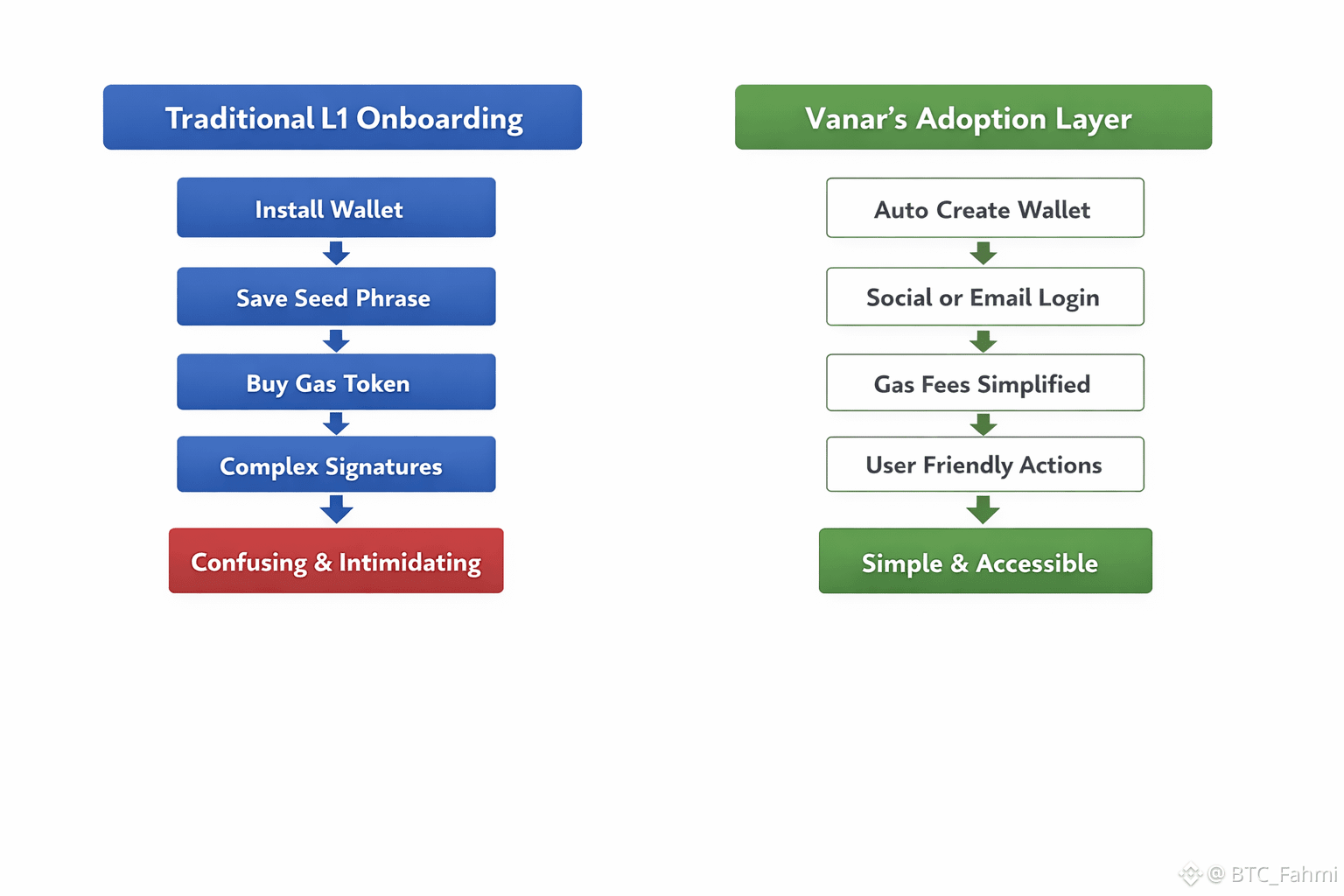
When people say “adoption,” they usually point at partnerships, grants, or a new exchange listing. Traders watch liquidity and volatility. Investors watch narratives and runway. But adoption, in practice, is an interface layer that sits between a chain and a human being. It is the set of defaults that decides whether the product feels like an app or a ritual. Most L1 roadmaps talk about throughput and finality because those are legible technical wins. The harder work is making the chain disappear at the moment of use, while still keeping the properties that justify using a blockchain at all.
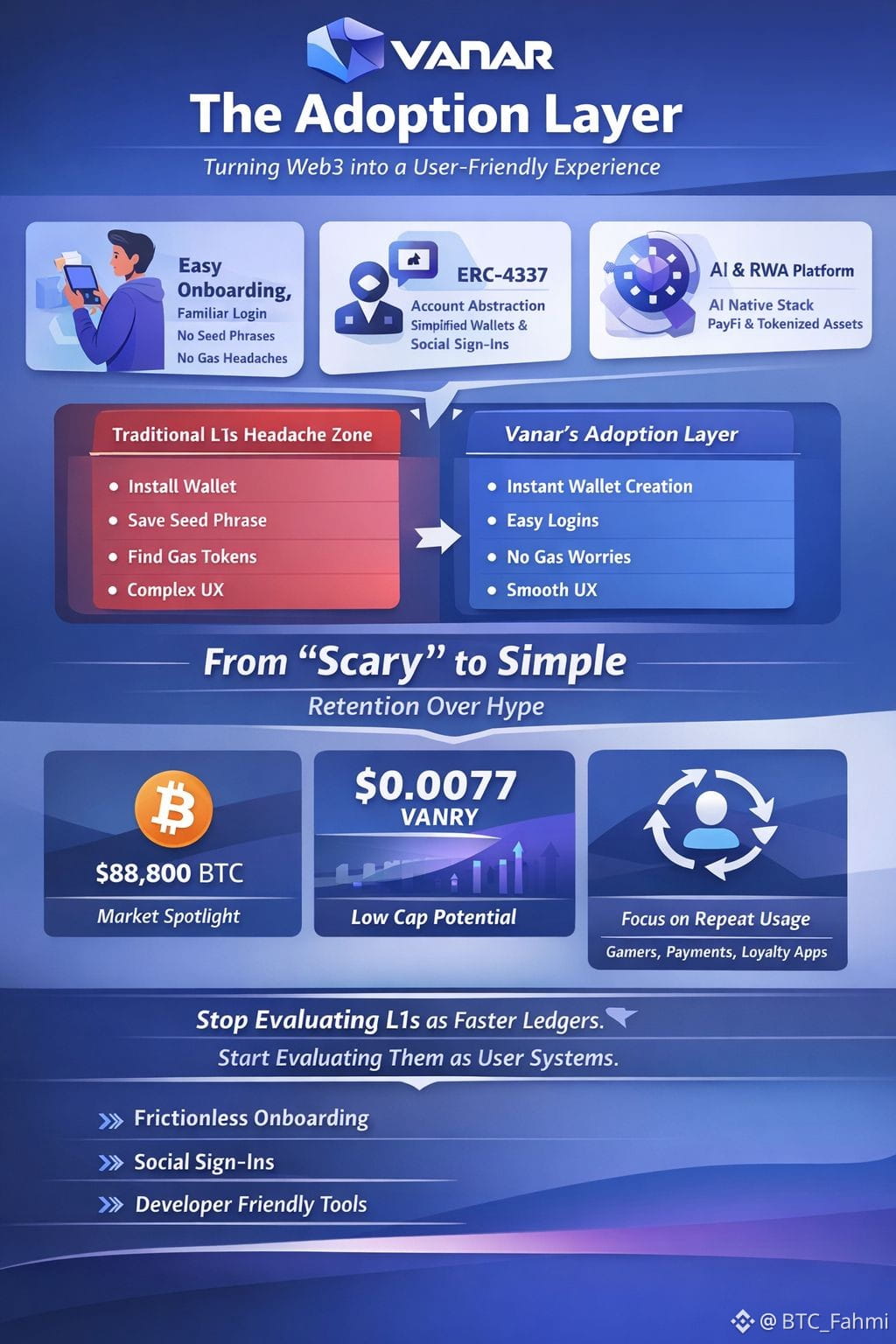
Vanar’s pitch, at least from its own materials and developer documentation, is that this missing layer is the primary product. Its docs describe using ERC 4337 style account abstraction so projects can create wallets on a user’s behalf and support traditional authentication methods such as social sign on or email and password, explicitly framed as removing friction associated with Web3 onboarding. That is not a small UX tweak. It is a stance that the default wallet experience is not sacred, and that the chain should meet users where they already are.
It also helps to notice that Vanar’s public positioning is not locked to a single niche. Some recent writeups describe it as purpose built for entertainment and gaming scale use cases, with a rebrand from Virtua to Vanar highlighted as a strategic shift in late 2023. Meanwhile Vanar’s own site currently frames the stack as “AI native,” mentioning a broader architecture oriented around PayFi and tokenized real world assets, with components like an AI logic engine and onchain data compression concepts. You do not need to treat any of that as a guarantee. But it does signal something investors should care about: the “adoption layer” is not only for gamers. The same primitives that make a first time NFT claim painless are the primitives you want for stablecoin payments, loyalty programs, or regulated flows where recovery and predictability matter more than ideology.
Now put the market data in its proper place, not as proof, but as context. As of January 28, 2026, VANRY is trading around $0.0077. Public trackers list a market cap in the high teens of millions of dollars and circulating supply around 2.23 billion tokens, with daily trading volume in the low single digit millions. In the same moment, bitcoin is around $88,800. That contrast matters for traders because it frames what “attention” usually flows toward. Large caps dominate mindshare, while smaller L1 ecosystems live and die by whether they can create repeat usage loops that are not dependent on market mood.
This is where the retention problem becomes the lens that separates infrastructure that looks good on paper from infrastructure that compounds. Retention is not a marketing metric, it is a product truth. If users do one transaction and never come back, the chain is not an economy, it is a checkout page. The adoption layer is supposed to change the shape of that curve. It tries to turn a scary first interaction into a normal first interaction, and then make the second interaction feel easier than the first. That is how habits form. Traders should care because retention tends to precede durable liquidity, not the other way around. Investors should care because retention is what makes partnerships real instead of ceremonial.
A simple real life example makes this concrete. Imagine a mid sized game studio running a limited digital drop for a tournament. The studio does not need users to “become crypto people.” It needs them to claim an item, trade it if they want, and come back next week. In the old flow, the support team becomes a wallet help desk. Refund requests spike when someone buys the wrong gas token. People churn with a bad taste even if the asset is free. In a flow built around embedded wallets and familiar login, the user experience looks closer to any other consumer app. Recovery is intelligible. Gas can be abstracted or sponsored at the application level. The user is not asked to understand the plumbing on day one. Whether Vanar executes this perfectly is an empirical question, but the design intent is aligned with where consumer crypto repeatedly fails: the moment of first friction.
The current trend across serious L1 builders is quietly converging on this same conclusion. Raw performance is table stakes. The differentiator is distribution plus usability plus safety nets. Account abstraction, passkeys, social recovery, predictable fee handling, and developer tooling that reduces edge case risk are not glamorous, but they are what make an L1 feel like a product rather than a protocol. If Vanar is building an “adoption layer,” the fairest way to evaluate it is not by slogans. It is by running a few tests: how many clicks from landing page to first successful action, how often users get stuck, how recovery works, how fee surprises are handled, and whether developers can ship without reinventing onboarding every time.
If you are trading, treat this like any other adoption thesis. Watch whether the ecosystem produces repeat usage rather than one off campaigns. Compare onchain activity trends and the diversity of apps, not only token candles. If you are investing, read the docs, try the onboarding flow yourself, and pressure test the story against retention. A chain does not win because it is loud. It wins because people return when nobody is paying them to return.
Stop evaluating L1s only as faster ledgers. Evaluate them as user systems. Open Vanar’s developer docs, inspect how it approaches wallet abstraction and onboarding, and then compare that experience to the most popular chains you already know. If the first five minutes feel boring and safe, that is not a small detail. That is the adoption layer doing its job, and in a market obsessed with throughput, boring might be the most undervalued edge of all.