

Dusk because it is not trying to be everything for everyone. It is building a Layer 1 that takes regulated finance seriously, where privacy is not treated like a side feature and compliance is not treated like a marketing word. The core idea is simple to say and hard to execute. Let people and institutions transact and build financial products without leaking sensitive data to the entire world, while still keeping the system accountable enough for real market rules.
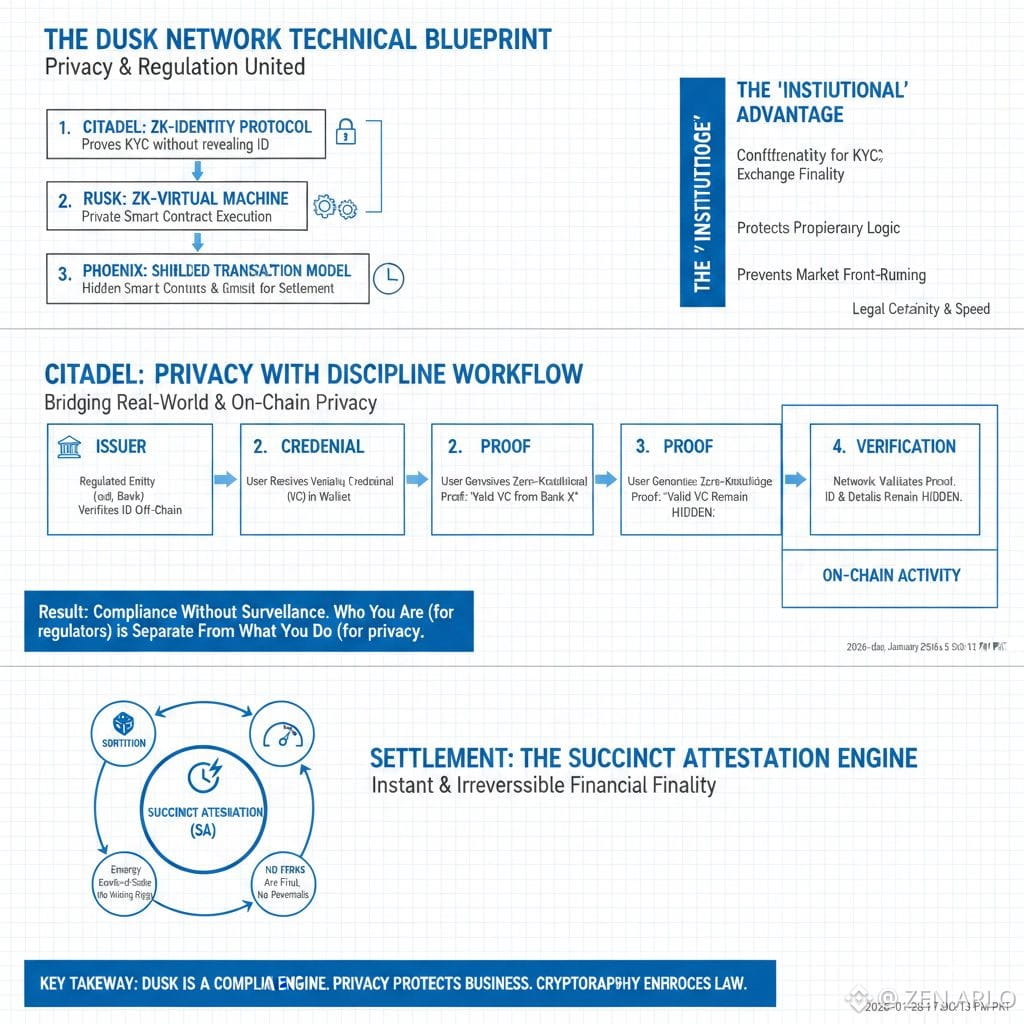
Most blockchains make you choose between two extremes. Either everything is public and anyone can trace activity forever, or privacy is added in a way that makes institutions and regulated issuers uncomfortable. Dusk is aiming for the narrow lane in between. Confidentiality where it protects participants and strategies, and auditability where it is required for trust and oversight. That balance is the reason Dusk keeps coming up whenever the conversation shifts from crypto culture to actual financial infrastructure.
Duskis structured. It is not just one execution environment with a single way to do everything. The settlement layer is designed to stay stable and predictable, while execution environments can serve different needs. That matters because finance demands reliability, and developers demand flexibility. If the settlement core stays consistent, applications can evolve without breaking what makes the network credible.
Dusk is not a vague promise. It is built into how value moves. The network supports two ways to transact because real systems need both. There is a transparent path for situations where visibility is expected, and there is a confidential path designed for the moments when broadcasting balances and flows would be reckless. This dual approach is not about ideology. It is about practicality. The world of regulated assets and institutional activity does not function with a single universal privacy setting.
Finality is another part that quietly matters. In normal consumer crypto conversations, finality is often treated like a performance metric. In markets, finality is a rule. Settlement must mean settlement. Dusk is built around consensus mechanics that target reliable completion of transactions, because a financial rail that cannot provide dependable settlement will always be treated as a toy, no matter how advanced the smart contracts look.
Dusk becomes very distinct is the asset layer and what it is trying to enable. Simple token standards are fine when you only need transfers. Regulated assets are not that. They come with rules about who can hold them, how transfers can happen, what limits exist, and how lifecycle events like dividends or voting should be handled. Dusk is aiming to make those requirements native instead of forcing every issuer to reinvent the wheel. The XSC standard and the Zedger model exist for that reason, to support securities style assets where privacy and controls are part of the design, not an afterthought.
This is also where the project feels more mature than many chains. It is not just talking about programmable money. It is talking about programmable financial instruments with constraints, which is the part most people skip because it sounds less exciting. But that is exactly the part that institutions care about. If you want tokenized real world assets to move beyond demos, the system must handle rules, and it must handle them without making every participant fully transparent to the public.
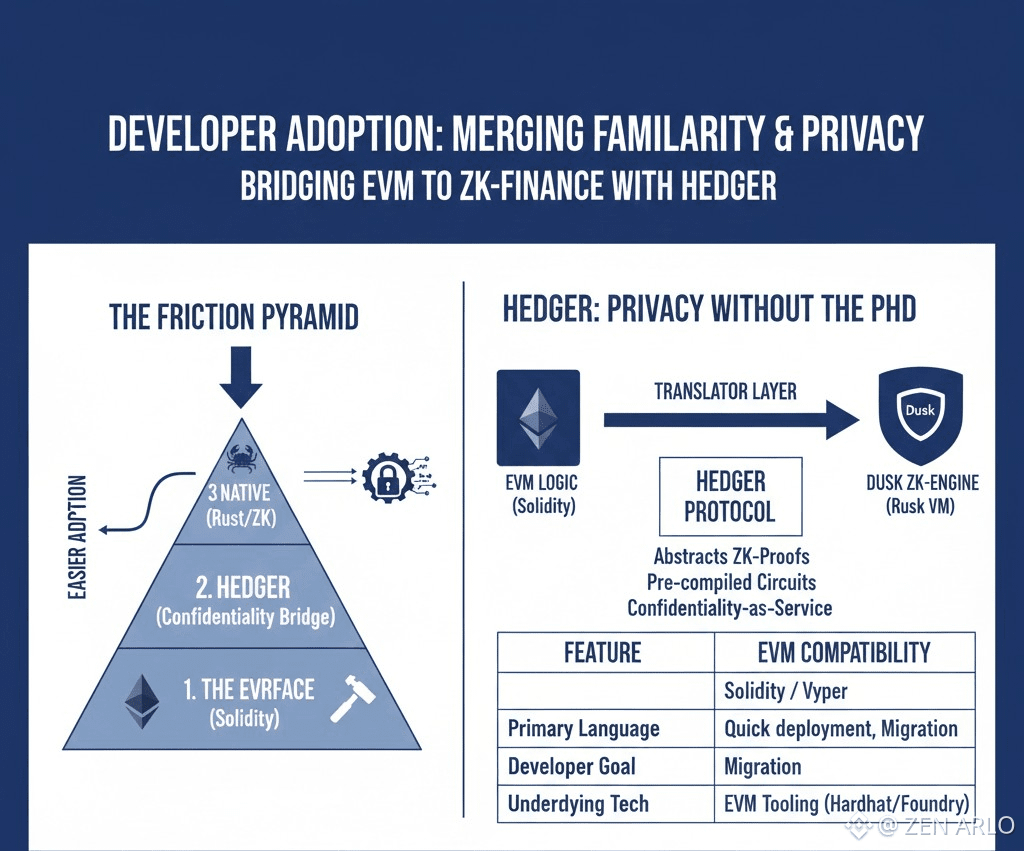
Dusk has been building an EVM path so teams can build with familiar tooling while still settling into the same base layer. That is important because adoption often comes down to friction. If builders can ship using patterns they already understand, the ecosystem grows faster. The privacy direction is reinforced through components like Hedger, which is positioned around bringing confidentiality into environments developers already know, instead of forcing every team into custom cryptography work.
Dusk is trying to be realistic. Regulated systems require verification and access rules, but public identity broadcasting is a deal breaker for both institutions and users. Dusk includes a direction through Citadel that leans into selective disclosure. Prove what is necessary, reveal as little as possible. That approach aligns with how regulated finance actually works when done properly.
DUSK is designed for staking, fees, and network incentives, the core things that keep settlement and security functioning. It has also existed as an ERC20 representation on Ethereum and a BSC representation, with migration toward native usage through the official bridging and migration mechanics. The point is not the wrapper version. The point is the network role. Staking and incentives are not optional here, because consensus participation is directly tied to the settlement guarantees the whole thesis depends on.
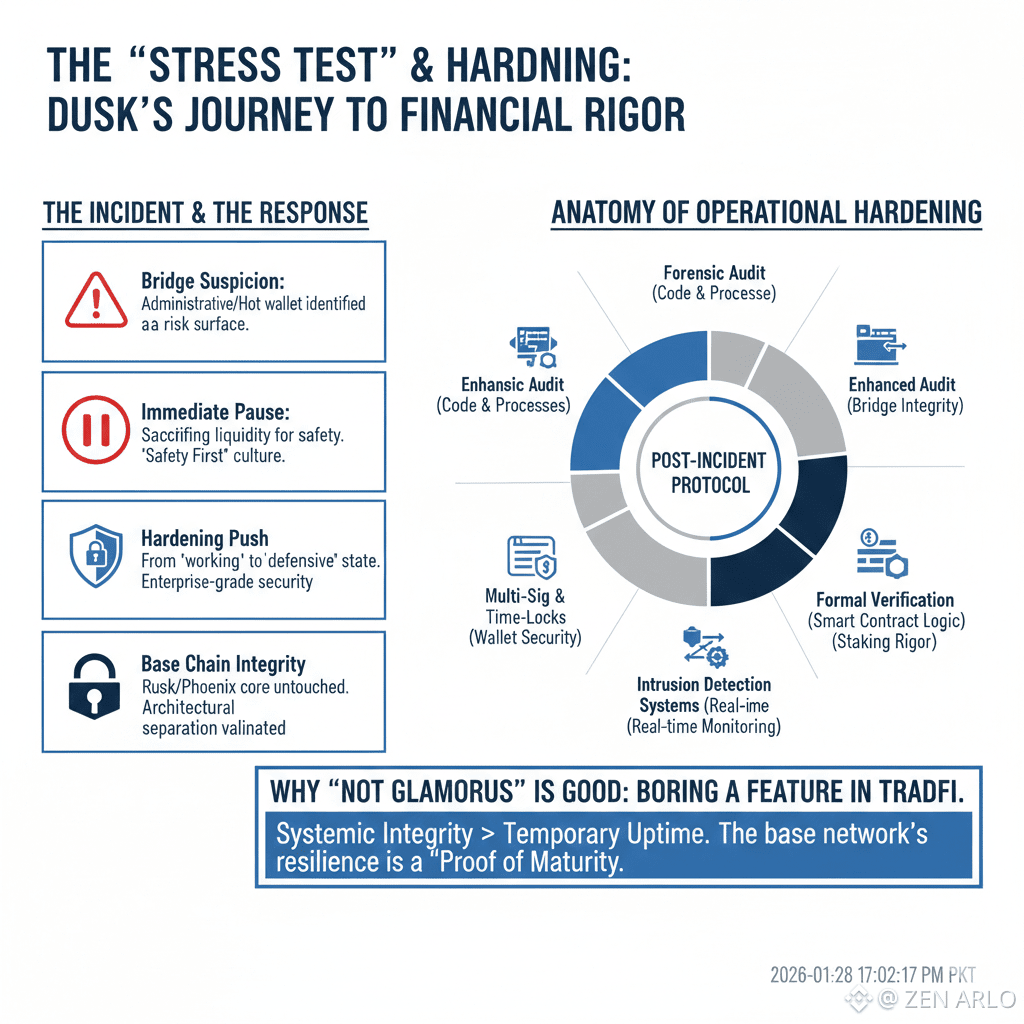
When I look at recent developments, the project has been moving through operational milestones around mainnet rollout and the bridge and migration flow. There was also an official incident notice in January 2026 around bridge operations, where suspicious activity involving a team managed wallet used in bridge processes led to a pause and a hardening push. The base network was not described as compromised in that notice, but bridge services were treated as the risk surface that needed immediate tightening before reopening. This kind of moment is not glamorous, but it is revealing. The hardest parts of infrastructure are operational, and how a project responds to stress tells you more than any roadmap graphic.
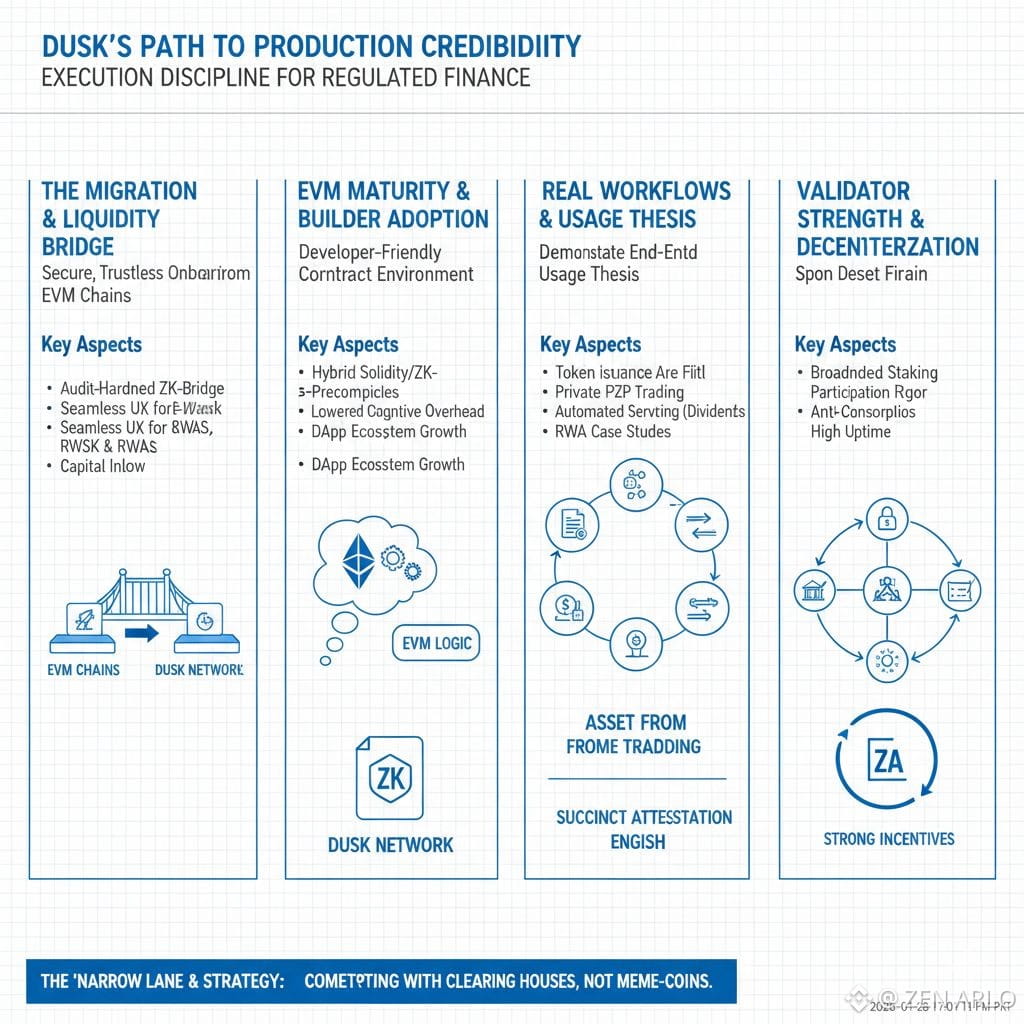
From here, what matters most is execution with discipline. The bridge and migration path needs to return in a stronger state because it is essential for liquidity and onboarding. The EVM environment needs to keep maturing because it is the practical surface most builders will use. The regulated asset stack needs to show more real workflows, not just standards, so the thesis becomes visible through usage. And the network needs to keep strengthening decentralization and staking participation, because settlement credibility is only as strong as the validator incentives and the rigor of the system.
Dusk feels like it is building for the world that already exists. Finance needs confidentiality. It also needs rules. It needs settlement that behaves like settlement. Dusk is trying to deliver that combination without turning privacy into a loophole or turning compliance into surveillance. If they keep shipping in that narrow lane, the project sits in a category that is still underbuilt across the space: privacy with discipline, designed for regulated markets.
