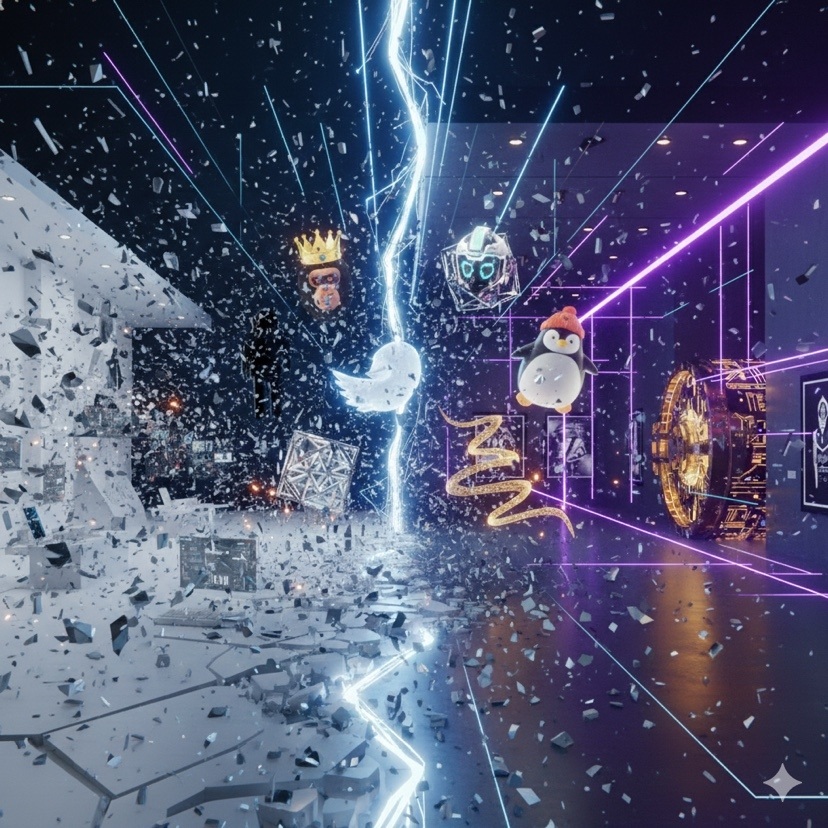
The NFT market didn’t just "dip"—it fractured. And honestly? It’s the best thing that could’ve happened.
If you’ve been doom-scrolling through headlines about the 93% crash in art NFT volumes, you’re looking at a gravestone, not a map. Matt Medved’s recent viral stats—showing a drop from billions to a few measly millions—aren't some shocking revelation. They’re just the official autopsy report for the "VC-subsidized, scale-at-all-costs" era of 2021.
The big, shiny marketplace model is broken. But in the rubble, two things are actually thriving: heavy-duty lending protocols and boutique curated galleries. Here’s the reality check: The "platform" era is dead. The "protocol and culture" era is here.
Platforms Die, Assets Live
There’s a massive misconception that when a platform like Nifty Gateway or OpenSea loses steam, the assets vanish. Wrong. We’re seeing a Great Decoupling. The "Discovery Layer" (where you browse) is failing, but the "Settlement Layer" (the blockchain) is doing just fine. Your NFT is still there; it just lost its mall. The consensus is shifting: we're moving away from "growth hacking" and back toward sustainable curation.
The Irony: Galleries are Winning
You want to know where the money went? It went offline. Or rather, it went Phygital. At Art Basel, the Zero 10 section sold out most of its digital works on day one. While crypto Twitter was arguing about floor prices, real collectors were buying digital art because a human curator at a physical booth told them why it mattered.
Web3 promised to kill the middleman, but we forgot that the middleman provides something code can’t: context. Speculative assets like PFPs are moving toward DeFi (look at Gondi, which processed nearly $650 million in loans this year), while high-end Art is retreating to boutique ecosystems like SuperRare.
The Biggest Mispricing
The market is currently treating all digital assets as one giant bucket. That’s the mistake. The 93% crash hit "Art NFTs" the hardest because they were priced like tech stocks instead of art. Meanwhile, PFP holders found liquidity in lending. That $2.75 million loan against a CryptoPunk on Gondi isn't a "flip"—it’s capital efficiency.
The opportunity? Assets with deep cultural roots but weak marketplace support are being criminally undervalued. If an artist has historical significance but their primary "mall" shut down, the "volume-only" crowd is ignoring them. That’s your entry point.
The Bottom Line
We’re not waiting for "NFTs to come back." They never left; they just moved houses. The 2021 playbook of "build a big marketplace and wait for retail" is a corpse. The future belongs to those building utility infrastructure (lending, borrowing) and cultural bridges (offline-online curation).
Culture doesn’t scale like a Fintech app. It scales through intimacy. If you’re still staring at OpenSea volume charts to tell you if the market is healthy, you’re looking at a broken compass. The market isn't smaller—it’s just smarter.
Want me to dive deeper into the specific lending data for Gondi or compare which curated galleries are actually making money right now?