
The vision for Ethereum Layer-2 (L2) is being rewritten as the ecosystem faces two major realities: Ethereum mainnet is much cheaper than expected, and the decentralization process of rollups is happening much slower than initially promised. Vitalik Buterin recently mentioned this change on Ethereum Research, arguing that the original idea of L2 as 'branded shards' of Ethereum is no longer realistic.
However, this is not a retreat from rollups. Instead, the ecosystem is recalibrating expectations and redefining the true role of L2. The current focus is on clearer classification of rollups, clarifying security levels, and creating differentiation through specialization rather than simply 'cheaper Ethereum'.
1. Decentralization in Stage 2 is still extremely rare.
The L2BEAT Stage evaluation framework has become the clearest standard for measuring the level of decentralization of rollups. Stage 0 means rollups still have 'training wheels', relying on many trust assumptions. Stage 1 reflects a partial level of decentralization with better safety mechanisms, but still significantly relies on upgrade or governance rights. Stage 2 is the milestone of 'no more training wheels', when important safety properties are ensured by code rather than humans.
Currently, most of the value locked in the L2 system still resides in Stage 1. About 91.5% of the total value is protected by Stage 1 rollups, around 8.5% in Stage 0, and only about 0.01% is in Stage 2. This indicates that progress really depends largely on major projects like Arbitrum, Base, and Optimism as they hold most of the ecosystem's value.
An important barrier is the discretionary upgrade rights. Many leading rollups still allow security councils or multisigs to bypass delays and upgrade immediately. Some projects even claim they may not want to advance to Stage 2 due to technical risks or legal pressures, meaning they do not truly 'scale Ethereum' in the original sense of the rollup-centric roadmap.
2. Why has the roadmap changed?
The rollup-centric roadmap of 2020 was built against a backdrop of very high Ethereum fees and network congestion, leading everyone to believe that the majority of users would have to move to L2. But that context has changed now.
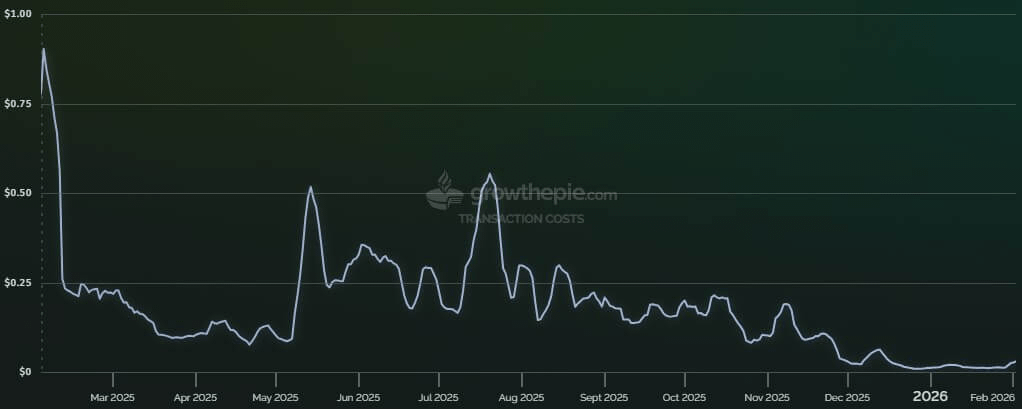
Ethereum mainnet fees are now significantly reduced, recently averaging around $0.35 per transaction, with gas sometimes dropping to just a few parts of a gwei. At the same time, Ethereum is also expanding its processing capacity. The gas limit of blocks has increased to about 60 million, doubling the long-standing limit of 30 million, and the community is even discussing future targets of up to 180 million gas.
This creates a new reality: Ethereum L1 is no longer clearly 'too expensive for regular users', undermining the assumption that rollups must become similar shards and only compete on cost.
Ethereum mainnet fees have dropped from over $0.50 at the beginning of 2025 to nearly zero by February 2026, reflecting an extended low-fee period.
3. L2 is gradually becoming more diverse, no longer resembling each other as before.
Buterin's new perspective sees L2 as a spectrum of trade-off options, ranging from rollups inheriting nearly full security of Ethereum to chains that only loosely connect via bridges.
His minimum requirement is quite clear: if an L2 processes ETH or assets issued on Ethereum, it must reach at least Stage 1. Otherwise, it should be considered a separate L1 with a bridge rather than an Ethereum scaling solution.
The greater challenge lies in creating differentiation. 'Cheap EVM' is no longer sufficient. Future rollups must compete on factors such as privacy, non-EVM execution environments, extremely low sequencer latency, outstanding scalability, or specialized applications like identity systems and social networks.
4. Three groups of rollups are gradually forming
This change is pushing the ecosystem into three more distinct groups:
Rollup pursuing Stage 2 focuses primarily on inheriting Ethereum's security.
Rollups that control or aim for compliance, optimized for compliance and organizational needs, often intentionally stop at Stage 1.
Specialized rollups, optimized for privacy, speed, application-specific processing, or non-financial use cases.
Major projects like Arbitrum, Optimism, Base, zkSync, and Starknet may need to clearly decide which direction they are pursuing.
5. What has changed for users and builders
For users, the burden shifts to understanding the underlying trust assumptions. Upgrade keys, exit mechanisms, proof systems, and censorship resistance are no longer minor details but core factors in differentiating products. Wallets and interfaces will need to clearly display the trust levels of each rollup.
For builders, the message is very clear: cheap EVM is becoming a commodity. The future belongs to rollups that offer unique features, stronger security, or transparent governance models.
6. Conclusion: Ethereum is not entering an 'L2 revolution' — but is entering a reset phase.
Ethereum is not really entering an L2 revolution but is undergoing a process of 're-layering expectations'. The old model assumed that Ethereum L1 would always be expensive and rollups would gradually become nearly identical shards. But the current reality is that L1 is expanding and becoming cheaper, while L2 is strongly diversifying in terms of trust models and purposes for existence.
The new role of L2 is now clear:
Achieve minimum security levels when processing Ethereum assets, and differentiate through specialization — not by marketing.
#EthereumFees #L2s