
Introduction
Bringing real-world financial assets on-chain is not simply a matter of tokenization. Stocks, bonds, and funds exist within strict legal frameworks that govern issuance, trading, custody, and settlement. Any blockchain attempting to host these instruments must satisfy regulators, protect investors, and provide market integrity while remaining technically robust.
Dusk Network was designed specifically for this challenge. Founded in 2018, Dusk is a Layer-1 blockchain built for regulated financial infrastructure, combining privacy, auditability, and compliance at the protocol level. Rather than avoiding regulation, Dusk treats it as a design constraint and a competitive advantage.
As institutions increasingly explore tokenized finance, Dusk is positioning itself as the blockchain layer capable of supporting real markets, not experimental prototypes.
A Regulation-First Blockchain Design
Most blockchain ecosystems prioritize permissionless access and address legal considerations at the application layer, if at all. Dusk takes the opposite approach. Regulatory requirements such as investor eligibility, identity verification, and asset lifecycle management are embedded directly into the network’s architecture.
This design reduces friction for issuers and financial service providers. Applications built on Dusk inherit compliance features by default, rather than implementing custom legal logic. For institutions that cannot accept regulatory ambiguity, this approach significantly lowers adoption barriers.
Dusk’s architecture is not about minimizing oversight, but about making regulated finance operational on public blockchain infrastructure.
DuskTrade and the NPEX Collaboration
A major step toward real-world adoption is the launch of DuskTrade in 2026, developed in collaboration with NPEX, a Dutch regulated exchange holding MTF, Broker, and ECSP licenses.
DuskTrade is designed as a compliant trading and investment platform for tokenized securities, with more than €300 million in real-world assets expected to be brought on-chain. Securities issued and traded through DuskTrade operate within existing European financial regulations, while benefiting from blockchain-based settlement and transparency.
This collaboration demonstrates that regulated exchanges and public blockchains are not mutually exclusive. Instead, Dusk and NPEX show how licensed market infrastructure can be extended on-chain without compromising legal safeguards.
The waitlist for DuskTrade opens in January, signaling the transition from infrastructure development to live market participation.
DuskEVM: EVM Compatibility with Institutional Settlement
To support developers and institutions accustomed to Ethereum tooling, Dusk is launching DuskEVM mainnet in the second week of January. DuskEVM is an EVM-compatible application layer that allows Solidity smart contracts to execute while settling transactions on Dusk’s Layer-1.
This modular design removes a major integration hurdle. Developers can deploy existing Ethereum-based applications without rewriting code, while institutions gain access to Dusk’s compliance, privacy, and settlement features.
DuskEVM enables a new category of applications: compliant DeFi protocols, regulated RWA platforms, and hybrid financial products that combine blockchain efficiency with legal certainty.
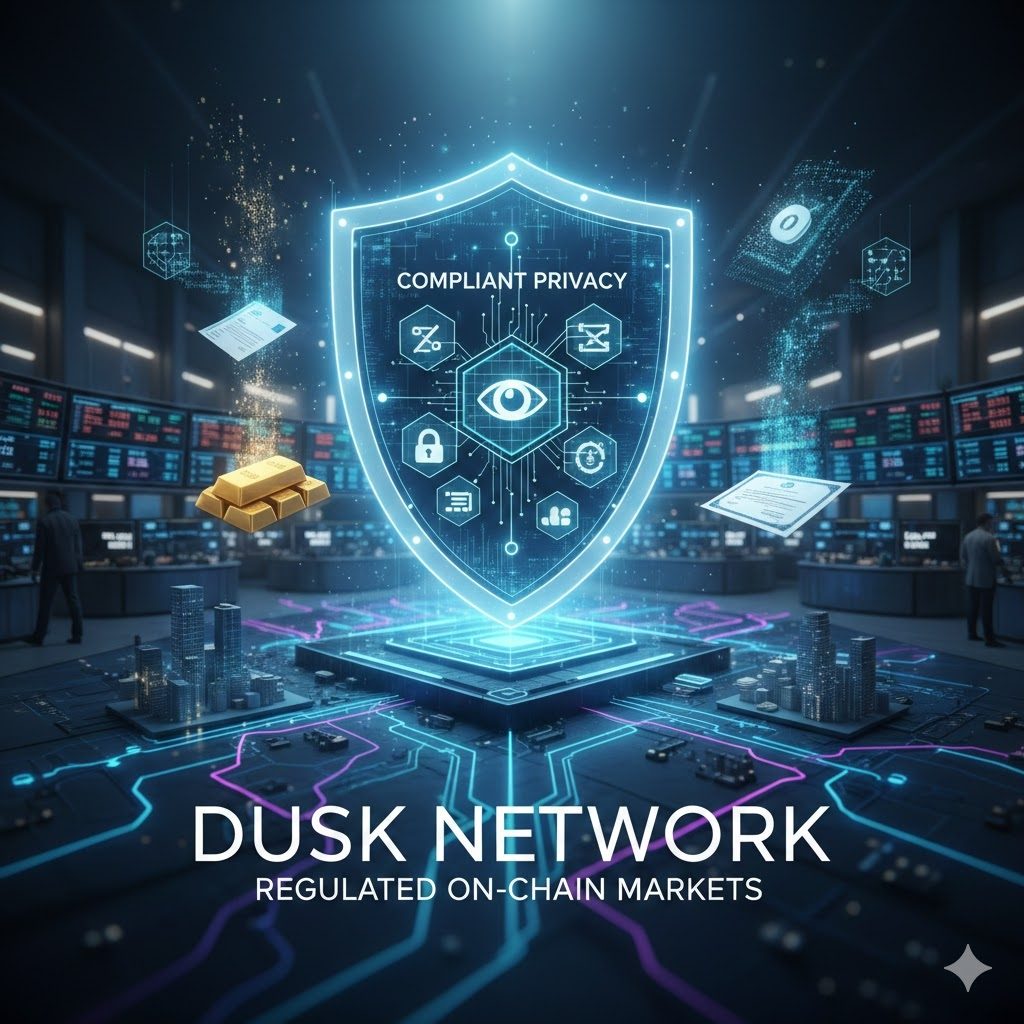
Privacy Built for Regulation: Hedger on DuskEVM
Financial institutions require privacy, but regulators require transparency. Dusk addresses this tension through Hedger, a privacy framework designed for regulated use cases on DuskEVM.
Hedger uses zero-knowledge proofs and homomorphic encryption to enable confidential transactions that remain auditable by authorized parties. This allows large trades and sensitive financial positions to remain private without compromising regulatory oversight.Unlike anonymity-focused privacy solutions, Hedger is purpose-built for compliance. It supports selective disclosure, enabling regulators to access information when legally required while protecting market participants from unnecessary exposure.
Hedger Alpha is already live, demonstrating that compliant privacy on EVM is an operational reality rather than a theoretical promise.
Identity, Asset Control, and Legal Enforcement
Real financial markets involve more than peer-to-peer transfers. Assets must be recoverable, disputes must be resolvable, and investor protections must exist. Dusk incorporates these realities into its protocol design.
Key features include identity verification for regulated assets, ensuring that only eligible investors can hold specific securities. The network also supports forced transfers, allowing authorized entities to intervene in cases of lost access, court orders, or legal disputes.
In addition, Dusk enables on-chain governance and shareholder voting, allowing companies to manage investor participation directly through tokenized assets. These mechanisms align blockchain operations with existing legal frameworks rather than attempting to replace them.
Regulatory Readiness and European Alignment
European regulatory frameworks such as MiCA and the DLT Pilot Regime are shaping the future of digital finance. Dusk’s infrastructure is designed to operate within these frameworks, not around them.
By embedding compliance into smart contracts and network logic, Dusk reduces legal risk for institutions and issuers. This readiness is critical for traditional financial players who are unable to experiment in legally uncertain environments.
Dusk’s long-term trajectory includes functioning as blockchain-based market infrastructure comparable to traditional securities depositories, but with faster settlement times and reduced operational costs.
Real-World Assets and Stablecoin Infrastructure
Beyond equities and bonds, Dusk’s regulated architecture supports additional financial applications. One of the most immediate is stablecoin reserve management, where issuers require compliant access to regulated assets backing their tokens.
Dusk’s privacy and settlement capabilities allow large-scale asset movements without exposing sensitive information, while maintaining full auditability. This makes the network suitable not only for securities, but also for payment-focused and treasury-oriented financial products.
As tokenization expands, Dusk is positioned to serve as the settlement layer for a wide range of real-world financial instruments.
Conclusion
Dusk Network is building financial infrastructure with long-term viability as its primary objective. Through regulated exchange partnerships, EVM compatibility, compliant privacy, and embedded legal controls, it is creating a blockchain environment where real markets can operate on-chain.
The success of DuskTrade, DuskEVM, and institutional adoption will determine whether Dusk becomes foundational infrastructure for tokenized finance. If successful, it will demonstrate that public blockchains and financial regulation can coexist and reinforce one another, shaping the next generation of capital markets.