
This morning I stopped by my usual coffee shop, ordered a black iced coffee, and sat by the window watching the traffic slide past like it always does. I opened Plasma on my phone not to chase a feeling of winning or losing, I just reread the update notes out of habit, the way people check the weather, to know whether they should carry a raincoat.
I like Plasma because it does not ask me to believe with emotion, it forces me to look with behavior, with small changes that can be felt and measured. I have been in markets long enough to know that what exhausts people is not always a single crash, it is the repetition of hope and disappointment, so fast that newcomers barely understand what they believed in before it moves again. That is why I look at Q1 and Q2 like a work schedule, not a festival, I want to see what they do first, what they are willing to postpone, and whether they can keep their rhythm when no one is clapping.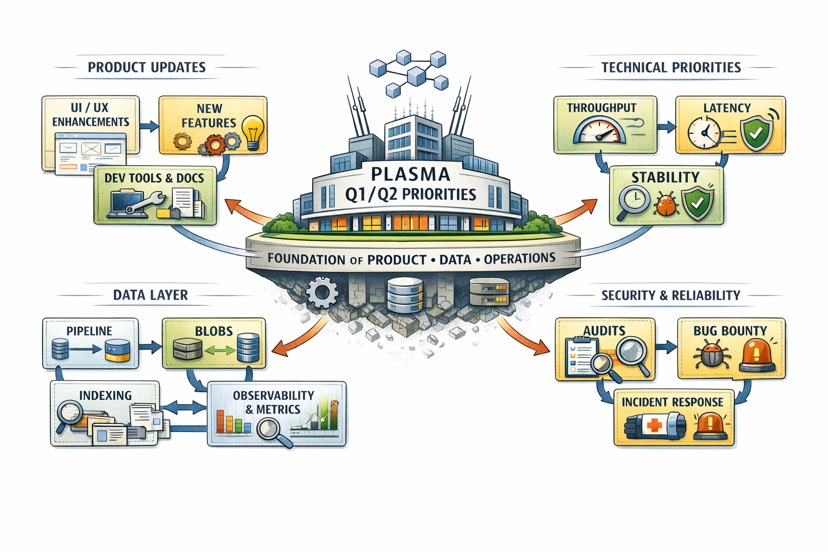
In the Q1 product updates, I see them talking about product in a practical way, there are two new features shipped, but the important part for me is not the name on the label. I care about whether those features reduce how often a user has to overthink, whether they reduce ambiguity when a step feels uncertain, whether they reduce the feeling that you must carry every risk alone. I also notice that they treat UI and UX as part of the backbone, that sounds ordinary, but it is not, because many projects only remember UI when complaints get loud. When UI and UX are done right, they do not create cheers, they create something rarer, calm, and calm is scarce in a market designed to steal your sleep.
The dev tools, SDK, and docs are even less glamorous, and that is exactly why they matter. I have watched too many ecosystems die not because the idea was bad, but because builders had poor tools, unclear documentation, and a crooked path to testing. If Plasma in Q1 truly made dev tools easier, made the SDK tighter, and made docs less vague, then they are investing in durable pull, not short term push. The projects that survive time are rarely the ones with the best story, they are the ones that let other people work every day without guessing, without praying, without having to relearn the system after every update.
On Q1 technical priorities, throughput, latency, and stability are words I have heard until they lost their shine, but I still treat them like a health check. High throughput sounds exciting, but if latency swings, if stability is uneven, then throughput is just a number for marketing. What I want to see is Plasma choosing stability as a real priority, tracking latency over time, tracking congestion under load, and making the system behave consistently when transaction flow piles up. Newcomers often see one good day and think that is the essence, veterans look at one bad week and know that is the essence. If Q1 builds the foundation well, then Q2 has somewhere solid to stand when it talks about expansion.
The data layer, pipeline, blobs, indexing, observability, and metrics are where I expect seriousness, not decoration. Data is what users do not see, but they feel it in their skin. When data clogs, you see pending, you feel time stretch, you feel an uncomfortable silence, and you start asking whether you are doing the right thing. If Plasma in Q1 built a cleaner pipeline, used blobs to move data in a way that reduces choke points, improved indexing for faster tracing, improved observability for real state visibility, and published metrics consistently, then they are doing something decent. Decent means giving users and developers a way to understand the system through truth, instead of forcing them to live on rumors and guesses. I do not need a perfect picture, I need a system that can explain itself, point at its weak spots, and turn those weak spots into concrete fixes.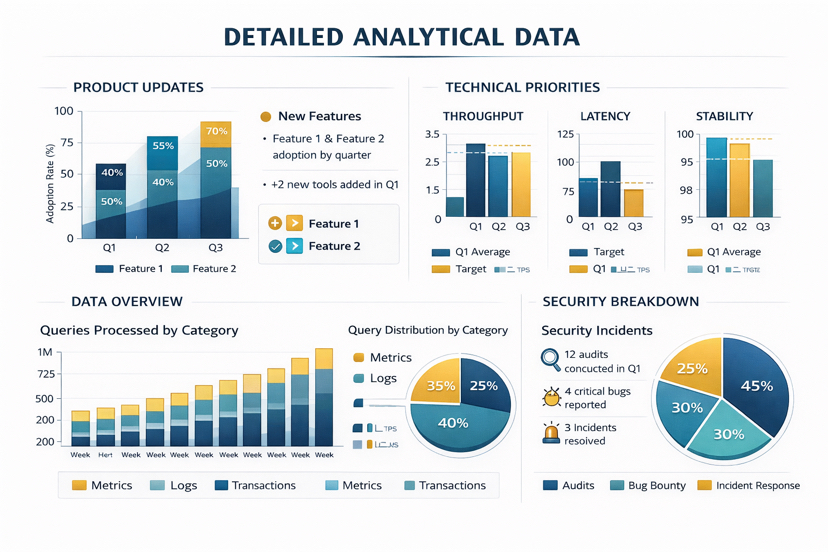
Security, audits, bug bounties, and incident response are the part I always read slower. I have seen plenty of teams treat security like a checkbox, then when something breaks, all that is left is panic. If Plasma runs audits seriously, operates a disciplined bug bounty, and prepares incident response like a real procedure, then that is not good news, it is the minimum price of being allowed to exist. A network mechanism is not only in code, it is in how the team responds when code stops being perfect, and markets always find that imperfect moment.
I am writing this for newcomers, and for anyone who is tired, because I know what it feels like to watch everything repeat. Plasma in Q1 might not produce applause, but if they make the product less confusing, make the tools less painful, make data less blind, make stability less dependent on luck, and make safety less performative, then they are walking one of the few paths that can survive time. And if one day they abandon discipline to chase noise, the market will not get angry, it will simply turn away, quietly and fast, the way it always has. $XPL #Plasma @Plasma
