
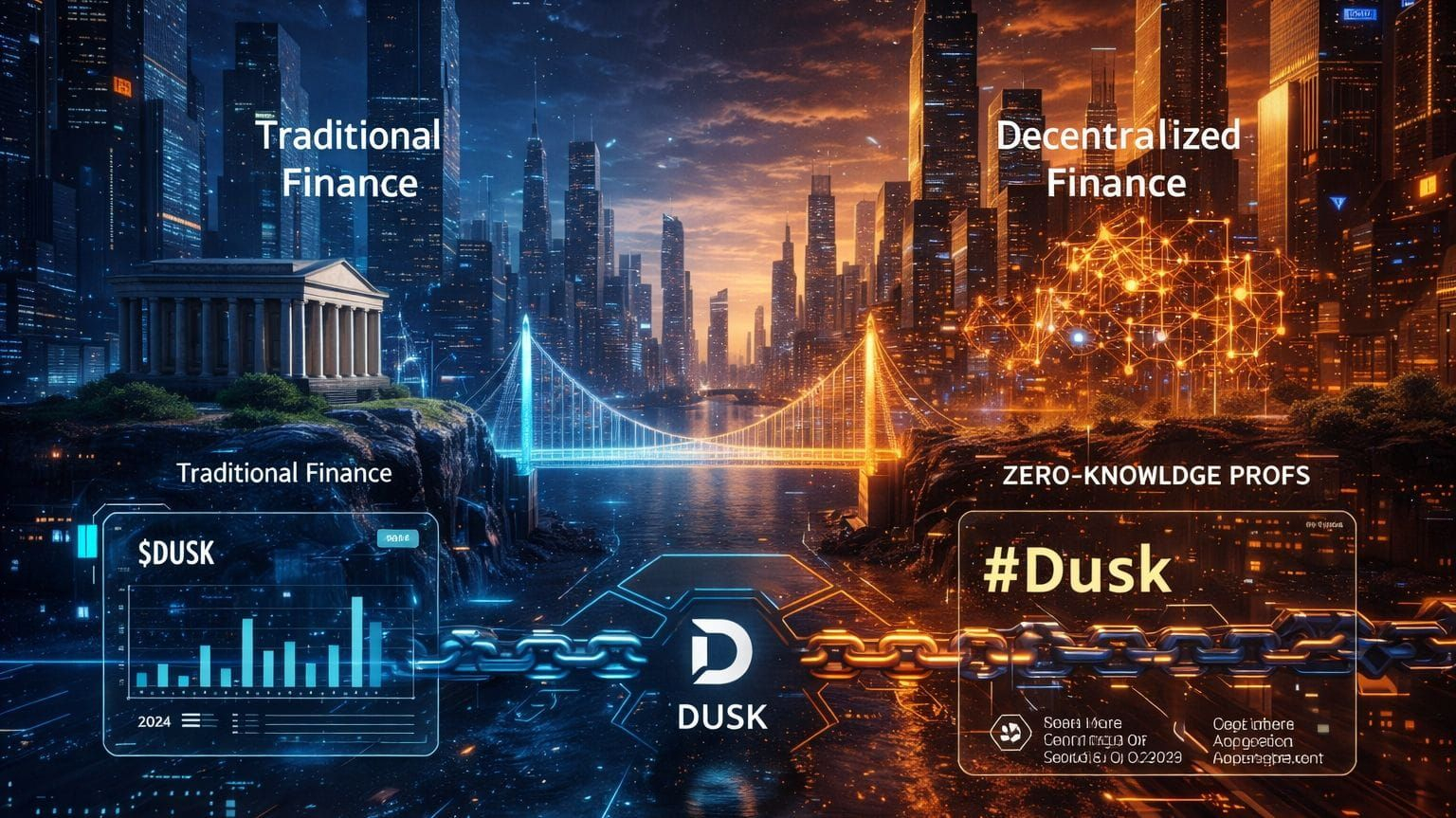
The financial system has never been a neutral arena. It is among the most heavily regulated sectors of any modern economy, shaped not only by markets but by law, politics, and collective memory. Banks, in particular, sit at the center of this regulatory gravity. They are trusted custodians of value, but also frequent points of systemic failure. Every major financial crisis reinforces the same paradox: society demands innovation in finance, yet insists on restraint.
In the emerging Dusk economy, this paradox does not disappear. It sharpens.
Dusk Network positions itself at the intersection of privacy, compliance, and institutional finance—a space where experimentation is constrained by design. Unlike the open, permissionless ethos that defined early crypto culture, Dusk speaks fluently in the language of regulation. It does not seek to route around banks or ignore oversight. Instead, it attempts something more delicate: to federate cryptographic privacy with the legal frameworks that govern capital markets.
Whether this is a necessary evolution or a philosophical compromise remains an open question. But it is precisely within the most regulated sector—banking and financial infrastructure—that Dusk’s ambitions are most clearly revealed.
The Weight of Regulation as Economic Architecture
To understand why financial institutions shape the Dusk economy so profoundly, one must first appreciate what regulation truly represents. Regulation is often framed as friction, but in reality it is architecture. It defines who may participate, under what conditions, and with what liabilities. It encodes historical lessons about fraud, instability, and power asymmetry.
Banks are not merely financial intermediaries; they are legal constructs. Their balance sheets are intertwined with sovereign guarantees, central bank liquidity, and international settlement standards. Compliance is not optional; it is existential. Any blockchain seeking relevance in this domain must therefore speak a different dialect of decentralization—one that tolerates oversight without surrendering cryptographic integrity.
Dusk’s design reflects this reality. Its focus on zero-knowledge proofs, selective disclosure, and regulated privacy suggests a belief that future financial systems will not be fully transparent nor fully opaque, but conditionally legible. Information will be revealed not by default, but by right, obligation, or consent.
In this sense, Dusk does not attempt to abolish regulation. It treats regulation as a constraint to be engineered around, rather than an enemy to be defeated.
Privacy as a Compliance Primitive
In mainstream crypto narratives, privacy is often framed as resistance: resistance to surveillance, censorship, and centralized control. In institutional finance, privacy serves a different function. It protects counterparties, preserves market integrity, and prevents information asymmetry from turning into exploitation.
Banks already operate with layers of confidentiality. Client data is guarded, trades are shielded until settlement, and disclosures follow strict timelines. The irony is that many public blockchains violate these norms by default, exposing transaction graphs that would be unacceptable in regulated markets.
Dusk’s proposition is that privacy is not an add-on feature, but a primitive. By embedding zero-knowledge proofs at the protocol level, it seeks to create a mesh of chains where compliance and confidentiality coexist. Transactions can be validated without revealing their contents. Rules can be enforced without universal transparency.
This is particularly relevant for assets like securities, bonds, and regulated derivatives. These instruments require auditability without public exposure, traceability without surveillance, and finality without leakage. Dusk positions itself as a blueprint for this middle ground—a system where the ledger is verifiable, but not voyeuristic.
Yet skepticism is warranted. Privacy systems increase complexity, and complexity invites risk. Zero-knowledge circuits are difficult to audit, and their failures can be catastrophic. Regulators, already cautious, may struggle to trust systems they cannot intuitively inspect. The promise of cryptographic compliance must therefore contend with institutional inertia and legal conservatism.
Banks as Anchors, Not Adversaries
One of the more controversial implications of Dusk’s approach is its implicit acceptance of banks as enduring institutions. While much of Web3 culture imagines a post-bank future, Dusk appears to assume the opposite: that banks will remain central, but their infrastructure will evolve.
This assumption may be pragmatic rather than ideological. Banks control liquidity, custody, and access to fiat rails. They are the gateways through which most economic activity flows. Any attempt to build regulated on-chain finance without them risks irrelevance.
By aligning with banking requirements, Dusk reframes decentralization not as disintermediation, but as reintermediation through cryptography. Trust shifts from opaque internal processes to mathematically provable systems. The bank remains, but its role is transformed—from trusted operator to accountable participant within a verifiable network.
Still, this raises uncomfortable questions. If blockchains become extensions of regulated finance, do they lose their emancipatory potential? Does aligning with banks mean inheriting their failures, biases, and exclusionary practices?
Dusk does not fully resolve these tensions. Instead, it exposes them. It suggests that the future of finance may not be a clean break from the past, but a negotiated settlement between legacy power and cryptographic possibility.
The Dusk Economy as a Regulated Experiment
What emerges from this perspective is a vision of the Dusk economy as a regulated experiment. Not a permissionless free-for-all, nor a closed consortium chain, but a federated environment where participation is structured, rights are granular, and obligations are enforceable.
Such an economy favors institutions, but it does not exclude individuals. It offers tools for tokenized securities, compliant DeFi, and privacy-preserving asset issuance. It assumes that capital markets will migrate on-chain not because ideology demands it, but because efficiency and programmability make it inevitable.
Yet the risks are substantial. Regulatory capture is a real threat. If compliance becomes the primary design driver, innovation may narrow. Smaller actors could be priced out by legal complexity. The very features that make Dusk attractive to institutions could render it inaccessible to grassroots experimentation.
This tension mirrors the broader evolution of the internet itself. Early networks were open, chaotic, and lightly governed. Over time, standards emerged, platforms consolidated, and regulation followed. The internet did not disappear; it matured. Whether blockchain will follow a similar path remains uncertain, but Dusk seems to be betting that maturity, not maximalism, will define the next phase.
Skepticism, Legitimacy, and the Burden of Proof
For all its conceptual elegance, Dusk faces a heavy burden of proof. Institutional finance is slow to change, and skepticism is rational. Banks do not adopt new infrastructure lightly, especially when regulatory clarity is incomplete.
Moreover, the success of privacy-preserving compliance depends not only on technology, but on trust. Regulators must trust that cryptographic proofs correspond to legal realities. Institutions must trust that protocols will remain stable, secure, and governed responsibly. Users must trust that privacy mechanisms will not become tools of exclusion or control.
These forms of trust cannot be automated. They are social, legal, and political. Technology can support them, but not replace them.
This is where Dusk’s ambition intersects with humility. It does not claim to overthrow finance. It claims to offer a new substrate—one that can be audited, regulated, and evolved. Whether this substrate becomes foundational or peripheral will depend less on code than on adoption, governance, and real-world performance under stress.
Trust, Technology, and the Human Layer
At its core, the Dusk economy raises an old question in a new form: where does trust belong?
In traditional finance, trust is vested in institutions, laws, and reputations. In early crypto, trust was displaced onto code and consensus. Dusk suggests a third path—a synthesis where trust is distributed across cryptography, regulation, and human oversight.
This synthesis is neither pure nor comfortable. It accepts that humans will continue to govern, regulate, and sometimes fail. It also insists that systems can be designed to limit the damage of those failures, to make trust measurable rather than assumed.
In this sense, Dusk is less a rebellion than a reconciliation. It attempts to reconcile privacy with accountability, decentralization with regulation, and innovation with restraint. Whether it succeeds is uncertain. But the attempt itself reflects a maturing understanding of how deeply finance is embedded in human society.
Technology can encode rules, but it cannot eliminate judgment. Blockchains can enforce constraints, but they cannot define values. The future of regulated on-chain finance will therefore not be decided solely by protocols like Dusk, but by the collective willingness of institutions and individuals to redefine what trust means in a digital age.
If the internet was a blueprint for the free flow of information, then regulated blockchains may become the blueprint for the responsible flow of value. Not free of friction, not free of power, but perhaps more transparent in how both are exercised.
In that light, the most heavily regulated sector may not be the enemy of innovation after all. It may be the proving ground where technology learns, once again, that progress is not the absence of trust—but its careful redesign.
@Dusk $DUSK #Dusk