
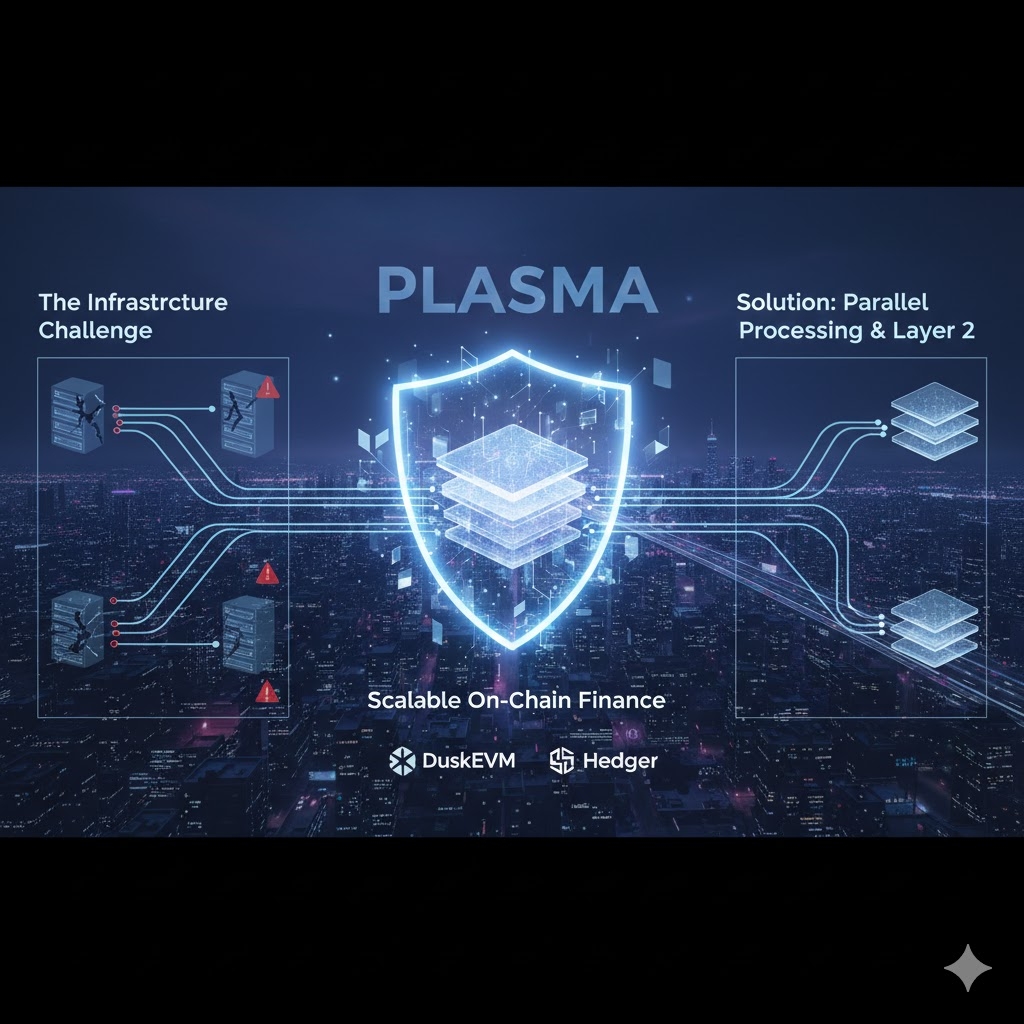
Blockchain adoption has progressed significantly over the past decade, yet core infrastructure constraints continue to limit its applicability for large-scale financial and enterprise use. Scalability bottlenecks, fragmented liquidity, high execution costs, and data availability trade-offs remain persistent challenges across Layer-1 blockchains and their Layer-2 extensions. While rollups and modular designs have improved throughput, many systems still struggle to deliver predictable performance, capital efficiency, and verifiable execution at scale.
Plasma is positioned to address these structural limitations by focusing on a narrowly defined but critical domain: high-performance, capital-efficient settlement for stablecoin-centric and financial applications. As on-chain activity increasingly shifts toward payments, trading, and treasury operations, infrastructure optimized for reliability and efficiency—rather than generalized experimentation—becomes essential for the next phase of adoption.
Core Architecture and Design Philosophy
Plasma is designed as a purpose-built blockchain optimized for financial throughput and operational clarity. Rather than pursuing maximal generality, its architecture prioritizes deterministic execution, cost predictability, and protocol-level efficiency for high-volume transactions.
At the protocol layer, Plasma emphasizes:
High throughput execution through optimized consensus and block production tailored to transactional workloads.
Low and stable fees, reducing variance that undermines usability for payments and institutional settlement.
Protocol-level efficiency, minimizing redundant computation and data overhead common in generalized virtual machine environments.
Structurally, Plasma differs from traditional Layer-1s that attempt to serve all use cases equally, as well as from rollups that inherit execution constraints from their settlement layers. By vertically integrating execution and settlement while maintaining cryptographic verifiability, Plasma aims to offer performance characteristics closer to traditional financial infrastructure—without sacrificing on-chain guarantees.
Differentiation from Traditional Layer-1s and Rollups
Conventional Layer-1 blockchains often face trade-offs between decentralization, throughput, and cost, resulting in congestion during periods of high demand. Rollups mitigate some of these issues but introduce additional complexity through cross-layer dependencies, delayed finality, and data availability assumptions.
Plasma’s approach reduces these frictions by:
Avoiding dependency on external execution layers for core transaction processing.
Designing data structures and state transitions around financial primitives rather than arbitrary computation.
Prioritizing settlement certainty and operational simplicity over maximal composability.
This design philosophy reflects a long-term view: infrastructure optimized for financial reliability tends to age better than systems optimized solely for flexibility.
Institutional and Real-World Relevance
For institutional users, infrastructure requirements differ materially from those of retail experimentation. Predictable fees, consistent performance, and auditable execution are prerequisites for deploying meaningful capital on-chain.
Plasma is well-suited for:
Payments and remittances, where low latency and cost certainty are critical.
Trading and settlement systems, requiring high throughput without congestion risk.
Treasury and liquidity management, where capital efficiency directly impacts returns.
By aligning its architecture with stablecoin-based financial flows, Plasma addresses the dominant on-chain activity class rather than speculative edge cases. This focus enhances its relevance to fintechs, payment providers, and institutions exploring blockchain-native rails.
Transparency, Verification, and Trust Minimization
A defining requirement for serious on-chain infrastructure is the ability to verify system behavior independently. Plasma emphasizes transparent state transitions and cryptographic guarantees that allow users and institutions to audit activity without relying on centralized intermediaries.
Key properties include:
Verifiable execution, ensuring transactions are processed according to protocol rules.
Clear settlement guarantees, reducing ambiguity around finality.
Minimized trust assumptions, particularly important for enterprises operating under regulatory or fiduciary constraints.
These characteristics align Plasma with the core ethos of blockchain while making it suitable for compliance-conscious deployment.
Ecosystem Development and Builder Accessibility
Sustainable infrastructure adoption depends on developer experience and ecosystem support. Plasma focuses on lowering friction for builders by offering:
Tooling designed for financial and transactional applications.
Compatibility pathways for existing blockchain ecosystems.
Clear economic incentives aligned with long-term usage rather than short-term speculation.
By reducing complexity and focusing on a well-defined application domain, Plasma enables developers to deploy scalable systems without navigating the overhead of generalized environments.
Strategic Positioning in the Blockchain Landscape
Plasma occupies a distinct position in the evolving blockchain stack. Rather than competing directly with generalized Layer-1s or serving as an auxiliary scaling layer, it functions as specialized financial infrastructure optimized for stable, high-volume on-chain activity.
Its value proposition lies in doing fewer things—but doing them with greater efficiency, clarity, and reliability. As blockchain adoption matures, such specialization may prove more durable than broad but fragile designs.
If on-chain finance is to support real-world scale, it will require infrastructure that prioritizes performance, verification, and capital efficiency from the ground up. Plasma represents a focused attempt to meet that requirement and, in doing so, position itself as foundational infrastructure rather than a niche experiment.