When the crypto market turns bearish, falling prices don’t just erode portfolios - they distort investors’ mental frameworks. In such periods, many people become trapped in debates about a coin’s “intrinsic value,” as if proving that value alone will eventually force the market to acknowledge it.
In reality, this obsession with intrinsic value is often less about rational analysis and more about psychological defense. As uncertainty rises, people instinctively seek a theoretical anchor to counter fear and self-doubt. “Intrinsic value” becomes a mental lifeboat - allowing holders to feel justified, even while the market moves against them.

The problem is that markets do not operate on what makes sense on paper. They operate on capital flows, liquidity, and real-world acceptance. An asset can have solid technology, long-term vision, and an elegant narrative - yet without sustained demand, without continuous cash flow, its price can stagnate or decline for an extended period of time.
In crypto, value is not something waiting to be discovered. It is something that forms over time through repeated use, collective belief, and the ability to translate into tangible benefits. When these elements weaken, continued arguments about intrinsic value only delay an investor’s adaptation to a new market cycle.
BNB 👉 Strength Comes from Being Used, Not Being Explained
BNB is a clear example of the gap between theoretical value and practical value. Across multiple cycles, BNB has rarely been praised for revolutionary philosophy or groundbreaking technology. What keeps BNB resilient is not complex valuation models, but its concrete role within an ecosystem that operates every single day.
BNB is used to reduce trading fees, participate in launchpads, pay fees across the BNB Chain ecosystem, stake, and support a wide range of activities directly tied to user behavior. Every time the Binance ecosystem functions, BNB gains another reason to exist. Its value does not need to be defended with arguments - it is continuously validated through real usage.

During bearish phases, when speculative capital retreats and narratives lose their appeal, most tokens are left with little more than stories. BNB, however, retains structural support because it is embedded in infrastructure: trading, liquidity, and operational activity. Market sentiment may be questioned, but BNB remains necessary for the system to function.
The key distinction is that BNB possesses non-speculative demand. This demand does not rely solely on price appreciation expectations; it comes from BNB being an inseparable component of the ecosystem itself. In crypto, any asset that continues to be used when the market turns cold holds a significant survival advantage.
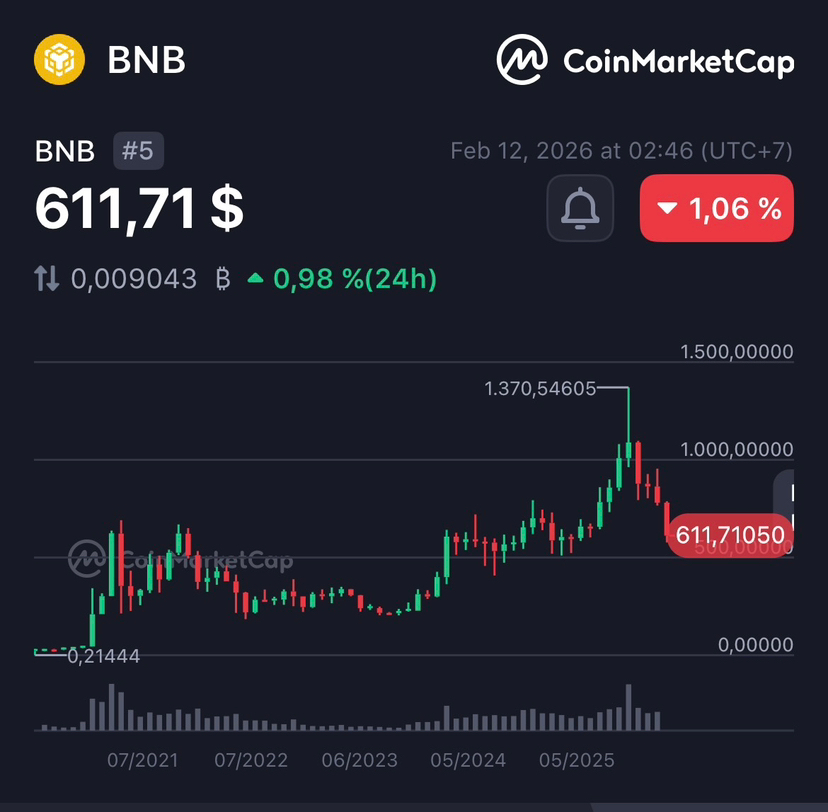
Real Value Does Not Need to Win Every Argument
BNB illustrates a simple but uncomfortable truth: value is not determined by how well an asset is explained, but by how difficult it is to remove from a functioning system. Once an asset becomes infrastructure, it no longer needs to win every debate - it only needs to continue being used.
The greatest risk for investors is not buying a low-quality asset, but becoming trapped in a mental framework that prevents adaptation when market conditions change. In many cases, “intrinsic value” becomes a psychological anchor, holding people in place while the market has already moved into a completely different phase.
Those who survive long-term in crypto are not the ones who define value most eloquently, but the ones who understand when value is currently needed by the market - and when it is wiser to wait, adapt, or let go, rather than insist on being right.