


Upon observing Fogo, the initial impression is that it does not resemble a chain striving to compete on a public scoreboard. The rationale is that the concept becomes clearer when considering speed as a factor that influences user behaviour rather than merely a feature to highlight in a visual representation. This is why Fogo continues to attract interest from individuals who genuinely aim to create products that users engage with daily, rather than merely accumulating metrics that appear favourable for a short period before fading away. Many networks continue to discuss performance as though the sole consideration is the volume of processing achievable in a hypothetical second. However, actual users do not exist in hypothetical scenarios; they operate in straightforward cycles where they interact, anticipate a response, and determine whether to continue or disengage. Latency serves as a critical factor in decision-making: it is the point at which your brain either places trust in the system or begins to question it. When uncertainty arises, the product gradually begins to lose users in a subtle manner that often goes unnoticed until it is too late.
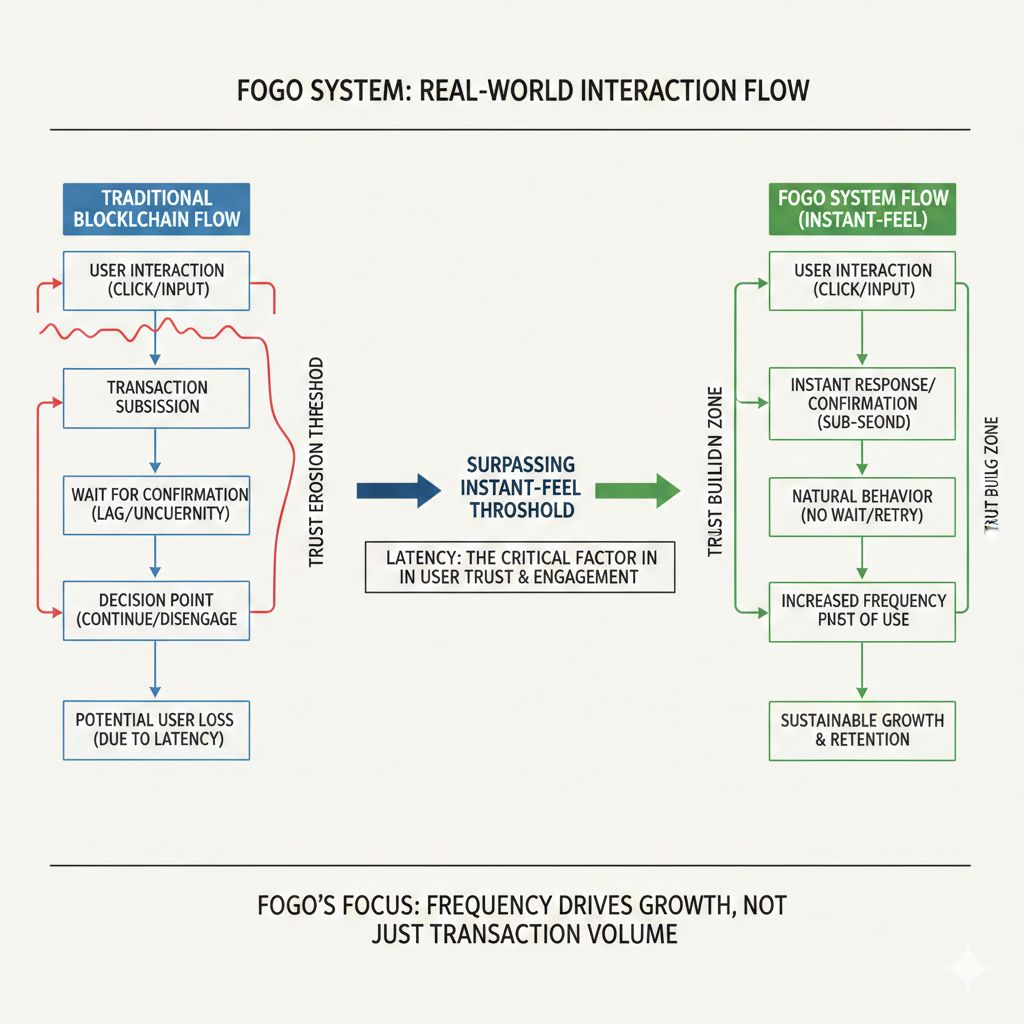
Fogo's standout feature is not merely its speed in isolated instances, optimal conditions, or in benchmarks that lack repetition. None of those factors independently influence retention. The change in retention occurs when an on-chain experience surpasses the instant-feel threshold, transitioning from confirmations being perceived as a distinct ritual to being regarded as a standard application response. At that moment, the user ceases to check, wait, and engage in defensive behaviours such as refreshing or retrying, and begins to act in a more natural manner. This represents the most significant investment in product design, as natural behaviour fosters frequency, and frequency drives sustainable growth without the necessity for ongoing marketing efforts to thrive.
This immediate threshold is not merely a motivational statement; it represents a tangible boundary observable in people's behaviour. When feedback is precise and reliable, individuals engage more, take additional actions during each session, make quicker decisions, connect interactions seamlessly without hesitation, and remain within the experience long enough to develop familiarity. However, when feedback is delayed or inconsistent, even in a robust system, individuals tend to reduce their actions, hesitate, second-guess themselves, and begin to perceive the system as fragile. A system that feels fragile cannot effectively support real-time products, regardless of the throughput claims made.
The prevalent focus on TPS overlooks a critical distinction: TPS pertains to capacity, while latency relates to the user experience. Users are not aware of the theoretical capabilities of the network; rather, they assess the effectiveness of their specific actions based on the speed of the response and the predictability of that response, even in scenarios where multiple users are engaging simultaneously. Upon acceptance of this concept, the focus shifts from pursuing peak figures to prioritising consistency and fluidity. Smoothness contributes to the perception of a chain as a dependable environment, rather than merely a system that functions well until critical moments arise.
Fogo gains significance when appropriately categorised, as not all applications require extreme speed. Disregarding this reality results in writing that may appear impressive on the surface but ultimately lacks substance. However, certain categories require responsiveness, as delays can significantly alter behaviour and jeopardise the product's success. This is precisely where Fogo's direction begins to feel intentional, as the chain's design is ideally suited for experiences that require users to act without hesitation, enabling them to perform actions swiftly, repeat them frequently, and rely on the system to function seamlessly when attention is focused.
Trading serves as a prime illustration, as it involves not merely interaction, but interaction that is influenced by the element of time. When individuals experience a delay in trade flow, their frustration is compounded by a sense of vulnerability, as the world continues to progress in their absence. This leads users to engage in trading less frequently, cancel transactions less often, make fewer adjustments, and perceive the environment as uncertain. When uncertainty becomes the prevailing sentiment, liquidity diminishes, participation declines, and the product loses the vitality that invigorates markets. Ultra-fast finality is not merely a superficial measure; it represents the point at which the user can confidently proceed without concern for their safety. In a trading context, that mental shift distinguishes a venue perceived as usable from one regarded as a risk.
In gaming and various interactive experiences, latency is distinctly noticeable as enjoyment relies on rhythm, which in turn depends on responses that align with the brain's expectations. When actions falter, even slightly, the experience ceases to feel engaging and begins to feel burdensome. This compels developers to streamline mechanics, eliminate real-time interactions, and focus on designing around delays rather than fostering creativity. When you establish an environment where confirmations are immediate and consistent, it opens the door to entirely new design possibilities. The game is responsive, the world evolves, and the player can engage continuously without the underlying concern of whether their input is being processed appropriately.
The same reasoning is applicable to marketplaces and any environment where users are making decisions based on real-time conditions. Marketplaces function as confidence generators, and the timing of events plays a crucial role in influencing that confidence. A delayed listing update or a delayed purchase confirmation not only hinders the process but also prompts the user to question the information presented to them. When users begin to question reality, conversion rates decline as both buyers and sellers become hesitant, resulting in a less fluid ecosystem. This illustrates that low-latency reliability is not merely an enhancement, but a fundamental advantage.
The reason Fogo's approach appears to prioritise product decision-making over technical demonstration is that latency proves beneficial only when it remains consistent under stress. Peak speed is straightforward to promote, yet challenging to convert into actual experience. Many systems may appear efficient under stable conditions, yet they can quickly devolve into unpredictability when faced with increased user demand. This moment is crucial in determining if the chain can facilitate real-time experiences without requiring developers to implement defensive UX layers. Defensive UX layers counteract the goal of creating a seamless experience for on-chain applications. Each additional "please wait" moment serves as a reminder to the user that they are navigating a delicate environment rather than a smooth one.
To comprehend the significance of Fogo's SVM performance in this context, it is essential to consider it as a mechanism that prevents interruptions. Parallel execution and high-throughput design serve practical purposes, enabling numerous independent actions to progress simultaneously rather than being constrained to a linear sequence. Real-time products are designed to facilitate simultaneous actions by numerous individuals, allowing for extensive activity that operates without conflict, and accommodating significant bursts of demand. The crucial factor that determines whether Fogo's latency is a genuine feature is not merely the average confirmation time, but rather the distribution of confirmation experiences encountered by actual users throughout an entire day.
Averages obscure the underlying issues, and it is the pain that users retain in their memory. The primary inquiry revolves around the consistency of confirmations during peak periods, the manner in which they decline under pressure, and the reliability of the chain's predictability, allowing users to establish habits effortlessly without constant consideration of the chain itself. The moment users cease to focus on the chain, it signifies that the chain has effectively fulfilled its role as infrastructure, allowing the application to take center stage. This outcome aligns perfectly with the objectives of a reputable Layer 1 solution.
This is also the reason Fogo does not need to "defeat everything" in order to achieve victory. Success is not a universal designation; it involves mastering a particular domain of use cases where responsiveness directly correlates with retention. If Fogo establishes itself as the most dependable low-latency environment for applications requiring real-time responsiveness, the network effect is likely to follow. Developers will select the environment that optimally supports their product, users will remain in spaces that provide a seamless experience, and engagement will be highest where the system encourages participation during peak times.
When individuals request "latest updates" or "updates from the last 24 hours," I prefer not to convey false certainty or fabricate events. The most genuine approach to convey a sense of novelty is to center it around the observable dynamics of the project's real-world rhythm. In a latency-first chain such as Fogo, the significant daily narrative extends beyond a mere list of announcements. The evaluation focuses on the continuity of a smooth experience as attention shifts, the stability of usage during peak hours, and the reliability of the product promise under less favourable conditions.
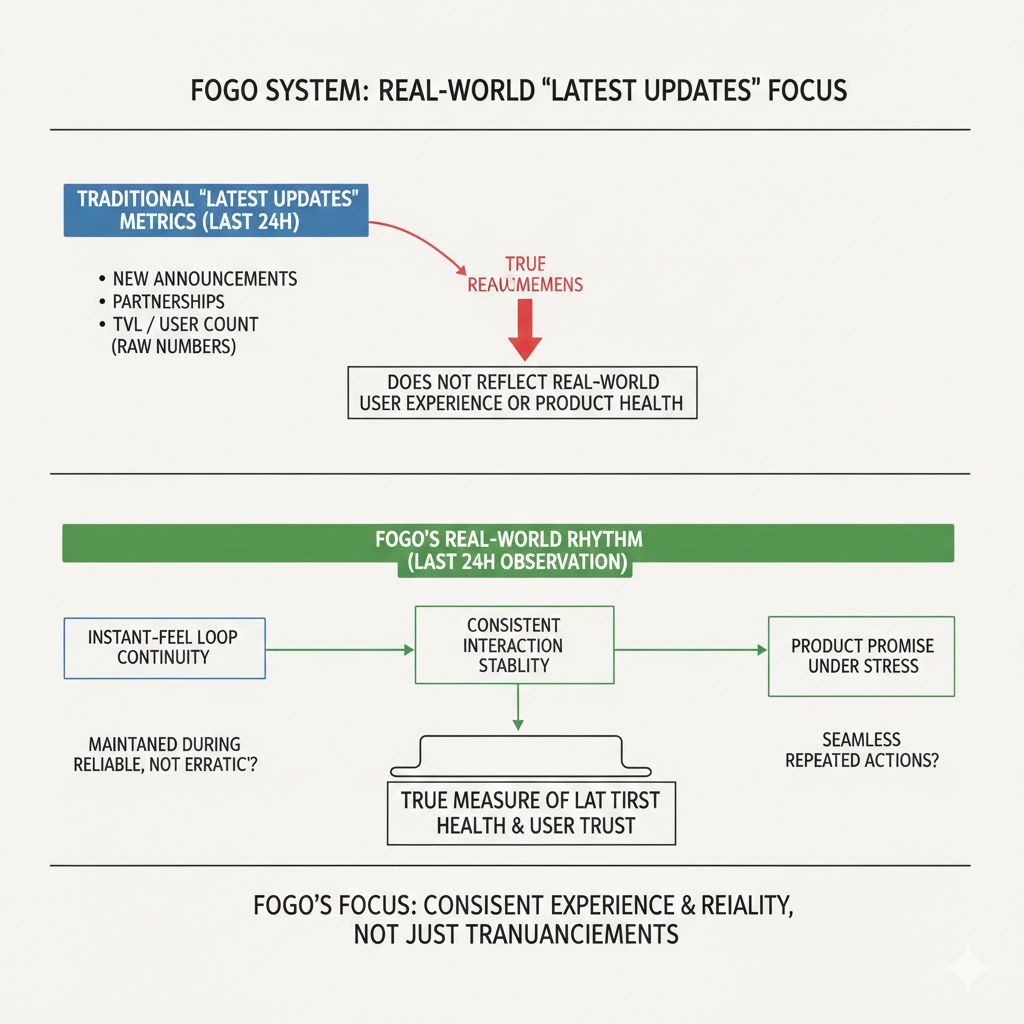
To achieve a clear and focused observation style regarding the last 24 hours within this article, it is essential to emphasise that the primary daily assessment revolves around whether Fogo successfully maintained its instant-feel loop during heightened activity periods. Additionally, it is crucial to evaluate whether interactions remained consistent rather than erratic, whether the system exhibited sufficient stability to facilitate repeated actions seamlessly, and whether the chain's responsiveness continued to convey a sense of reliability.
If Fogo genuinely prioritises low-latency reliability, then the standout feature is not a singular dApp or function; rather, it is the ability to develop entire product categories that were previously deemed unfeasible on-chain, now capable of functioning smoothly and without interruption. Users will no longer be acutely aware of waiting on infrastructure, and this inherent advantage thrives without the need for excessive promotion, as it becomes an experience users can appreciate from their first interaction and a foundation for developers to innovate upon once they shift from a defensive design mindset.