
Yesterday, something happened that should have stopped everyone in their tracks.
Brazil’s Congress reintroduced a bill to acquire 1,000,000 Bitcoin as a national strategic reserve.
Not 1,000 Bitcoin. Not 10,000.
One million.
At today’s price near $68,000, that’s about $68 billion worth of Bitcoin from one country over five years. Let that sink in.
While most people are watching charts and arguing about whether Bitcoin is dead, something much bigger is happening quietly.
Governments are starting to compete to buy Bitcoin.
If even part of these proposals pass, the Bitcoin you hold or plan to buy will compete with sovereign nations for supply.
This is not speculation. It is happening right now.
First, Understand What This Bill Actually Says
On February 9, 2026, Brazilian Federal Deputy Luiz Gastão introduced Substitute Bill No. 1 under PL 4501/2024.
The bill called the Strategic Sovereign Bitcoin Reserve (RESBit) proposes:
Gradual acquisition of up to 1,000,000 BTC over five years
Management by Brazil’s central bank and Ministry of Finance
Seized Bitcoin cannot be sold,it remains in the reserve
Incentives for public companies to mine and store Bitcoin
Federal taxes may be collected in Bitcoin
Bitcoin can serve as collateral for Drex (Brazil’s CBDC)
Semi-annual transparency reports
Legal protection for self-custody and transaction privacy
This is not vague. It is a structured national framework. And Brazil is not alone.
The Countries Already in This Race
Here is what is happening around the world right now, in the past few months alone:
El Salvador: holds over 7,560 BTC and continues to accumulate.
United States: The BITCOIN Act of 2025 proposes purchasing 1 million BTC over five years. Several states are also exploring holding Bitcoin in public funds.
Philippines: House Bill 421 proposes building a 10,000 BTC reserve.
Czech Republic: The central bank is evaluating allocating up to 5% of its reserves to Bitcoin.
Germany and France have also introduced pro-Bitcoin discussions and proposals. These are not small economies experimenting.
These are major countries debating Bitcoin as a reserve asset.
Why Is This Happening Now?
To understand why governments are suddenly racing toward Bitcoin, you need to understand the problem they’re all trying to solve.
Every country holds foreign reserves usually U.S. dollars, gold, and government bonds. These reserves stabilize currencies and protect against crises.
For decades, the U.S. dollar dominated. But three things changed.
1. Dollar Freezing Risk
In 2022, the U.S. froze $300 billion of Russia’s reserves. That showed the world something important: If your reserves are held in another country’s system, they can be frozen.
Countries began asking: What asset cannot be seized by another government?
2. Money Printing and Inflation
Since 2020, trillions of dollars were created. Countries holding dollar reserves saw purchasing power decline. Gold helps, but gold is heavy, slow to transfer, and expensive to store.
Bitcoin is digital, transferable, and cannot be inflated beyond 21 million coins.
3. Fixed Supply
Only 21 million Bitcoin will ever exist. About 19.8 million are mined. An estimated 3–4 million are permanently lost. That leaves roughly 15–16 million accessible.
Brazil wants 1 million. The U.S. proposal suggests another 1 million.
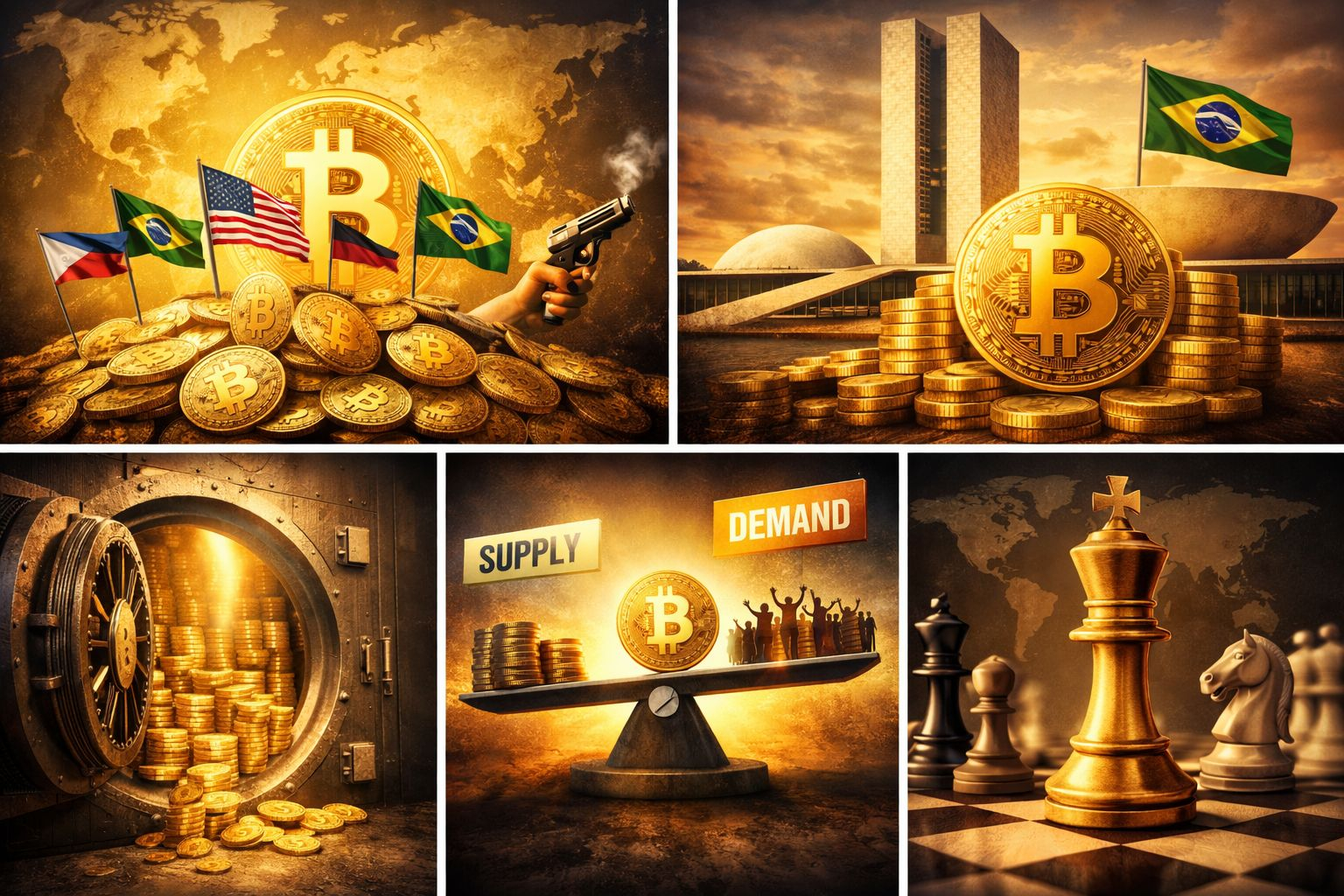
There are not enough Bitcoin for every country to build a large reserve. And governments understand this.

The Game Theory That Changes Everything
If you are a finance minister watching this happen, you think differently.
If several countries begin buying at scale, supply tightens.
If supply tightens, price rises.
If price rises, late buyers pay much more.
That creates one clear incentive:
Move early or pay later.
This is not just finance. It is strategy.
Bitcoin is becoming a geopolitical asset.
What This Means for Supply
Roughly 7–8 million Bitcoin are considered liquid and actively tradeable.
If the U.S. and Brazil each bought even half of their proposed targets, that could remove about 1 million BTC from circulation. That’s over 10% of liquid supply.
Basic economics: same demand, dramatically reduced supply.
You don’t need a finance degree to understand what that does to price.
The Current Contradiction
Bitcoin is currently trading near $68,000. Down roughly 35% from its all-time high above $100,000.
Crypto Twitter is calling it a bear market. Articles are being written about the “death of the bull run.” Retail investors are panic-selling.
And meanwhile, Brazil just proposed buying a million Bitcoin at $68,000. Let that contradiction land.
A sovereign nation with a $2 trillion economy, professional economists, and access to global financial intelligence looked at Bitcoin at $68,000 and said: “We want a million of these. Now.”
If Bitcoin at $68,000 was a bad deal, Brazil’s government economists would know that better than any retail trader on Crypto Twitter.
They didn’t propose a million Bitcoin because they think it’s going lower. They proposed it because they think that in 10, 20, 30 years, they’ll wish they’d bought even more.
What Could Go Wrong
Let’s be realistic.
Brazil’s bill may not pass.
The U.S. proposal may stall.
Governments could reverse course.
Purchases would happen gradually over five years.
Market timing is uncertain.
None of this is guaranteed, But the risk of ignoring this and being wrong is watching sovereign nations accumulate Bitcoin for decades while you waited for a lower price that never came.
The Question This Raises For You
I’m not going to tell you to buy Bitcoin. That’s your decision, with your money, based on your risk tolerance and financial situation.
But I want to ask you one honest question:
If a $2 trillion economy proposes spending $68 billion on Bitcoin at today’s price, what does that tell you?
Retail sees: “Bitcoin is down 35%, maybe I should sell.”
Sovereign governments see: “Bitcoin is 35% cheaper than it was three months ago. Buy more.”
One of these perspectives is backed by decades of financial expertise, access to global intelligence, and multi-generational time horizons.
The other is backed by anxiety, social media, and 15-minute candles.
In Summary
Brazil proposed buying 1 million Bitcoin.
The United States, the Philippines, Czech Republic, and others are evaluating similar strategies.
This is no longer just a crypto story, It is a monetary policy story, A geopolitical story.
Only 21 million Bitcoin will ever exist. Nations are starting to compete for them.
And if even part of these proposals move forward, supply dynamics change permanently.
The race may already have begun.
Thank you for reading, Happy Valentine Day ❤️