


Looking at why certain chains silently build up and others yell, I always eventually go back to a single un-glamorous fact: metadata propagation, rather than TVL, trending hashtags, and media buzz, are what the process of adoption is often initiated by. It begins by making a chain ubiquitous now that developers are working everywhere - in wallets, SDKs, and infra tools.
Chain Registries Chain Registries are the EVM Adoption DNS.
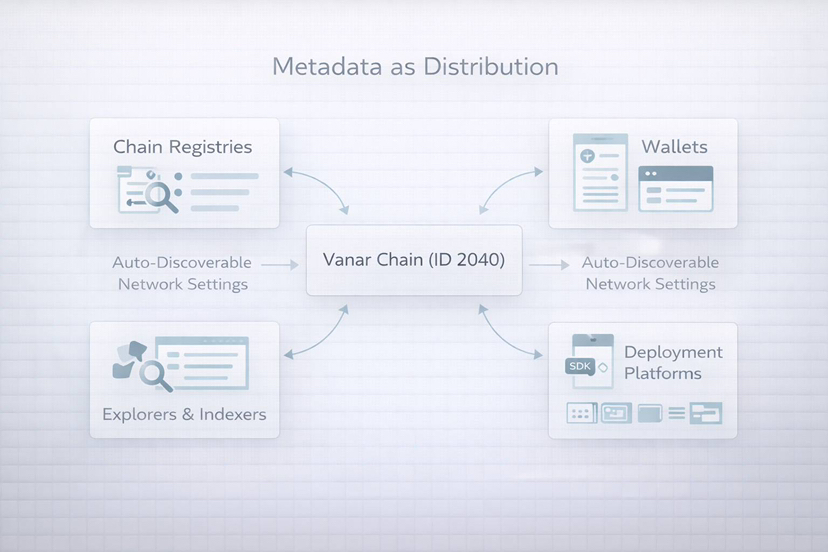
I envision chain registries such as the crypto DNS. Once a chain is accessible with the right Chain ID and RPC endpoints as well as an explorer link and native currency information established, it can be accessible to the entire ecosystem.
Vanar has constant identities on major registries. Chain ID 2040 is the mainnet with active status and VANRY token and its official explorer. Vanguard, the testnet, has its Chain ID 78600, explorer and RPC list.
This is important since developers do not want to rely on a PDF to do network settings. They would like the automatic access to the settings wherever the other chains are already in use.
Add Network is not a Convenience feature it is a Distribution Channel.
The majority of individuals think that the network addition to MetaMask is only a user-experience process, but I consider it an acquisition channel.
The process of wallet-onboarding is expressly documented by Vanar: just add the network to an EVM wallet and you can now use the mainnet or the testnet. The same simplicity slices off a big dead-end - the point at which developers need to enter settings manually and choose which RPC to use, and hope that they have not pasted an evil URL.
The network information is shown as a developer product - one reference page that is supposed to be looked into when developing or integrating. It carries the message of we would want you to ship but not to read.
thirdweb Listing Makes Chains Plug and Play Infrastructure.
As of 2026, the distribution will not be restricted to wallet lists, deployment platforms are also a significant factor.
A chain deployed on thirdweb comes with a complete set of developer workflows: deployment flows, templates, dashboards and RPC routing. The thirdweb chain page dedicated to Vanar presents the Chain ID of 2040, native token details, which is a default thirdweb RPC endpoint, the explorer address.
That is important as it transforms the behavior of builders. They need no longer make decisions on whether to make Vanar a special project; they can just treat it as any other EVM chain that is already within their tool-kit. That puts the chain out of a niche subject into a casually shipable chain by the developers.
The idea of the wider chainlist as espoused by thirdweb further confirms the fact that the contemporary EVM development is registry based. Chains are made to be a choice in the tooling uncertainty, and they are no longer bespoke integrations.
The details of the mainnet and Vanguard testnet can be found in the documentation provided by Vanar. It releases all the requirements to communicate with either of the networks.
Similar key information, Chain ID 2040 and RPC URLs are echoed by independent network-setups that enforce the metadata uniformity across the internet.
That echo matters. The more locations we display network data, the less there are places of failure in the learning process of connection. It also minimizes chances of users being victims of counterfeit RPC links since they are able to cross-verify settings.
How Chains Earn Builder Time It is testnet Presence.
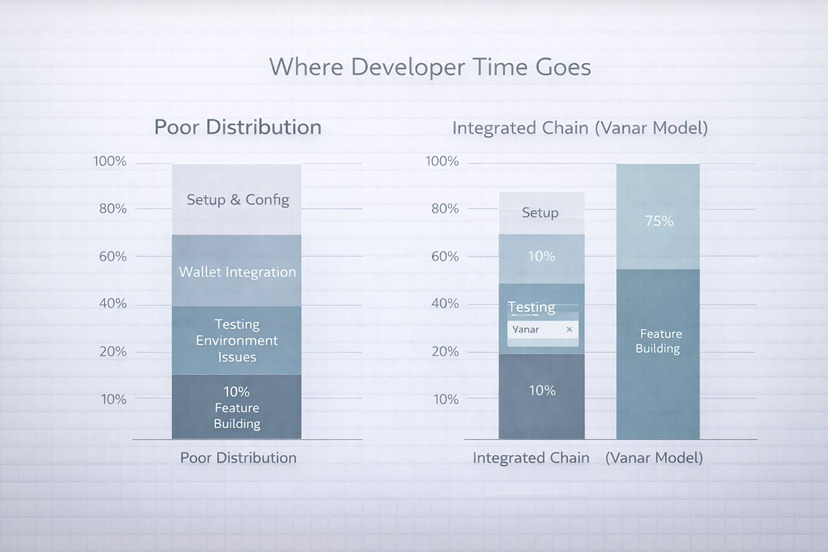
A chain receives adoption by gaining developer time. The biggest part of that time is dedicated to testnets by developers.
The publicly listed Vanguard testnet by Vanar has Chain ID 78600, explorer, and RPC. This allows teams to do serious work such as simulate, break things without harm and iterate.
This matters since the story of Vanar is dealing with the topic of never-ending applications, business processes, and agents, permanently interacting. Those systems require a series of test cycles, thus the testnet is not a check box view but the runway where the actual apps are developed.
Operator Documentation: The Lost Half of Growing an Ecosystem.
Ecosystems do not just scale developers, there is scaling of the network by operators.
As a network gets larger, you require additional providers of RPC, additional indexers, additional monitoring, and additional redundancy. It is infrastructure growth and not community growth.
Vanar consists of RPC node configuration notes, and frames these nodes as necessary components of network communication and interaction. This implicitly welcomes a second generation of participants, infra teams not creating dApps but serving builders.
The Distribution Thesis: The Compounds of Adoption When the Support Becomes Default.
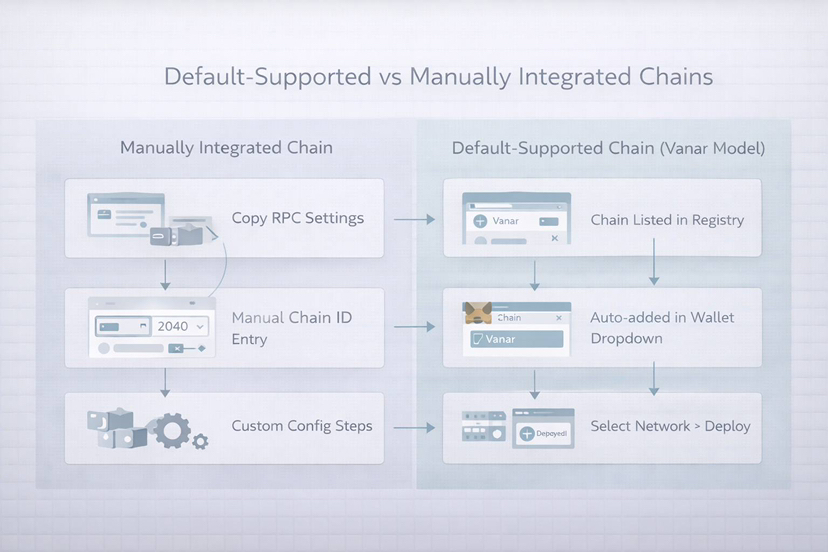
This is the mental model that I have now regarding Vanar.
Vanar performs much of these boring operations in front of people and that is why I consider its distribution so seriously. Chain ID registries verify the core identity (2040 mainnet). It is made visible to other EVM chains through tooling platforms and thus it is not exotically foreign. The formal documentation is made like a product which requires builders to hurry.
The Importance of This More than any Single Feature
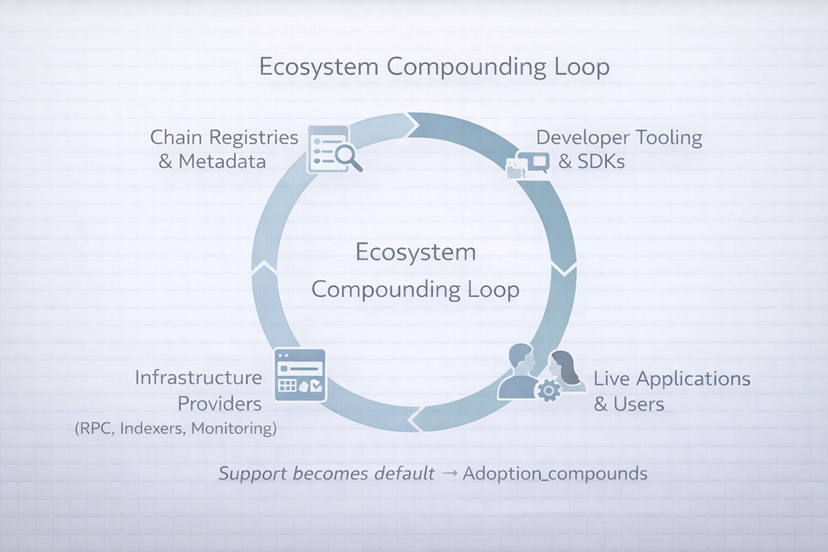
Features fade fast. Economies of distribution are lasting.
A new VM feature can be copied. A novel story can be tested out of the market.
However, a chain integrating into the routine of developers and infra teams forms a moat, which is difficult to duplicate. It is not a single integration, but it is hundreds of little this just works.
As soon as it becomes easy to try, adoption is a numbers game - a compounding game.