
Brothers, let's talk about high-performance L1 in the crypto circle. Can we stop being manipulated by the number 'TPS'? Nowadays, no matter what project it is, as soon as it comes out, they boast about how high their TPS is, printing hundreds or thousands on their posters, and dare to call themselves the 'fastest public chain'. But when it comes to our actual transactions, it all falls apart! To put it bluntly, TPS is just a 'facade', it looks good but is not practical at all. What really affects whether our transactions are smooth or stable is not this number but three more concrete things—delay stability, execution reliability, and transaction fairness.
Let's talk about the most practical aspect: when you usually make on-chain transactions, whether it's a regular transfer, engaging in perpetual contracts, or high-frequency trading, what are you most afraid of? It's definitely not 'being a little slow', but 'sudden fluctuations' and 'suddenly freezing'! Many public chains boast about their low average latency, but once the market surges or plummets and traffic becomes dense, the latency doubles and skyrockets. Your submitted orders either get stuck for a long time without a response or repeatedly fail. The more anxious you feel, the more you retry, and the system becomes more unresponsive. In the end, you either miss the best market conditions or incur significant losses. This is the trap of solely focusing on TPS!
Those who truly understand the industry know that to measure the quality of a transactional public chain, it’s not about peak TPS, but rather the latency distribution during peak periods, especially whether the two numbers, P95 and P99, can be stabilized. What does this mean? Simply put, it refers to whether this chain can maintain stability during the most chaotic times when there are the most people, allowing each of your transactions to be smoothly submitted and quickly confirmed without significant fluctuations. Fogo has done particularly well in this regard; it has not followed the trend of boosting TPS data but has instead focused all its energy on 'stability', which is a truly pragmatic project that considers users!
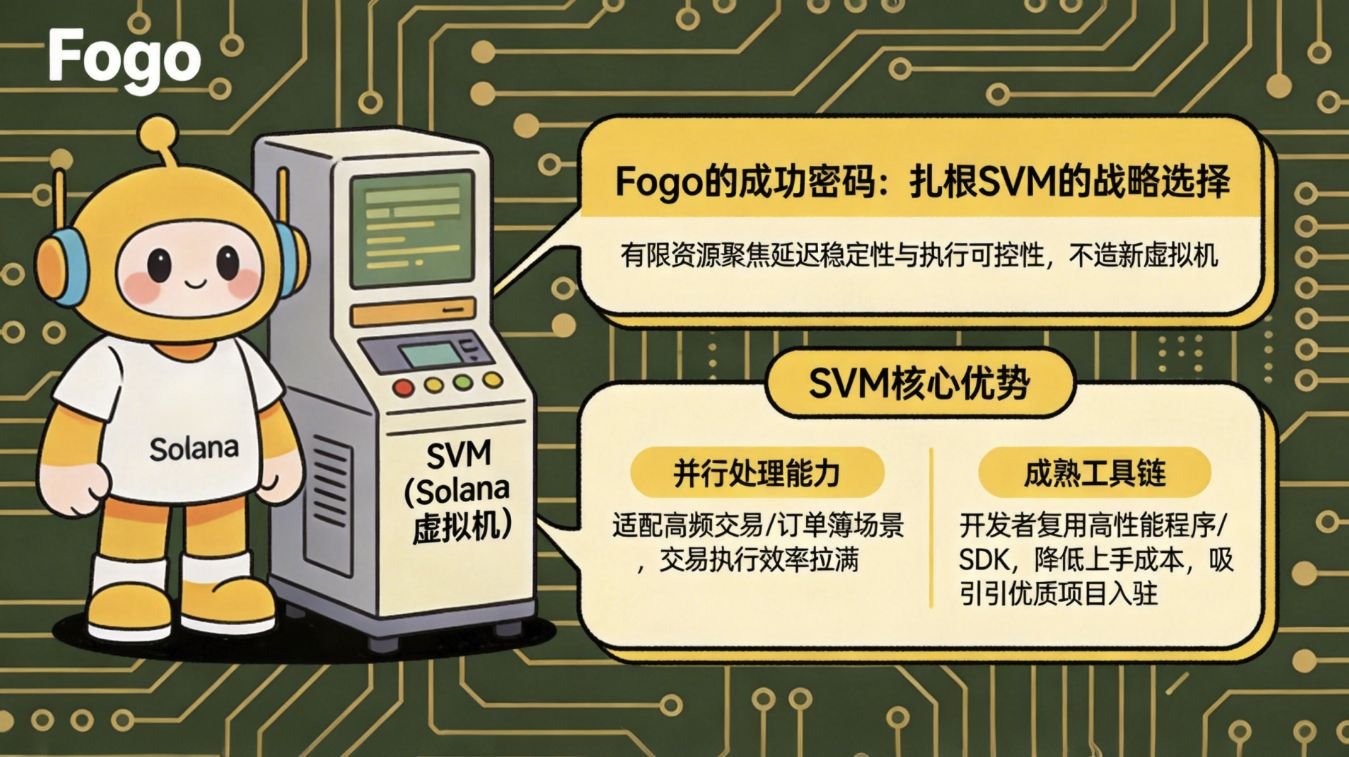
The smartest thing about Fogo is that it chose the right path—directly rooted in SVM (Solana Virtual Machine), rather than engaging in 'innovation' to create a new virtual machine. Instead, it poured its limited engineering resources entirely into latency stability and controlled execution. Some may ask, what are the advantages of choosing SVM? There are many! Firstly, SVM has particularly strong parallel processing capabilities, perfectly suited for high-frequency trading and order book scenarios that require high speed and stability, maximizing transaction execution efficiency. Secondly, the SVM toolchain is particularly mature, allowing developers not to start from scratch; many ready-made high-performance programs and SDKs can be reused directly, which lowers the entry cost for developers and attracts quality projects more quickly, gradually building the ecosystem.
What's even more rare is that Fogo has taken 'executing predictability' to the extreme, which is a shortcoming for many public chains! We all know that in high-concurrency scenarios, many public chains experience a large number of transaction failures and rollbacks. One transaction failure is manageable, but if it involves scenarios like order books or real-time auctions, one failure can trigger a chain reaction—orders get canceled without notice, the market is swept away, slippage increases, and ultimately the entire trading experience collapses. Fogo has specifically optimized for this issue, ensuring that even during peak traffic and chaotic market conditions, it can minimize transaction failures and rollbacks, allowing every transaction to be executed as expected, whether for ordinary users or professional traders, enabling them to trade with confidence.
In addition, Fogo places a special emphasis on trading fairness, which is also a major concern for many ordinary users! In the cryptocurrency space, there are quite a few bots that leverage speed advantages to trade first and earn profit margins, leaving ordinary users with no chance and feeling like they are being harvested like leeks, gradually losing confidence in on-chain trading. Fogo has long thought about this; it has specifically optimized the matching rules based on low latency, limiting those speed advantages, ensuring transparency and predictability in the matching rules, allowing ordinary users and professional traders to compete in the same fair environment without worrying about being harvested by bots.
In fact, determining whether a transactional public chain is reliable does not require looking at how fancy its promotional materials are; just focus on three quantifiable points: first, the latency distribution under high load, especially the performance of P95 and P99; second, the transaction failure rate and retry rate during congestion—will there be a large number of rollbacks; third, the long-term stability in high-frequency scenarios, whether order books, market-making, and perpetual contracts can continue to operate stably. Fogo has made significant efforts in these three areas, gradually achieving the utmost in 'stability'.
The cryptocurrency space has always liked the narrative of 'universality', boasting various grand concepts and using beautiful data to deceive people. However, trading systems have never cared about these superficialities; they only speak one word—'stability'! Fogo has not followed the trend of speculation or exaggerated its promotion, but instead focused on truly converting SVM's parallel advantages into 'stable and predictable execution capabilities under high pressure'. It is not merely a fast chain that刷海报, but a practical public chain that can genuinely address user pain points and support the development of on-chain finance.
I believe that as the cryptocurrency space matures, projects that rely solely on beautiful data and hype will eventually be abandoned by users and liquidity. In contrast, practical projects like Fogo that focus on solving actual problems and engrave 'stability' into their core will undoubtedly stand out. For ordinary users and developers, such projects are truly valuable in the long term, worthy of our attention and expectations. They will also become one of the most reliable and practical answers in the foundation of on-chain financial infrastructure!