
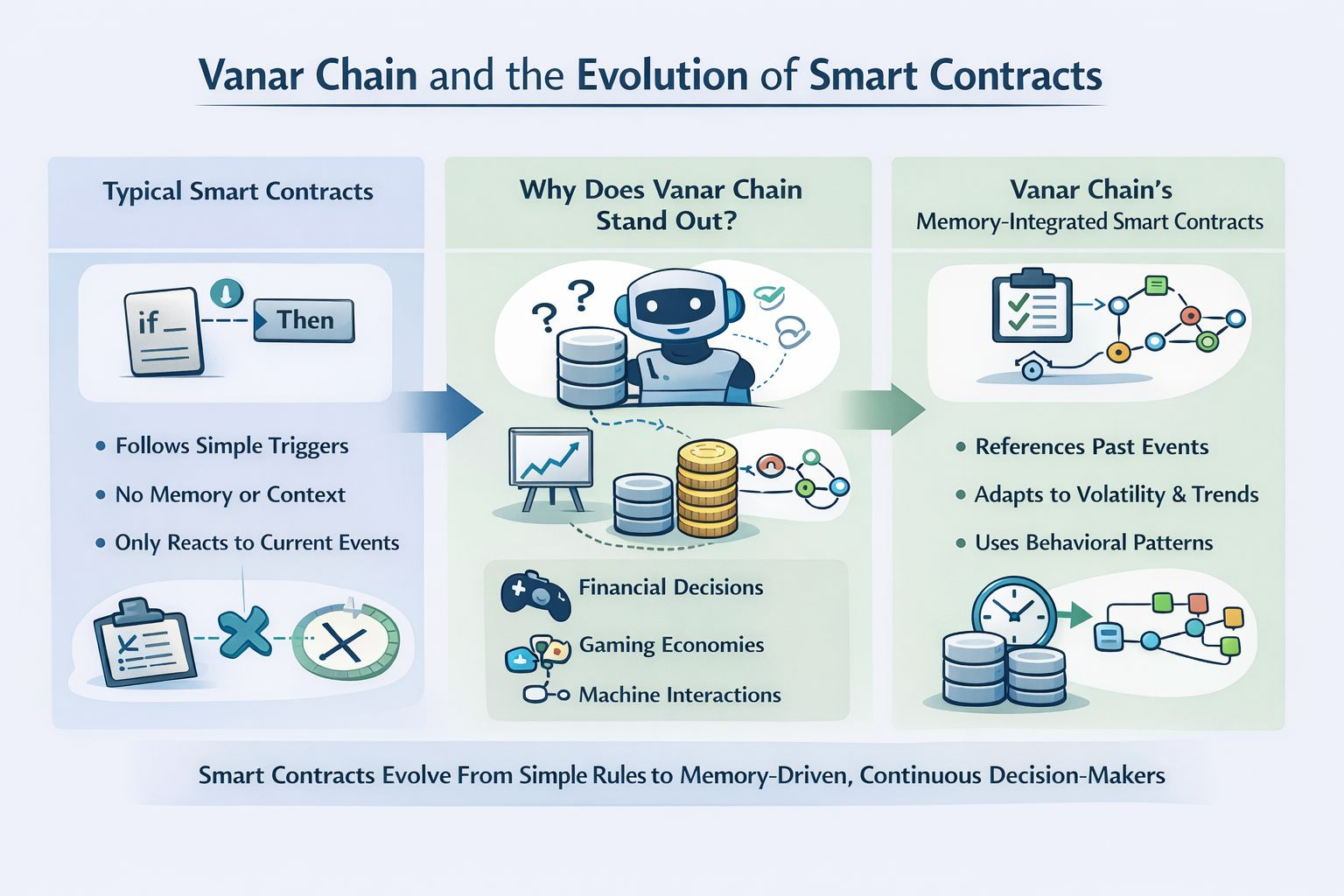
When I first got into smart contracts years back, their simplicity was the appeal. One condition triggers one action. No second-guessing, no gray areas. It was precise and predictable. But lately, that same simplicity has started to feel limiting for the kinds of systems we’re trying to build now.
What drew my attention to Vanar Chain wasn’t hype or branding, but where it currently sits in practice. With validator participation in the low hundreds, the network is clearly early-stage, yet far beyond experimental. It’s running in real conditions. More than forty ecosystem deployments are already live, which signals something important: developers aren’t just sketching ideas around AI-driven flows. They’re testing them where mistakes cost money, not just reputation.
That matters because the broader market is already filling up with autonomous agents. Trading bots are executing strategies across chains. Liquidity managers rebalance positions without human oversight. Yet most of these systems still operate with shallow memory. They react to signals, not histories.
Traditional smart contracts are rigid by design. They follow predefined triggers without awareness of context. Price drops ten percent, liquidate. Threshold crossed, execute. It works, but it’s blind. A more cognitive model introduces memory into that logic. Instead of reacting to a single event, the system can reference prior states, past decisions, and behavioral patterns. Volatility over time starts to matter. Wallet behavior trends become inputs. The contract doesn’t just follow rules; it adapts its interpretation of them.
Vanar Chain appears to be anchoring this state directly at the protocol layer rather than outsourcing memory to off-chain systems. That design choice creates something new: decisions that can be inspected later, not just outcomes that appear on a ledger. It also introduces real challenges. Persistent memory increases storage demands and widens the attack surface. With validator counts still limited, scaling this safely won’t be trivial.
Still, if this direction holds, the shift is structural. Contracts stop behaving like static scripts and begin acting more like participants with continuity. At that point, the chain itself stops being just a record of transactions and starts to resemble a cognitive base layer where logic doesn’t just execute — it remembers.$VANRY @Vanarchain #vanar