For months, analysts have been debating one big question:
Is Russia’s economy entering a “death zone” — or transforming under pressure?
The reality isn’t black and white. It’s a high-risk transition phase.
The Pressure Points
Since the escalation of the conflict in Ukraine, Russia shifted into a wartime economic model. On the surface, GDP numbers held up. Underneath, structural stress is building.
1️⃣ High Interest Rates
The Central Bank of Russia pushed rates to extremely elevated levels to defend the ruble and contain inflation.
That stabilizes the currency — but crushes business expansion and mortgage growth.
2️⃣ Labor Shortage
Military mobilization and emigration have reduced workforce availability. Many industries face hiring pressure, pushing wages higher but squeezing productivity.
3️⃣ Budget Imbalance
A significant share of federal spending is now directed toward defense and security. That means fewer resources for civilian sectors like healthcare, education, and long-term development.
4️⃣ Inflation Pressure
War-driven spending and supply constraints create upward price pressure. Controlling inflation while maintaining industrial output is becoming increasingly difficult.
This isn’t a sudden collapse. It’s more like economic compression.
But There’s Another Side
History shows that crisis economies sometimes adapt in unexpected ways.
1️⃣ Forced Industrial Substitution
Sanctions reduced imports from the West. That triggered domestic production growth in key sectors.
Expansion of local manufacturing
Infrastructure pivot toward Asian markets
Energy trade diversification
Long-term infrastructure projects linking Russia more deeply with Asian economies could reshape trade flows for decades.
2️⃣ Financial Structure
Despite sanctions, Russia maintains:
A relatively low debt-to-GDP ratio compared to many Western nations
Ongoing oil and commodity revenues
Acceleration toward alternative payment systems and digital financial rails
High rates are painful — but they signal aggressive currency defense rather than passive decline.
3️⃣ Human Capital Shift
Labor shortages are driving wage increases in certain sectors.
Military R&D investment is strengthening engineering and technical training capacity.
The key question is whether that expertise can eventually pivot into:
Civilian aerospace
Heavy industry
Energy innovation
Advanced manufacturing
The Real Crossroads
If the conflict stabilizes or moves toward diplomatic de-escalation, Russia could redirect wartime industrial capacity toward civilian growth.
If not, prolonged military expenditure risks long-term structural damage.
This isn’t simply a “death zone.”
It’s a stress test.
The outcome depends less on headlines — .”
It’s a stress test.
The outcome depends less on headlines — and more on how efficiently wartime production transitions into sustainable civilian productivity.
Markets don’t reward emotion.
They reward adaptation.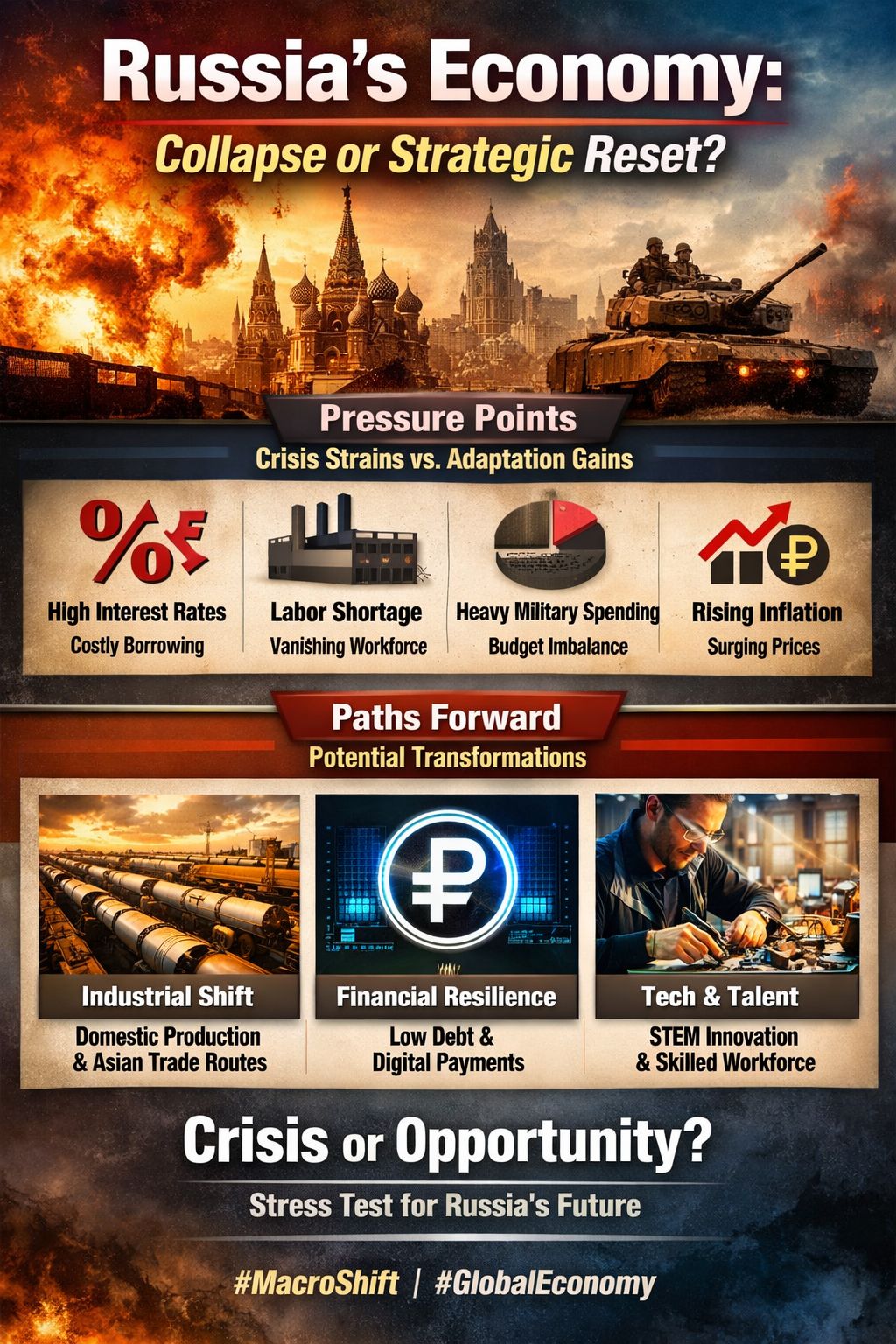
#MarketRebound #MacroShift #GlobalEconomy #TradeSmart