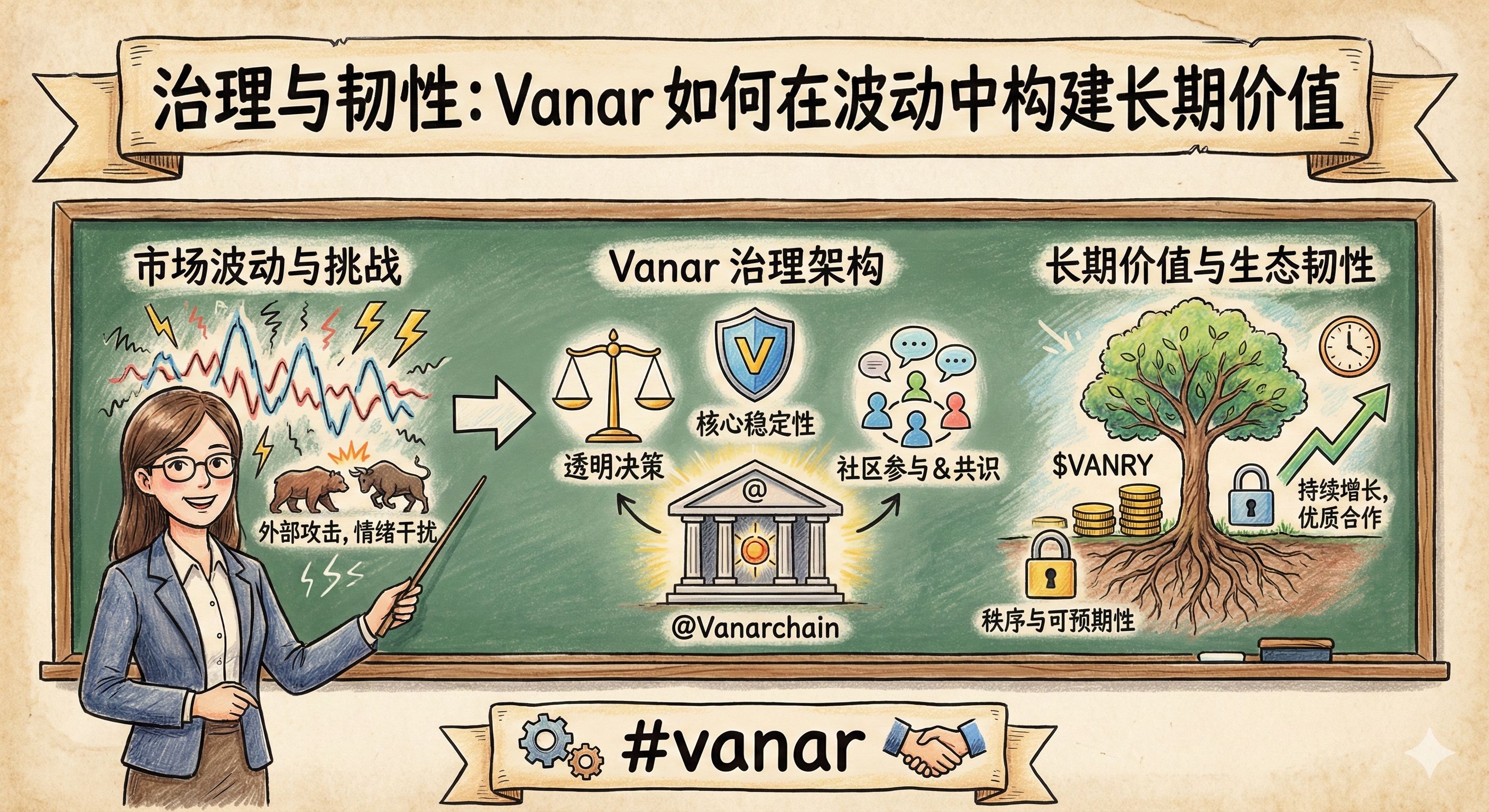
Evaluating the long-term potential of a public blockchain requires not only examining its technical architecture and application ecosystem but also assessing its self-repair capabilities in uncertain environments. Market fluctuations, external attacks, and changes in developers are all real factors that test the stability of the chain.
I observe @Vanarchain and am more concerned about its governance design. Can the network quickly reach a consensus when facing disagreements? Are key decisions transparent? Are the node and community participation mechanisms effective? These seemingly abstract rules determine whether the chain can maintain its rhythm in the face of sudden events, rather than being swayed by emotions and short-term market fluctuations.
Vanar's governance structure allows the community to have substantial say on-chain while retaining the stability of core nodes. This balance means that the network will not be paralyzed by single-point shocks and can maintain continuity during strategic adjustments. For developers, this resilience is extremely important—stable rules mean that application logic can run long-term without worrying about frequent disruptive changes in the underlying layers.
$VANRY 's value can also be understood from this perspective. It not only reflects asset flow and ecological activity but also refracts the network's ability to maintain order and predictability under pressure. While short-term market sentiment can amplify volatility, a chain with solid governance mechanisms is more likely to form real value in the long run.
Additionally, the clarity of governance also affects external cooperation and resource attractiveness. Partners and developers, when entering a network, not only look at technology and user numbers but also consider whether the rules are stable and the decision-making predictable. Vanar's governance design gives it an advantage in attracting quality participants in the long term, which is a core source of ecological resilience.
In summary, Vanar's long-term value does not rely on short-term hype or superficial applications, but on whether the network can maintain stability and self-regulation in changing environments. Governance mechanisms and resilience are the key dimensions by which I judge whether it can withstand the test of time.