
When i first looked at vanar chain, I used to tune out most blockchain pitches because they all hit the same notes. Faster transactions. Cheaper fees. Bigger validator sets. After a while it all blends into background noise—you skim, give a polite nod, and keep scrolling.
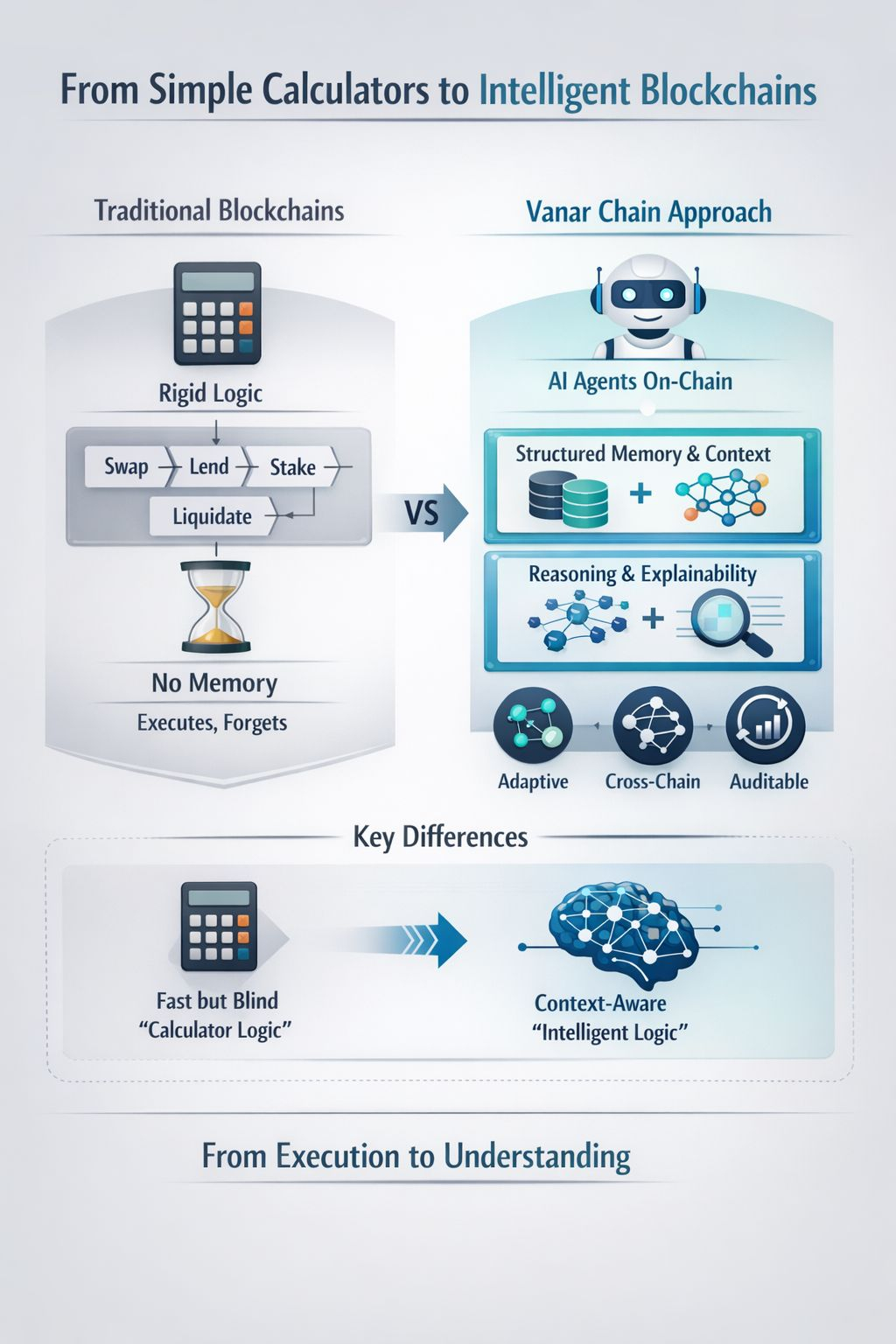
Most blockchains today behave like ultra-fast calculators. You give them inputs, they execute rigid logic, and they move on. The process is clean, predictable, and reliable — but it’s also blind to context. Smart contracts don’t remember yesterday unless a developer forces memory into the design, and even then, it feels artificial. Real systems don’t work that way. They accumulate history, adapt to patterns, and operate with context.
This is the gap Vanar Chain is trying to address. The core network still focuses on fundamentals: security, validators, and consensus. But its deeper architecture is built around the idea that future on-chain activity won’t just come from human users. AI agents are increasingly likely to act directly on blockchains, managing capital, executing workflows, and reacting to changing conditions. That requires more than storage. It requires structured memory and context that can be reasoned over inside the system itself.
Instead of treating “on-chain AI reasoning” as a flashy add-on, Vanar frames it as infrastructure. Components designed for structured data and explainable reasoning point toward blockchains becoming environments where decisions can be traced, audited, and understood. In a space that has already suffered from opaque systems and cascading failures, explainability isn’t a luxury — it’s a requirement.
The tradeoff is obvious. More intelligence at the infrastructure level means more complexity. More complexity widens the attack surface. If reasoning mechanisms fail or are manipulated, the impact doesn’t stay isolated. It spreads across applications that depend on them. But the timing of this shift reflects where the ecosystem is heading. AI-driven crypto narratives are expanding fast, yet most projects simply bolt AI onto existing chains instead of rethinking the base layer.
Vanar’s design assumes AI agents will become first-class participants on-chain. That changes priorities. Memory becomes foundational. Context matters as much as throughput. And cross-network expansion becomes necessary, because intelligent systems don’t operate in silos.
Whether this model succeeds depends on real usage, not diagrams or promises. If AI-driven applications are actively running on the network by 2026, the architecture will have proven its relevance. If not, it may feel ahead of its time. Either way, the direction is clear: blockchains are slowly shifting from pure execution engines into infrastructure that understands what it is processing.$VANRY @Vanarchain #vanar