

When I started researching modern blockchains, I realized something very simple but very important. No matter how advanced the code becomes, the internet still follows the laws of physics. Data cannot travel faster than light. Messages between continents take real time. And in blockchains, every validator has to hear, verify, and vote before a block becomes final. That is where the real delay comes from.
In my search, I started to know about two main problems that keep appearing again and again. The first is latency. The second is tail performance, which means the slowest validators decide the real speed of the network, not the fastest ones. Even if most validators are powerful, if a few are slow, the entire system waits for them. They become the bottleneck. So average speed does not matter. Worst-case performance matters.
I researched how internet signals move through fiber cables at about two-thirds the speed of light. That means even in perfect conditions, sending data across the world takes close to 100 milliseconds one way. And consensus needs multiple message exchanges. So I understood that blockchains are not only software systems. They are physical systems running on a planet-sized network.
That is where Fogo becomes necessary.
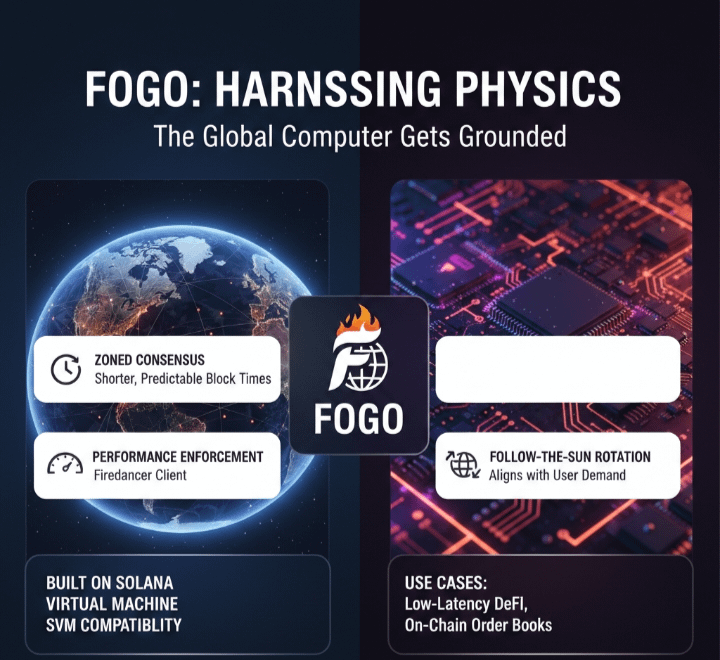
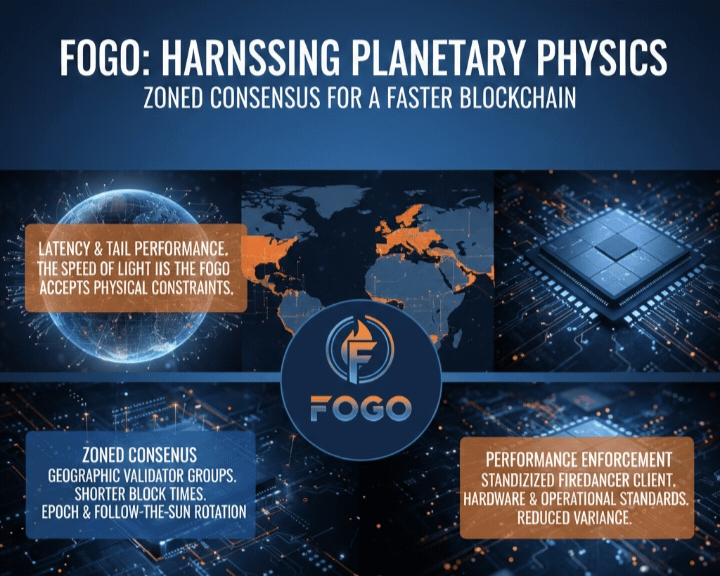
Fogo is a high-performance Layer 1 blockchain built on the Solana Virtual Machine. But what makes it different is that it does not ignore physical space. It accepts it. Fogo introduces zoned consensus. Instead of having all validators spread globally participating at the same time, validators are grouped into geographic zones. Only one zone actively participates in consensus during an epoch. This reduces the physical distance that messages must travel. When validators are close together, block times become shorter and more predictable.
I found this idea very practical. Instead of fighting physics, Fogo works with it.
Another important thing I learned is performance enforcement. Many blockchains allow different client implementations. That sounds decentralized, but in practice it creates variance. Some clients are slower. Some hardware is weaker. They become the slowest links. Fogo standardizes on a high-performance Firedancer-based client. It will have strict performance requirements. Validators must meet hardware and operational standards. This reduces variance and improves consistency.
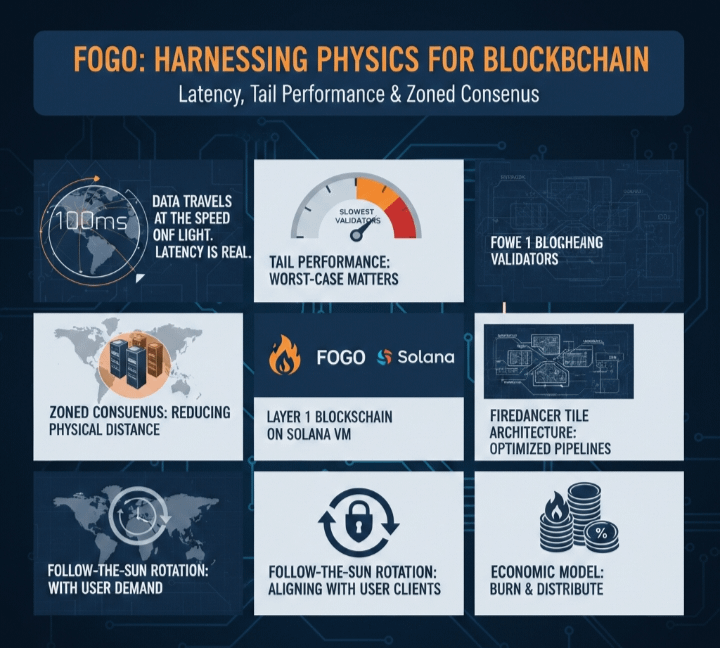
When I looked deeper into the architecture, I saw that Fogo keeps Solana compatibility. It uses Proof of History, Tower BFT, Turbine propagation, and the Solana Virtual Machine. That means developers can migrate their existing Solana programs without rewriting code. I researched that tools like Solana CLI and Anchor work the same way on Fogo. This makes adoption easier.
The leader schedule is stake-weighted and deterministic. Validators rotate block production responsibilities based on stake. Tower BFT works through vote lockouts. As validators vote on blocks, they lock into that chain with increasing commitment. Once two-thirds of stake confirms a block, it becomes confirmed, and after enough confirmations, it becomes finalized.
The zoned model also has rotation strategies. In my search, I found that Fogo supports epoch-based rotation and something called follow-the-sun rotation. That means consensus activity can shift geographically throughout the day. It will have active zones during peak hours in different regions. This is a very interesting idea because it aligns physical proximity with user demand.
Then I studied the Firedancer tile architecture. Instead of running one large monolithic process, the validator is split into independent tiles. Each tile runs on a dedicated CPU core. They handle networking, verification, deduplication, execution, block packing, storage, and Proof of History. Data moves through shared memory without copying. This zero-copy design reduces overhead. They become highly optimized pipelines instead of general-purpose software.
From an economic perspective, Fogo has a balanced design. Half of the base transaction fee is burned, and half goes to validators. Priority fees go fully to block producers. It also implements a rent model, where accounts pay for storage. Part of the rent is burned and part is distributed. This discourages unnecessary state growth.
Fogo mainnet operates with a fixed 2 percent annual inflation rate. Newly minted tokens go to validators and stakers. Validators set a commission rate, and delegators receive rewards based on performance. If a validator earns more vote credits, it will have higher rewards. This aligns incentives around uptime and correctness.
For developers, Fogo will have full SVM compatibility. That means Solana programs can migrate easily. Tooling remains familiar. This reduces friction and lowers barriers for builders. I see this as one of Fogo’s strongest advantages.
Strategically, Fogo may win in areas that require predictable, ultra-low latency. On-chain order books, perpetual futures, auction systems, and time-sensitive DeFi protocols need consistency. Proximity engineering matters in financial markets. By reducing network distance and enforcing performance, Fogo aims to make on-chain trading more competitive with centralized systems.
But I also see risks. If zones are too small, security could weaken. If hardware requirements are too high, decentralization may reduce. Geographic clustering might introduce regulatory risks. These are real questions that will shape its long-term sustainability.
In conclusion, after researching deeply, I believe Fogo is necessary because it addresses what many chains ignore: physics and variance. Instead of chasing theoretical improvements, it optimizes the real-world constraints of distributed systems. Whether it succeeds will depend on execution, governance, and adoption. But the idea of designing a blockchain that respects physical space and enforces performance is a meaningful step forward.
If blockchains are global computers, then Fogo is trying to make that computer aware of the planet it runs on.