
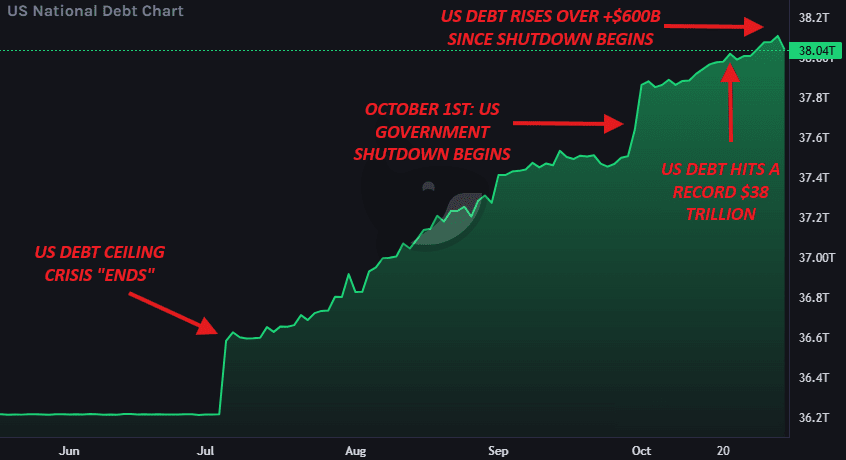
Officially: the U.S. government shutdown, which began on October 1, has now entered its 35th day — becoming the longest continuous shutdown in U.S. history, surpassing the record of 34 days from 2018–2019.
But while most government agencies have not yet been funded and have temporarily ceased operations, there is one part that continues to operate non-stop: borrowing.
Since the shutdown began, the U.S. government has borrowed an additional $600 billion in new debt.
On average, that is about 17 billion USD each day. Here’s why.
❍ How can the government still borrow money when it is 'shut down'?
This is the central paradox of this crisis.
The term 'shutdown' only applies to discretionary spending — that is, the budget that Congress must approve annually for agencies, national parks, or civil service salaries.
What does not stop is mandatory spending, including items like Social Security, Medicare, and, critically, interest payments on the national debt.
The US Treasury must continue to make these payments to avoid default — which would trigger a global financial disaster.
To do this, they continue to issue new bonds, bills, and treasury notes to pay off maturing debts and upcoming interest.
❍ 'Burn rate' of 17 billion USD every day
The figure of 600 billion USD, equivalent to 17 billion USD each day, shows the colossal scale of the government's basic 'cash burn rate.'
Even when hundreds of thousands of employees are temporarily laid off, and many services are halted, the government’s core financial obligations are so large that it must borrow tens of billions every day just to maintain operations.
This reflects the reality that US deficit spending and debt repayment is a massive machine, operating completely separately from the political debates that are paralyzing discretionary budgets.
💭 A few random thoughts
Ironically:
A government shutdown – often justified as a fight for 'fiscal responsibility' – is occurring at the same time the country must borrow an additional 17 billion USD every day just to 'keep the lights on' and pay old debts.
It illustrates the irony of the system:
The heated debates over a few billion dollars of discretionary spending are, in fact, just a tiny 'rounding number' compared to the mandatory spending machine and the national debt of trillions of dollars – which continues to run 24/7, regardless of whether the 'government is shut down or not.'