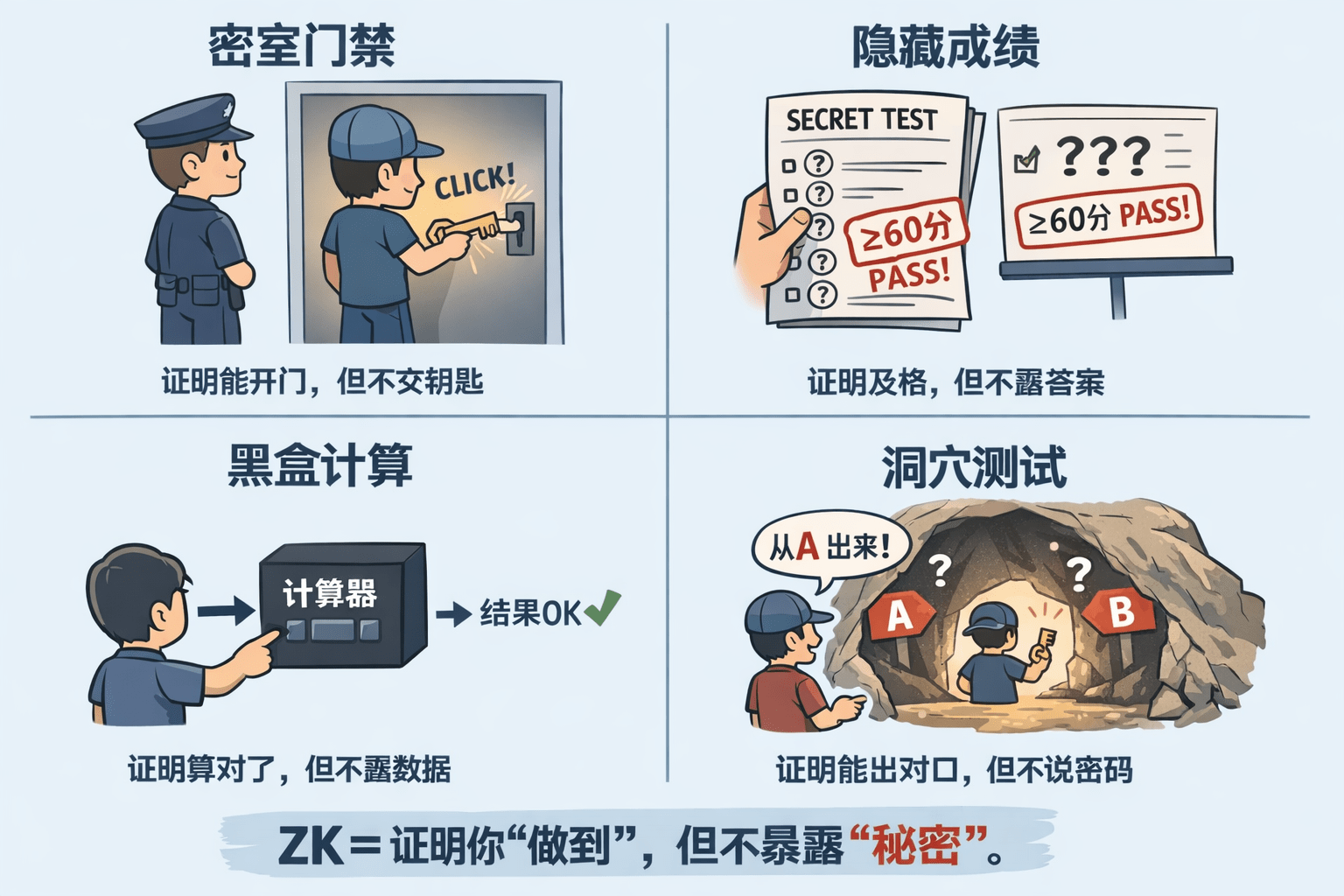
In Web3 projects, you often see 'ZK (Zero-Knowledge Proof)', but what exactly is ZK?
First, let's eliminate a misunderstanding: ZK is not that token that crashed to the ground.$ZK (it's just a name coincidence).
The true meaning of ZK is: a cryptographic technique that allows you to prove 'I know/I meet a certain condition' without revealing the specific content.
In simple terms:
I can prove to you 'I know/I satisfy a certain condition' without telling you the specific content.
Here are a few common examples from everyday life for better understanding.
1. The most intuitive example: proving you know the password without revealing the password
You want to log into a website:
Traditional method: you send the password to the website, and the website compares it.
The ideal method of ZK: you do not send the password, but rather give the website a 'proof' that assures the website: 'this person indeed knows the correct password', but the website cannot deduce the password from the proof.
This is 'zero knowledge': the verifier only receives the conclusion 'you are correct', and nothing else.
2. Another common Web3 example:
Proving you are over 18 years old without exposing your ID information
You want to access a service that only allows adults:
Traditional: upload your ID (revealing your birthday, ID number, address, and a bunch of privacy)
ZK: you present a proof: 'I am ≥18 years old'
But do not disclose what your birthday is or what your ID number is.
3. Why is it 'trustworthy'? (not discussing mathematics, but intuition)
ZK proofs generally have three layers of intuitive guarantees:
A correct person can prove: if you really know/meet the conditions, you can generate the proof
Cannot fool people: someone who does not know basically cannot forge a proof that can pass verification
No leakage: the proof itself does not 'reveal' the secret
4. What is ZK most commonly used for in Web3?
--A. Privacy
When transferring/identity/asset proof, do not disclose details
For example, 'I have enough balance to pay', but do not reveal how much money you actually have.
--B. Scalability (ZK Rollup)
It's expensive and slow on-chain, so many transactions are batch processed off-chain first.
ZK Rollup compresses a bunch of transactions into a 'proof' sent on-chain:
On-chain only verifies this proof (saving gas), but can still be confident that this batch of transactions is executed correctly.
--C. Compliance-friendly (Selective Disclosure)
Can prove 'passed KYC/not on the sanctions list/meet the rules', while not exposing all your personal information to every application.
5. Summary in one sentence
ZK = 'only proving the conclusion, not exposing the process and secrets'.
In Web3, it allows you to be both 'trusted' and 'less exposed'.
@Yi He Cousin @cz_binance Sister @heyibinance what do you think?