

@KITE AI 中文 If you’ve typed “Kite” into a search bar lately, you may have landed in the wrong neighborhood. One Kite is the trading interface and API used by people placing stock orders. The other, Kite AI, is building infrastructure for a different kind of user: software agents that need to authenticate, follow rules, and pay for things without a human hovering over every step. The name collision is a footnote; the timing is the story.
The timing looks right because “agentic commerce” has shifted from talking to pilots. Reuters reported that Perplexity partnered with PayPal to enable direct purchases inside its chat interface, with checkout handled through PayPal account linking. That’s still a person initiating the shopping, but the payment step becomes a capability you can call, not a webpage you must visit. Once that door is open, you start wondering how often software will walk through it without asking permission each time.
Kite AI’s bet is that the existing payment stack is mismatched to how agents behave. Humans pay in lumpy moments: a subscription, a cart, an invoice. Agents pay in drips and bursts: per API call, per second of compute, per small unit of data. That’s where the “native rail” pitch gets real: if settlement takes time and fees don’t shrink with payment size, a ten-cent transaction becomes silly, and developers get pushed back into clunky workarounds.
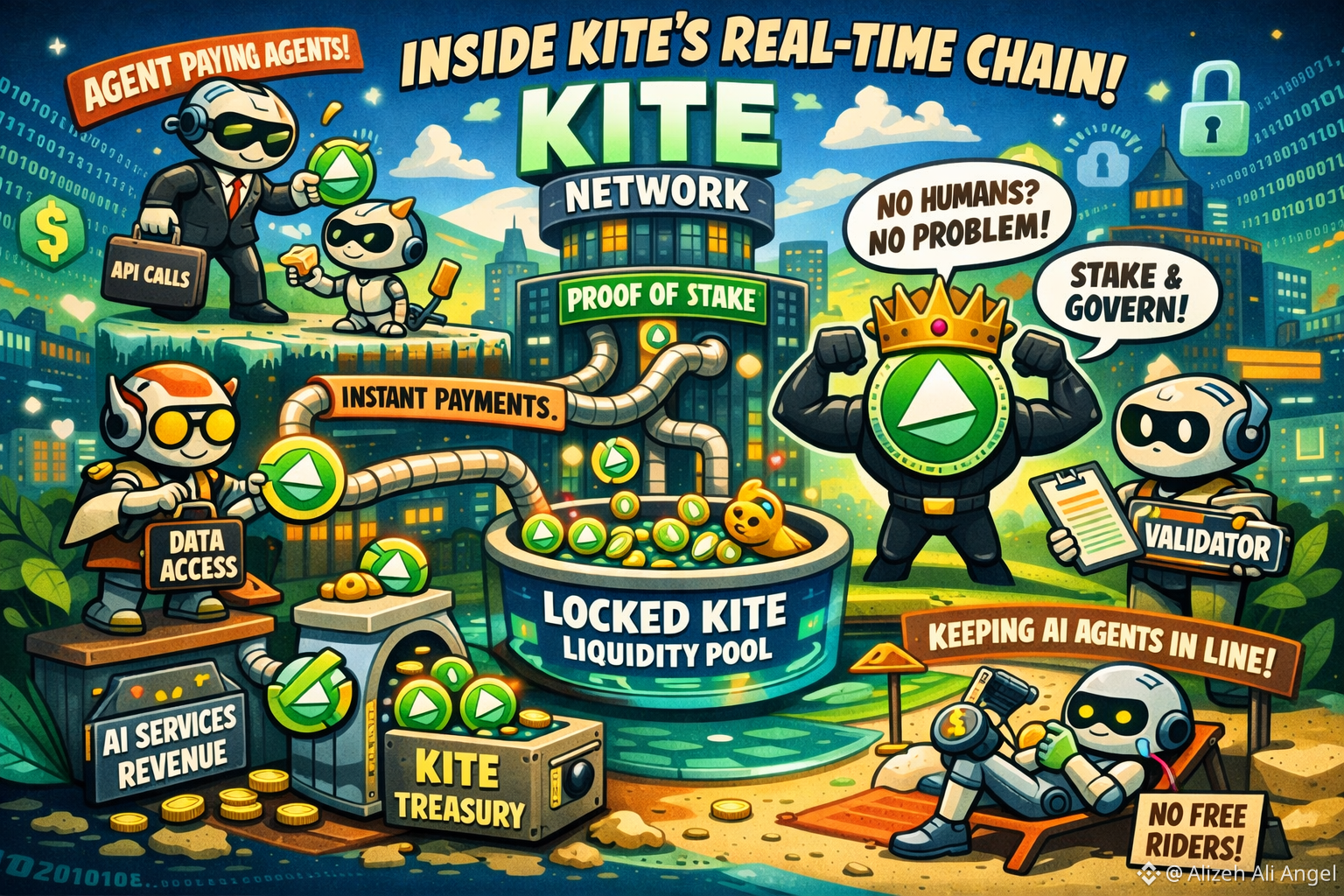
So what does Kite mean by a “real-time chain,” in plain language? It’s a Proof-of-Stake, EVM-compatible Layer 1 that positions itself as a low-cost coordination layer for agent payments and interactions. The “real-time” claim leans on off-chain payment channels: two parties can update balances instantly between themselves, then settle a final result on-chain when they’re done. The dream is that paying for a service feels as natural as making a request.
Here’s the part that often gets lost in the “agents paying agents” conversation: the token is not a cosmetic add-on. It’s the thing that turns a payment story into an enforceable system with skin in the game. Kite’s token, KITE, is designed to be the key that unlocks roles and creates consequences. The project’s MiCAR white paper is unusually direct about this: KITE “grants access to network services” because you stake it to activate roles like validator, module owner, or delegator, and you use it to participate in network coordination and smart contract activity. In other words, KITE is meant to be the permission slip and the bond.
That matters because payments are only half the unease. The bigger human worry is delegation. People are understandably nervous about giving an agent credentials and hoping it behaves, and merchants are nervous about accepting money from something that may not be clearly accountable. A token can’t magically make an agent honest, but it can make it expensive to be careless. When a network is secured by stake, the “right to operate” is coupled to an asset that can be rewarded, restricted, or potentially penalized depending on how the system is designed. Even if most end-user payments happen in stablecoins, the network still needs a native asset to secure consensus, meter usage, and give governance teeth.
Kite’s own tokenomics documents lean into that practical framing, and they do it in a way that’s pretty revealing about how the team sees adoption unfolding. In Phase 1—around token generation—the token is positioned as a gating mechanism for participation. Builders and AI service providers are expected to hold KITE to integrate into the ecosystem, which is a blunt but effective way to avoid a “free-rider” dynamic where everyone wants the network to exist but nobody anchors themselves to it. The more unusual move is the “module liquidity requirement,” where module owners with their own tokens must lock KITE into permanent liquidity pools paired with their module tokens to activate modules, keeping that liquidity non-withdrawable while the module stays active. Read plainly, that’s a commitment device: if you’re going to profit from agent traffic, you also tie up the network’s native token over the long haul.
Phase 2—tied to mainnet—is where KITE becomes even more tightly woven into day-to-day economics. The tokenomics page describes protocol commissions from AI service transactions, with a mechanism that can swap commissions into KITE before distributing them to modules and the L1. That’s the core relevance of KITE as more than “gas”: it becomes the asset the system uses to recycle real service revenue into security and governance weight. If you believe agent payments will become routine, this structure is trying to ensure that growth in real usage translates into more KITE held or staked by the parties who keep the network running.
This is also why the last few months made #KITE suddenly “matter” in public, not just inside docs. Binance’s Launchpool announcement laid out the basic supply parameters and the listing timeline: total supply capped at 10 billion KITE, with an initial circulating supply of 1.8 billion when it listed on November 3, 2025, alongside Launchpool rewards and trading pairs. Binance Research repeats the key figures and anchors them to that same date. Whether or not someone cares about exchange listings, that moment tends to force a project to clarify what the token is for, who needs it, and what happens when it starts moving in the wild.
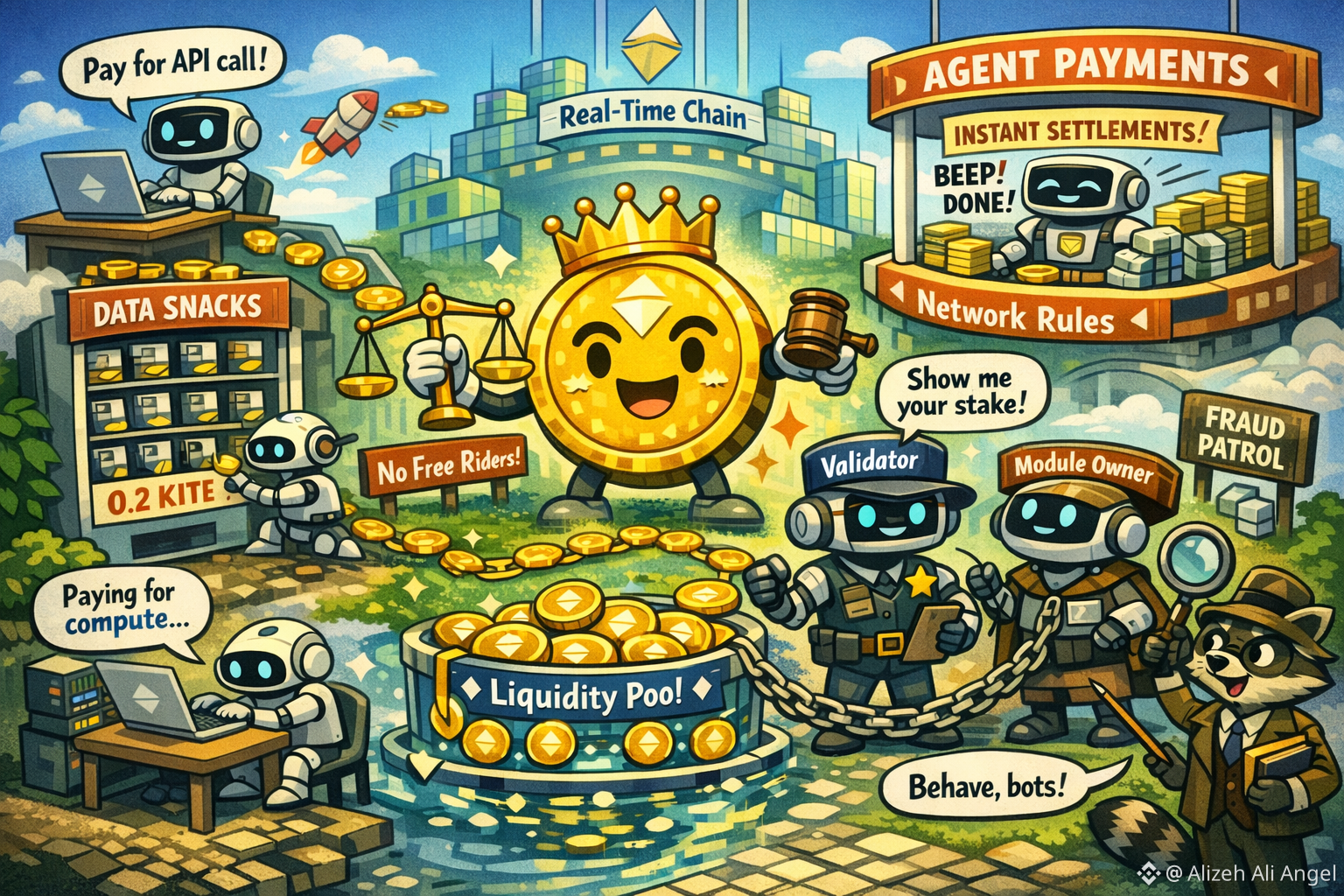
Standardization is the other lever, and it connects back to the token in a subtle way. Payments on the web are fragmented: every service wants a different key, a different plan, a different checkout flow. Kite positions itself as natively compatible with x402, which is part of a broader push to make “pay for this request” a normal pattern rather than a bespoke integration every time. If those standards catch on, the network’s native token becomes the operational substrate that makes those flows reliable—securing the chain, paying for execution, and governing the rules that determine what counts as acceptable agent behavior.
I’m still cautious for the same reason I’m interested. The hard parts of payments aren’t the transfers, but everything around them: fraud, disputes, compliance, and consumer protection. Those problems don’t vanish because a transaction settles quickly. If anything, they get sharper when software can fire off thousands of actions before a human notices. This is where KITE’s relevance is almost philosophical: if a system wants to let agents act with more independence, it needs a credible way to enforce limits, align incentives, and fund the policing of the commons. A native token is one of the few tools that can do all three at once, even if it introduces its own problems.
Still, it’s hard to ignore the direction of travel. When an agent can pay for compute the way it can already call an API, markets start to look different. Tiny services that were “too small to bill” become billable. Data that used to be shared informally can be sold in slices, with usage tracked. And the web gains a more native way for software to compensate software without pretending every interaction is a human checkout. Kite may or may not become the default rail, but the $KITE token is clearly meant to be more than a ticker symbol: it’s the stake, the access key, and the governance weight that the system uses to keep agent payments from turning into a trust exercise. The moment I’ll believe the rail has arrived is when KITE feels boring—when teams hold it not because they’re speculating, but because their agents can’t do reliable work without it.