
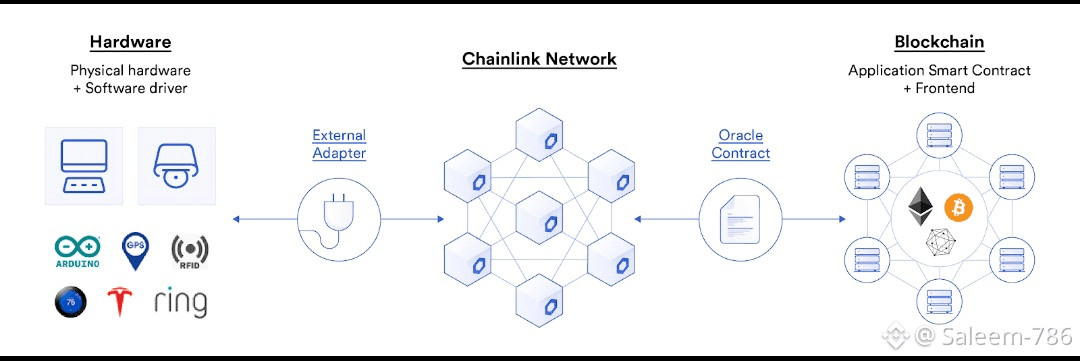
Most smart contract discussions still treat data as if it magically appears at the moment it’s needed. A function is called, a value is returned, and execution continues. In practice, this is where many systems quietly break. Not because the contract logic is wrong, but because the data feeding it arrives with assumptions that no one really questions.
What makes APRO Oracle interesting right now is that it doesn’t seem to position itself as just another data source. It behaves more like middleware — a layer that sits between messy external reality and rigid on-chain execution. That distinction matters more than it sounds.
Middleware isn’t about owning the data. It’s about managing how data is allowed to influence decisions. In traditional systems, middleware handles validation, filtering, retries, and failures before information reaches critical logic. APRO’s decentralized oracle network appears to be doing something similar for smart contracts. Instead of assuming inputs are clean, it treats data as something that needs to pass through a process before it earns the right to trigger irreversible outcomes.
This becomes clearer when you think about how many modern contracts are no longer simple. Lending protocols don’t just check a price once. They depend on continuous updates, thresholds, and edge cases. Prediction markets rely on event resolution that can be delayed or disputed. Real-world asset contracts depend on reports, indices, or documents that don’t update on-chain by default. In all of these cases, the risk isn’t just wrong data — it’s bad timing, partial context, or silent disagreement between sources.
APRO’s architecture suggests an assumption that these problems are normal, not exceptional. Multiple sources, verification layers, and off-chain processing aren’t just performance optimizations. They’re ways of slowing down blind execution. When contracts depend on middleware that absorbs uncertainty first, the system as a whole behaves differently. It becomes less reactive and more defensible.
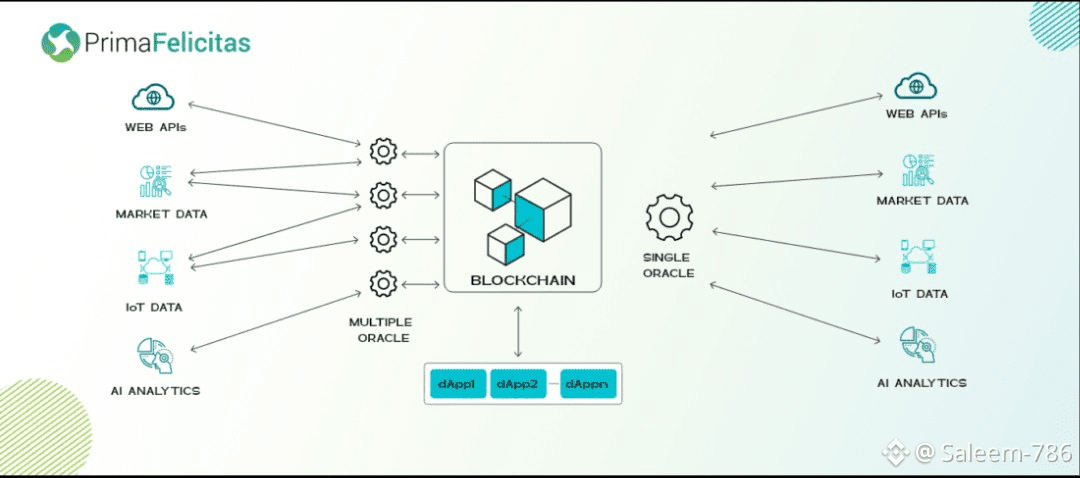
What feels new and not widely discussed on Binance Square — is how this middleware framing shifts responsibility. When something goes wrong in a smart contract today, blame usually lands on “the oracle” or “the market.” But middleware creates traceability. It forces questions like: which inputs were considered, which were ignored, and why a particular outcome was allowed to proceed. That doesn’t prevent loss, but it changes how loss is understood.
There’s also a subtle scaling implication here. As more contracts rely on complex external data, developers don’t want to design custom data logic every time. They want a shared layer that already expects inconsistency and noise. APRO’s oracle network starts to look less like a service you call and more like infrastructure you build on similar to how APIs or message queues function in traditional systems.
Another underappreciated point is how middleware changes incentives. When data delivery is treated as a process rather than a result, speed stops being the only metric that matters. Reliability under stress, explainability after failure, and consistency across environments become more important. That aligns with how serious systems evolve over time, especially once real money and reputations are involved.
None of this guarantees that APRO avoids failure. Middleware can fail too, and complexity always introduces new risks. But systems that acknowledge complexity upfront tend to fail in ways that are easier to diagnose and recover from. Systems that pretend data is simple tend to fail suddenly, and without clear explanations.
Seen through this lens, APRO’s decentralized oracle network isn’t just feeding smart contracts. It’s quietly shaping how contracts relate to the outside world. Not as a source of truth, but as a buffer between uncertainty and execution. As on-chain applications become more data-driven, that buffering role may end up being one of the most important layers in the stack even if it rarely gets talked about directly.
That’s the kind of progress that doesn’t trend loudly. But it’s usually the kind that lasts.