

@Walrus 🦭/acc There’s a certain kind of failure that only shows up once you’ve tried to build something real onchain. You can design perfect execution and still lose the user, not because the code was wrong, but because the data the code depended on wasn’t there when it mattered. The internet is full of data that feels permanent until the day it vanishes, gets rehosted, gets rate-limited, gets quietly edited, or becomes too expensive to fetch at scale. Walrus lives in that uncomfortable gap between “the chain is deterministic” and “the world is not,” and it treats storage not as an afterthought but as part of the trust boundary itself.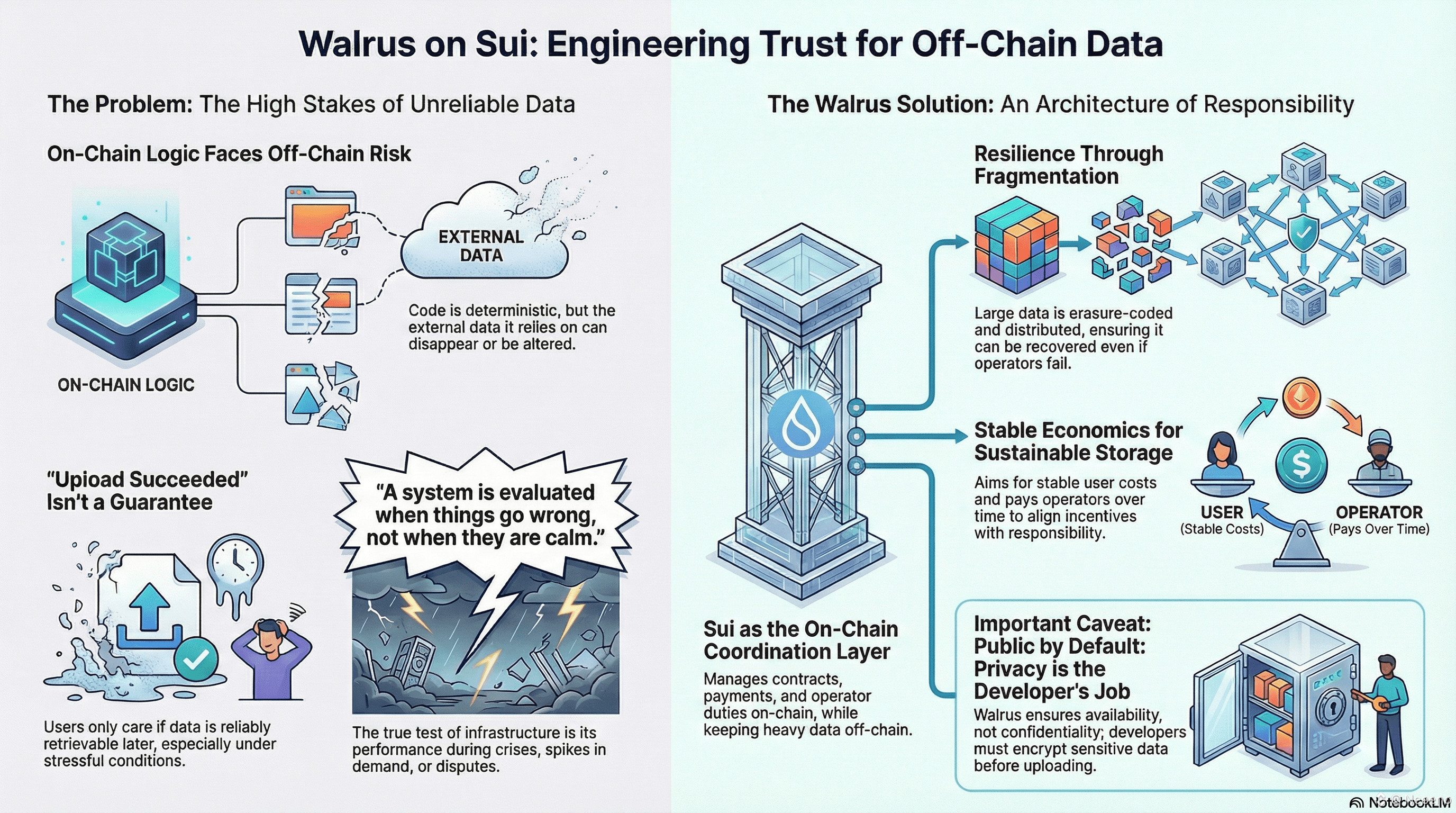
Most people hear “decentralized storage” and imagine a new place to put files. That’s not wrong, but it’s shallow. The deeper issue is that modern applications don’t just need a place to dump bytes. They need a way to make data behave like something the network can rely on: something that can be referenced, checked, paid for over time, and retrieved even when conditions are bad and incentives are mixed. Walrus frames itself around making unstructured data reliable and governable, which is a very particular promise. It isn’t asking you to believe data will always be available because the network is ideal; it’s asking you to believe availability can be engineered into the economics and the verification path.
The choice to build it on Sui is part of that philosophy. Walrus keeps the “heavy” part—large data—off the base layer, while using the base layer for the parts humans fight about: who is responsible, who is paid, what was committed to, and what the network should consider valid at a given time. Coordination becomes an onchain object rather than a social understanding. When you store data through this system, you’re not just uploading; you’re entering a contract with time, with a lifecycle, and with a set of operators whose responsibilities are defined in a place everyone can inspect.
That mindset shows up in the project’s timeline. Mysten Labs introduced Walrus publicly in mid-2024 as a developer preview for builders, which is the kind of move you make when you know the hard part will be operational reality, not just whitepaper elegance. Then, on March 27, 2025, Walrus announced mainnet, treating “programmable storage” as a foundational layer rather than a niche tool. The date matters because it anchors when the system moved from promise to responsibility—the moment you can no longer hide behind “testnet conditions.”
Under the hood, the core idea is simple in the way serious systems often are: don’t rely on full replication, and don’t rely on trust. Instead, take a large object, encode it into many fragments, distribute those fragments across independent operators, and make recovery possible even when a meaningful portion of those operators are down or dishonest. The arXiv paper describes a design that leans on fast erasure coding and a blockchain control plane, explicitly aiming for high resilience with controlled overhead. What’s important is not the math by itself, but the human consequence of that choice: the system is designed so “I couldn’t retrieve it” is less likely to become a personal crisis at the exact moment the data becomes valuable.
This is where storage stops being a commodity and starts being a social promise. If you’ve ever shipped an app where users upload media, you know how quickly “upload succeeded” becomes meaningless if “download later” is unreliable. People don’t evaluate infrastructure in calm conditions. They evaluate it when they’re angry, impatient, scared, or being accused by someone else of lying. Walrus implicitly acknowledges that by putting verifiable milestones onchain—moments after which the network claims responsibility for keeping the data available for a paid duration. That kind of commitment is less about technology and more about fairness: a way to say, “from here forward, the burden is on the system, not the user.”
The design also admits something many projects avoid saying out loud: participation changes. Operators rotate. Conditions change. The set of machines holding your fragments today may not be the set holding them next cycle. Walrus documents a release schedule with fixed production timing on mainnet, and it’s clear the protocol treats reconfiguration as a first-class reality rather than a corner case. That matters because downtime is not only an availability problem; it becomes a blame problem. A robust system is one where responsibility remains continuous even when membership changes.
Then there is the part people get wrong when they repeat the project in one sentence: privacy. Walrus is blunt that data stored on the network is public by default and discoverable, and it warns builders not to treat it like a private bucket without additional protection. This is not a cosmetic detail—it’s the difference between a storage network and a confidentiality system. The human failure mode here is painfully predictable: someone will store something sensitive, assume the word “decentralized” implies safety, and then learn the hard way that availability and confidentiality are different promises. Walrus puts the responsibility where it belongs: if you need secrecy, you must add encryption and access control before upload.
What I find interesting is that the team didn’t stop at the warning label. The Walrus blog has explicitly argued that web3 storage has an uncomfortable pattern—public by default, encryption pushed onto developers, access control brittle or missing—and points to a programmable encryption approach designed to integrate with the broader Sui environment. Whether you adopt that particular route or not, the posture is telling: they’re not pretending privacy is free, but they are trying to make “doing the right thing” less punishing for teams who want onchain policy and offchain confidentiality to agree with each other.
All of this would be an academic exercise if incentives didn’t match the reality of running disks, bandwidth, and uptime. Walrus speaks about payments in a way that feels closer to infrastructure operators than token traders: storage is a service delivered over time, yet paid upfront, and the distribution of that payment is paced so compensation matches ongoing responsibility. There’s an explicit desire to keep user costs stable in fiat terms over long horizons, which is another way of saying the system is trying not to offload volatility onto people who just want their data to be there later. That’s a quiet form of respect for users: don’t make them become macro speculators just to store files.
The market noticed that seriousness early, for better and for worse. In March 2025, Walrus Foundation announced a large private token sale led by Standard Crypto, and multiple outlets covered it as meaningful funding for the protocol’s growth. Money doesn’t validate truth, but it does change the obligation level. Once you raise at that scale, the world expects you to survive adversarial attention—not just from attackers, but from the pressure of adoption itself.
And then there’s the institutional packaging that shows up when an asset is no longer only “for crypto natives.” Grayscale created a trust product tied to WAL in 2025, and Walrus’ own year-end review frames it as a step that lets certain investors get exposure without handling tokens directly. That kind of wrapper doesn’t tell you the network is flawless, but it does tell you the asset has entered a world where reputational risk is priced in and where operational maturity is no longer optional.
Security, in a storage network, isn’t only about someone stealing funds. It’s about someone making data disappear, corrupting it, or making retrieval unreliable in a way that can’t be proven cleanly. Walrus leaned into that reality with a public bug bounty, run through HackenProof, with top rewards advertised at a level that signals they expect serious scrutiny. The program’s emphasis on both economic integrity and data integrity is the right instinct: the easiest way to kill trust in a storage protocol is not a dramatic hack, but a slow bleed of weird edge cases where users can’t tell if the system failed or if they did.
What makes all this feel like it belongs to the Sui ecosystem specifically is the way “data” becomes something that can be referenced and reasoned about by onchain logic without dragging the data itself onchain. Walrus’ docs describe Sui as the coordination layer for these operations—lifetime, payments, and governance around operator responsibility. The effect is subtle but important: applications can treat large offchain objects as if they have onchain consequences, and that’s where reliability starts to look like a property you can build around instead of a hope you pray for.
If you spend time around builders, you’ll notice they talk about infrastructure only when it hurts. When it works, it disappears. That’s the quiet goal Walrus keeps circling: to make the storage layer boring under stress. Not exciting, not loud, not a brand moment—just dependable. A system like this earns its place when a launch goes viral, when bandwidth spikes, when a subset of operators fail, when a team makes a mistake, when accusations fly about what was uploaded and when, and the network still gives everyone a way to converge on the same reality without begging a centralized provider for mercy.
Walrus’ own “2025 year in review” reads like a project that understands this is a long game: shipping is only the beginning, and the real work is smoothing the edges that turn simple ideas into survivable products. You can feel the direction: making storage feel effortless, making privacy less fragile, and making the integration between onchain coordination and offchain data less error-prone.
In the end, the most honest way to describe Walrus is not as a place to put files, but as a way to reduce the emotional cost of depending on data that lives outside the chain. The project’s choices—anchoring responsibility on Sui, engineering recoverability into the storage path, admitting public-by-default truths, paying operators over time, inviting adversarial testing—are all different expressions of the same ethic. It’s infrastructure built for the moments when things go wrong, when people are tired, when markets are loud, and when confidence is fragile.
A great system doesn’t demand your attention. It simply works in the background, and that steady reliability is what makes other things possible..

