
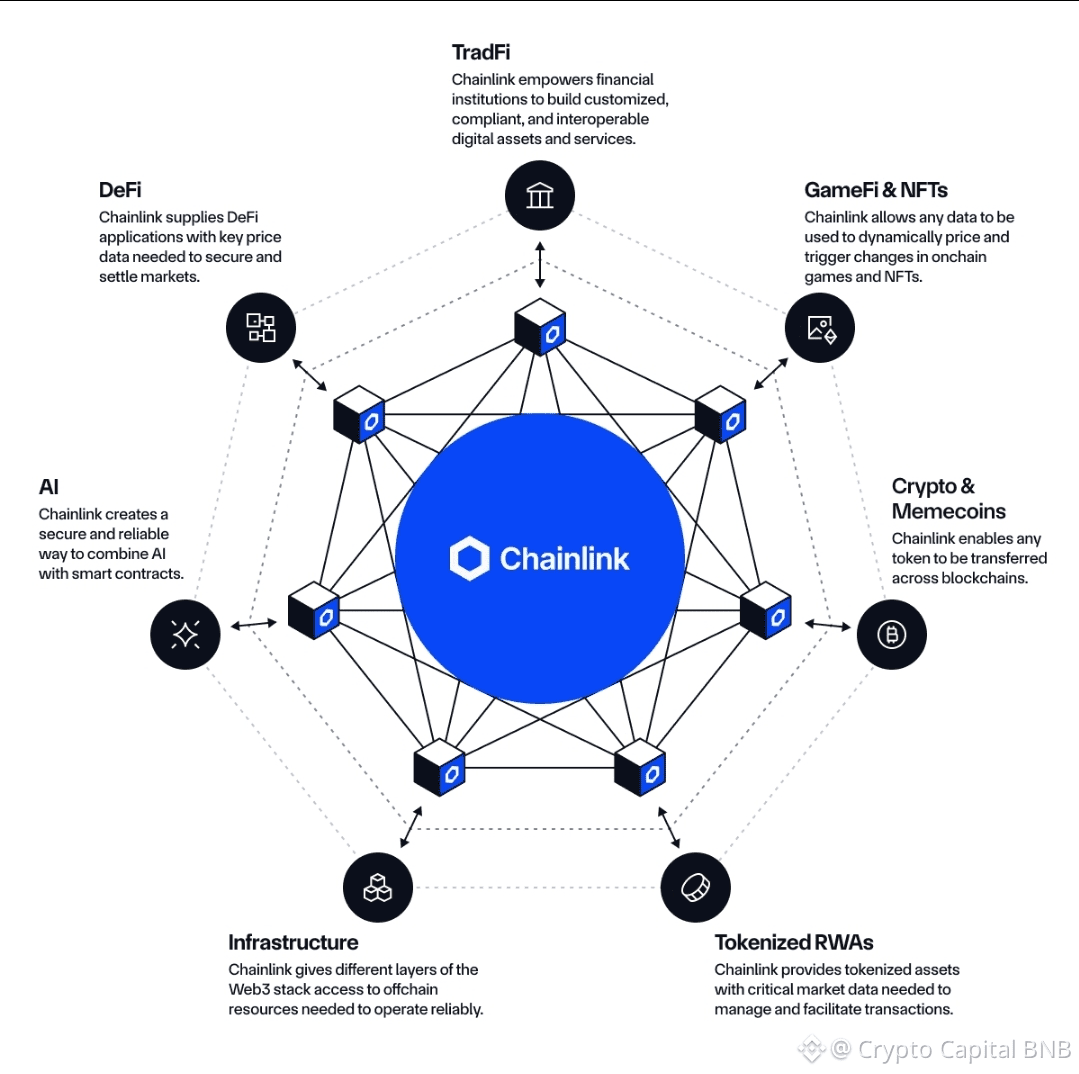
 It wasn’t introduced with excitement. No one said, “You have to look into this.” It was mentioned the way people mention electricity or Wi-Fi—only when something else depends on it. That actually made me more curious later. Important things often sound boring at first.I didn’t look it up right away. The name itself felt dry, almost mechanical. #Chainlink . It sounded like something that connects other things, not something you’d build an identity around. But then it kept coming back. I’d read about DeFi, or some automated contract, and there it was again. Not in the spotlight. Just quietly doing its job. From what I’ve seen, that kind of repetition usually means something is holding more weight than it shows.When I finally tried to understand what Chainlink actually does, I realized why people struggle to explain it casually. The idea isn’t emotional. It’s practical. Blockchains, on their own, are kind of blind. They’re sealed off. They don’t know prices, weather, outcomes, or anything happening outside their own world. Chainlink exists to bridge that gap. It brings outside information in. That’s it. Simple to say. Harder to really feel the implications.This part made me pause. Because once you realize how much depends on outside data, you also realize how fragile things can get. If a smart contract relies on information from the real world, that information has to be trustworthy. Otherwise, everything built on top of it becomes shaky. I could be wrong, but this feels like one of those quiet pressure points people don’t think about until something breaks.Chainlink tries to solve this by not trusting a single source. Instead of asking one voice, it asks many. Different nodes. Different feeds. The idea is that if enough independent sources agree, the data is probably safe to use. That makes sense to me. It also raises questions. Independence is hard to measure. Incentives don’t always behave the way we expect. I’m not fully convinced yet that any system can fully escape that tension.What stands out to me is how little drama surrounds Chainlink compared to other projects. There’s no constant reinvention of its purpose. No loud claims about changing everything overnight. It feels like it knows what it’s supposed to do and sticks to it. In a space where everything is competing for attention, that restraint feels almost out of place.From what I’ve seen, a huge number of decentralized applications quietly rely on Chainlink. Price feeds. Automated triggers. Conditions that need confirmation before something executes. Without something like this, many of those systems would either be unsafe or completely centralized. That realization made me look at Chainlink differently. It’s not trying to be the main character. It’s trying to make sure the story doesn’t fall apart.Still, I don’t want to pretend it’s flawless. The more something is used, the more pressure it carries. If Chainlink fails, a lot of things feel the impact. Decentralization reduces risk, but it doesn’t erase it. I could be wrong, but widespread reliance can quietly become its own vulnerability.I’ve also noticed that Chainlink keeps expanding what it does. Randomness. Automation. Cross-chain communication. At first, that made me uneasy. When projects grow outward, focus can blur. But in this case, the expansion feels connected. It’s still about coordination. Still about helping systems talk to each other. I’m not entirely sure where the line should be, though.Price conversations around Chainlink always feel strange to me. Infrastructure doesn’t show its value the same way consumer tools do. You don’t cheer for plumbing when it works. You only notice it when it doesn’t. From what I’ve seen, utility like this tends to stay quiet, even when it’s everywhere.When I think about Chainlink now, I don’t feel excitement. I don’t feel doubt either. It feels like one of those things you slowly learn to respect, not because it’s flashy, but because it keeps showing up where things need to function properly. I’m still not sure what its long-term shape will be. Maybe it fades into the background completely. Maybe it becomes something people finally notice.For now, it sits in that space where understanding feels incomplete but dismissal feels careless. And maybe that’s appropriate. Some systems aren’t meant to be admired. They’re meant to quietly hold everything else together, until you realize how much depended on them all along.

Article
The first time Chainlink crossed my path, I barely registered it.
Disclaimer: Includes third-party opinions. No financial advice. May include sponsored content. See T&Cs.