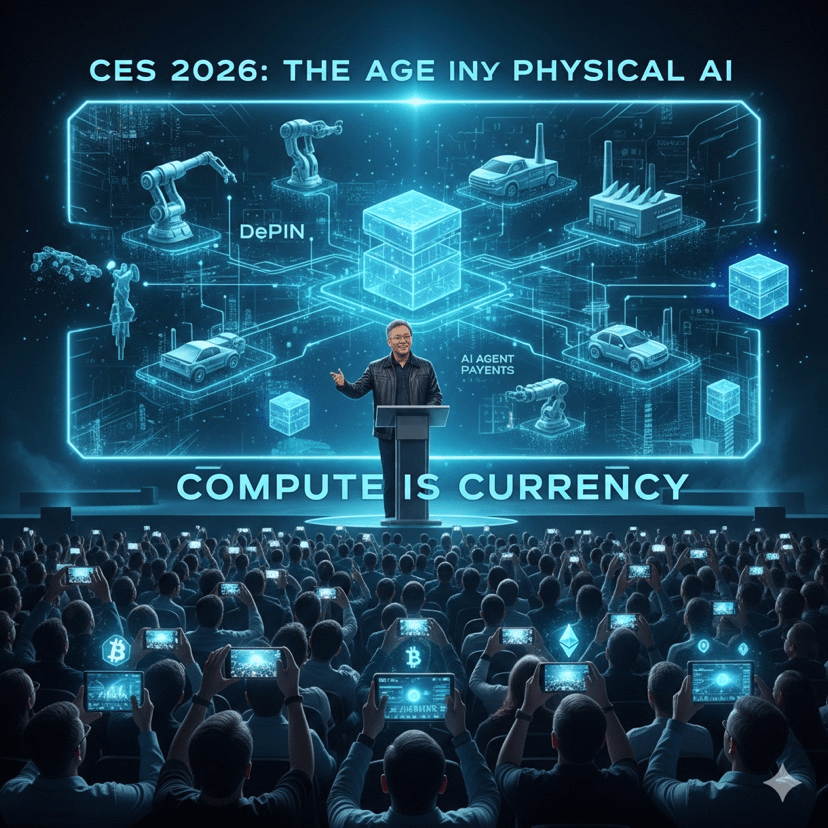
Computing power is national power: Highlights from NVIDIA's CES 2026 keynote and the new cryptocurrency order sparked by 'Physical AI'
In early 2026, at CES in Las Vegas, NVIDIA CEO Jensen Huang once again set the tone for the global tech industry with his signature black leather jacket and highly infectious speech. This keynote wasn't just a product launch—it was a deep sermon on 'Physical AI' and the 'Industrial AI Revolution'.
Key points of the speech: AI moving beyond screens into the physical world
Huang stated that we are currently experiencing the most significant 'paradigm shift' in the history of computing. The traditional computing infrastructure, valued at $10 trillion, is fully transitioning from a CPU-centric era to a GPU-centric era focused on 'training and generation'.
1. Vera Rubin Architecture: The pinnacle of extreme computing power
The most talked-about hardware highlight in the presentation is the Vera Rubin platform. This system is specifically designed for large-scale AI training and inference, featuring six newly developed chips. Its core includes the Vera CPU with 88 CPU cores and the Rubin GPU, which delivers five times the performance. Through extreme co-design, the Rubin platform achieves remarkable output efficiency at the same power level.
2. The Three-Stage Evolution of AI
Huang Renxun divides the development of AI into three stages:
* Generative AI: The foundational generation of text and images.
* Agentic AI: 'action agents' capable of reasoning, planning, researching, and autonomously operating software.
* Physical AI: AI that understands physical laws (such as gravity, inertia, and friction), moving from the digital world into autonomous driving and robotics.
3. Alpameo: The Thinking Self-Driving Car
Nvidia launched the world's first autonomous driving AI with 'reasoning capability'—Alpameo. It not only performs driving tasks but can also explain the logic and decision-making behind its actions in natural language, marking a new era of 'causal reasoning' in autonomous driving.
Future Outlook: The Convergence of Huang Renxun's AI Vision and Cryptocurrency
Huang Renxun mentioned in his speech that 'computation has been fundamentally reshaped, and every layer of architecture is being redefined.' This reshaping is creating a powerful chemical reaction with the Web3 and cryptocurrency ecosystem.
1. Assetization of Computing Power and DePIN Networks
Huang Renxun emphasized that computing power cost advances tenfold annually, making computing power a fundamental industrial resource like electricity. As the Vera Rubin platform goes into mass production, the scarcity of high-performance computing power will accelerate the growth of decentralized physical infrastructure networks (DePIN).
Cryptocurrency protocols can integrate GPU computing power scattered across the globe. As 'AI factories' become the norm, cryptocurrencies will become the ideal tool for pricing, settlement, and incentivizing computing resources.
2. On-chain payment economy for agentic AI
The presentation demonstrated how agentic AI can autonomously plan and invoke various tools to complete tasks. When AI agents need to purchase API services, rent bandwidth, or obtain specific data, traditional banking systems struggle to handle robot payments at millisecond-level speed, ultra-high frequency, and micro-transaction amounts.
The smart contracts (Smart Contracts) offered by cryptocurrencies will become the 'natural wallet' for AI agents, enabling the autonomous payment layer in the 'agent-driven economy' envisioned by Huang Renxun.
3. Data Authenticity and Ownership Verification
Huang Renxun mentioned that in the future, 'every pixel, every token will be generated in real time by AI.' This will bring serious challenges to content authenticity. Blockchain's immutability and verification technology will become key infrastructure for verifying the copyright of AI-generated content (AIGC) and marking the source of simulated data from 'physical AI,' ensuring traceability of digital assets in the era of AI proliferation.
4. Data Incentive Mechanism: Data-to-Earn
Physical AI (such as robots and self-driving cars) requires massive real-world data for training. Cryptocurrencies can serve as incentive mechanisms to encourage users to share high-quality physical interaction data. Through token incentives, this accelerates the 'ChatGPT moment' for physical AI that Huang Renxun envisions.
Conclusion: Computation is currency, and connectivity is trust
Huang Renxun showcased a future defined by computing power. For the cryptocurrency industry, blockchain will become an indispensable 'trust and value layer' in this revolution.
When AI gains physical mobility in the real world and reasoning capabilities in the digital world, it requires a decentralized, transparent, and code-driven financial order to support its operations. Nvidia has built a powerful computing heart, while cryptocurrencies provide the digital asset bloodstream flowing globally. The fusion of these two will define the next decade of digital civilization.