


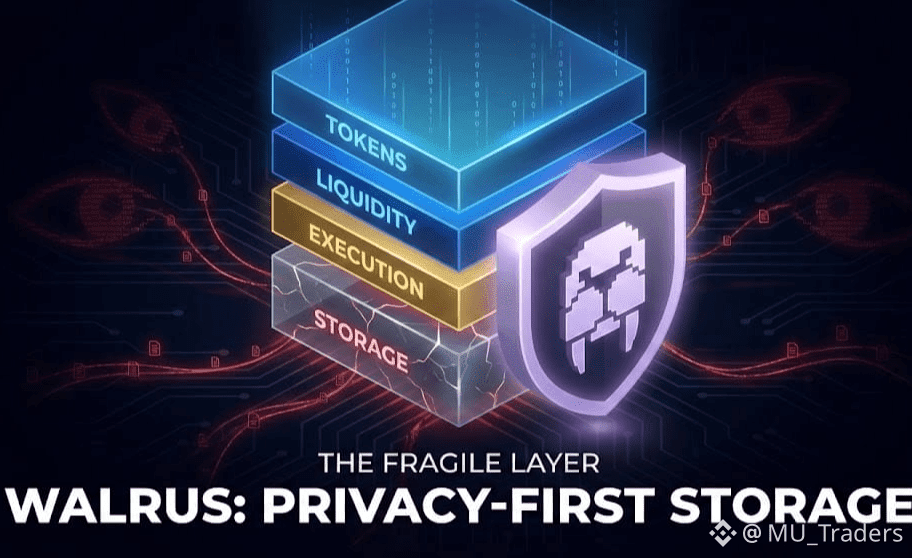
you probably spend most of your time thinking about tokens, liquidity, and execution, while assuming storage is already solved. That quiet assumption is risky. Walrus forces you to notice that much of crypto still depends on storage models that leak metadata, expose usage patterns, and quietly reintroduce trust.
Why Privacy-First Storage Suddenly Matters
As applications grow more social, data-rich, and persistent, storage stops being neutral infrastructure. Every read, write, or update creates behavioral signals. In many systems, those signals can be observed, analyzed, or restricted. Walrus treats privacy not as an add-on, but as a design constraint, reducing how much information storage itself reveals.
Hidden Risk in “Good Enough” Storage
Typical decentralized storage focuses on availability and cost, but ignores inference risk. Even if data is encrypted, access patterns still tell stories. Walrus reframes storage as something that should minimize what the network learns about you, not just what it stores. That shift matters as crypto applications begin to resemble full digital lives, not just wallets.
Changes the Trajectory
Built within the Sui ecosystem, Walrus benefits from fast finality and parallel execution, making privacy-preserving storage practical instead of theoretical. That opens room for applications that would feel unsafe on older stacks. In the long run, cryptocurrency systems that fail to protect data context may feel as outdated as custodial wallets do today.
Walrus does not try to be loud. It quietly reminds crypto space and privacy is weakest where we least expect it.
@Walrus 🦭/acc $WAL #Walrus