

@Walrus 🦭/acc only makes sense once you stop treating “data” like a background detail and start treating it like the thing that can ruin your day. People call everything a product in crypto, but Walrus behaves like a promise you’re not supposed to notice.
Reliable systems don’t get applause. They get ignored. But the moment data disappears, suspicion spreads everywhere “Did this load? Did I save it? Is this real?” Walrus started with a clear goal: not to be admired, but to be trusted when it matters. The official mainnet moment in late March 2025 wasn’t just a launch; it was the beginning of being judged by strangers. That matters because infrastructure doesn’t become infrastructure when the team says so. It becomes infrastructure when independent operators run it, when real users upload real things, and when failure stops being hypothetical. Walrus’ mainnet announcement framed this shift plainly: mainnet live, epoch timing, and a decentralized set of storage operators. 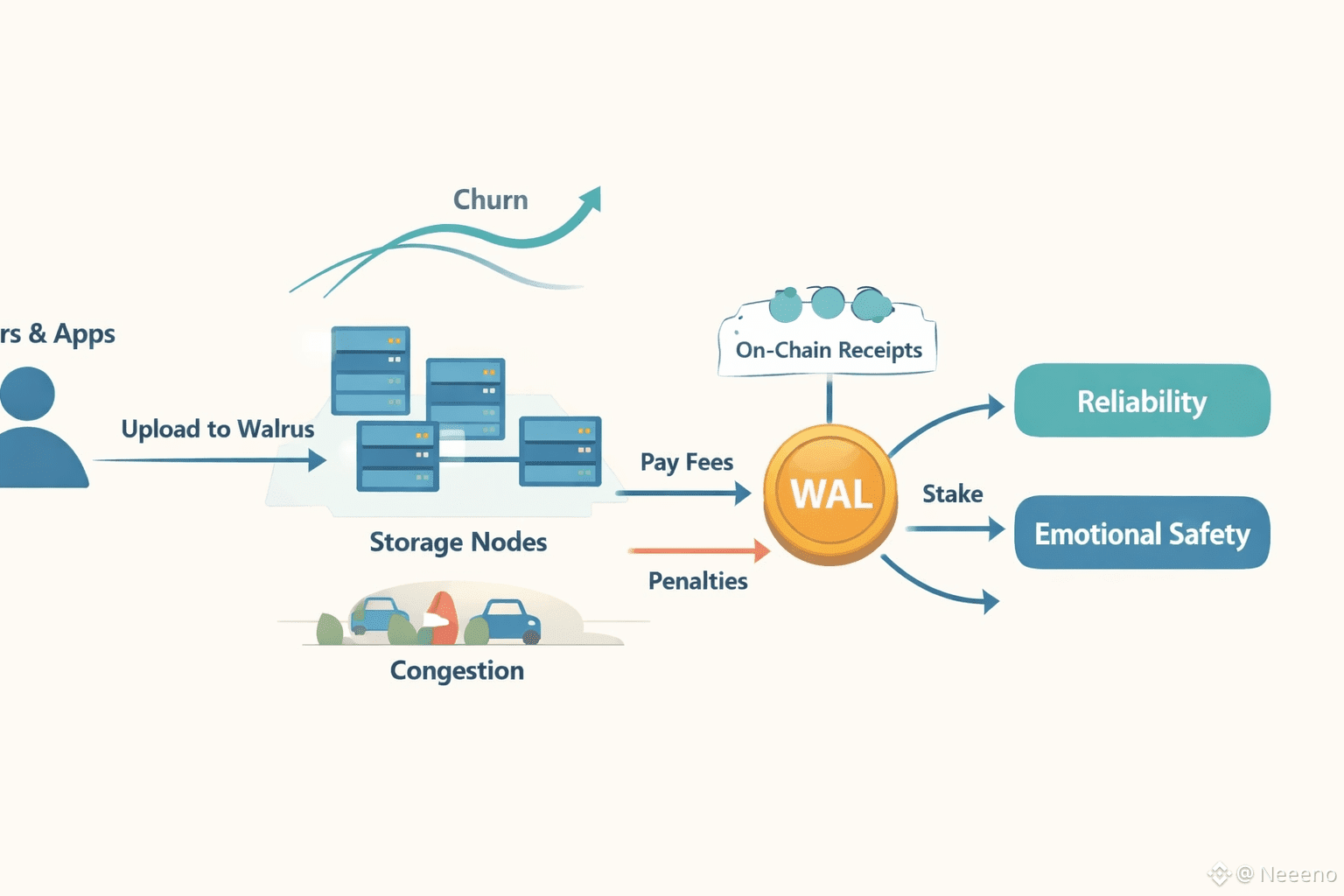
If you live inside the ecosystem, you learn to separate “onchain truth” from “offchain consequence.” Walrus sits in that seam. Onchain systems are crisp; they prefer clean inputs, clear state transitions, and deterministic outcomes. Offchain reality is messy: files get corrupted, networks drop, devices go offline, people disagree about what was uploaded, when it was uploaded, and whether it was the “real” version. Walrus doesn’t try to make the world less messy. It tries to make the mess less dangerous by making custody checkable and long-term behavior legible.
That’s where WAL stops being a ticker and starts being a measuring device. WAL isn’t there to decorate the story—it’s there to put a price on responsibility. When you make a token the unit of long-lived data custody, you’re admitting something that markets hate to admit: reliability is not a vibe, it’s a cost. WAL becomes the way the network expresses that cost across time, across operators, across failures, and across the quiet months when nobody is paying attention.
People often misunderstand what “trustless” feels like in practice. It doesn’t feel like freedom. It feels like reduced anxiety. With Walrus, the comfort isn’t that everything is impossible to break. The comfort is that if something goes wrong, the system has a way to remember what was supposed to be there, and a way to financially punish the gap between what was promised and what was delivered. That’s the emotional core: not excitement, but the ability to sleep without checking dashboards every hour.
The deeper idea is that Walrus treats data as something that outlives moments. Transactions are short. Narratives are short. Market cycles are short. But data is what people come back to when they’re scared—when they need to prove something, reconstruct something, or defend themselves in an argument that suddenly turned serious. If your storage layer is a little flaky, the human outcome isn’t “a minor bug.” It’s a slow drift toward centralization, because people will choose the boring option that feels safe, even if they hate it.
Walrus’ research story makes this philosophy clearer. The team published an academic-style paper describing a design that leans on erasure coding and efficient repair under churn, which is a polite technical way of saying: “nodes will fail, and we’re not building a fantasy.” The goal isn’t perfection; it’s resilience that doesn’t become prohibitively expensive over time. That’s a very specific kind of maturity: admitting that the enemy is not only attackers, but entropy.
When a storage network grows, the hardest failures are the ones that don’t look like failures at first. A few missing pieces here. A delayed retrieval there. A “try again later” that becomes normal. Then one day an application hits a stressful moment—high traffic, high stakes, heightened conflict—and the old habit of “mostly works” becomes a crisis. Walrus is built around the idea that a system should be shaped by its worst day, not its best day. That’s why the chain-facing part of the design matters: it gives the ecosystem a shared reference point for what the network committed to, even when operators are rotating and conditions are chaotic.
This is also why Walrus attracts builders who are tired of pretending that “content” is optional. The moment you build anything that includes media, identity, history, or AI-related datasets, your application stops being a tiny contract and becomes a living organism. Walrus becomes attractive not because it’s flashy, but because it’s honest about what modern apps carry. The Walrus Foundation’s own recap of 2025 leaned hard into this reality: the internet runs on data, and users are tired of being forced to trust whoever holds it.
You can feel the project’s priorities in the kinds of updates it chose to ship after mainnet. Not “look how many features,” but “remove the friction that makes builders cut corners.” Over 2025, Walrus talked publicly about improving privacy controls, reducing overhead for small files, and simplifying uploads—moves that are less about novelty and more about preventing quiet failure modes that lead teams back to centralized shortcuts.
That matters because in the real world, most mistakes aren’t malicious. They’re rushed. Someone uploads the wrong version. Someone’s phone drops connection mid-action. Someone assumes an old link will keep working forever. Someone misjudges cost and ends up rationing storage in ways that degrade the user experience. The “human bug” is nearly always uncertainty: not knowing what the system will do under stress. Walrus’ post-mainnet work reads like it’s trying to reduce that uncertainty until the default feeling is confidence, not vigilance.
WAL is the part many people talk about last, but it’s the part that keeps the whole thing emotionally honest. In October 2025, Walrus publicly announced WAL becoming available on Binance Alpha and spot markets. That isn’t just liquidity; it’s friction removal for the people who need the network to be usable without heroics. Accessibility matters because if only power users can acquire and manage WAL, then Walrus becomes a system for insiders, and infrastructure can’t survive as an insider game.
At the same time, accessibility without discipline can rot a network. If a token becomes purely a speculative object, it pulls attention away from the actual work: making the network reliable enough that users stop thinking about it. Walrus has tried to hold that line by framing WAL as part of an incentive loop that rewards correct behavior over time and penalizes failure. Their own materials describe staking, slashing, and burning as mechanisms intended to keep participants aligned with long-term performance rather than short-term extraction.
The “deflation” conversation around WAL is a good example of how Walrus thinks in long arcs. The Foundation has said it intends for transactions to burn WAL, explicitly positioning it as a pressure that increases with usage. It’s important to read that as intention and design direction, not as a magic trick—because burning doesn’t create value by itself. What it can create is a sense that waste has a cost, and that the system is built to discourage behavior that degrades reliability.
Zoom out, and you can see why Walrus spends so much time talking about “proof” and “rewards” in the same breath. In a storage network, the hardest question is simple: how do you pay for something that can’t be verified instantly, and how do you punish failure without turning into a bureaucracy? Walrus’ own technical writing describes an incentive framework where onchain evidence is a trigger for eligibility to earn fees over time—again, less about drama, more about making honesty feel like the natural path rather than a moral request.
This is where Walrus quietly touches the problem of disagreements between sources. Walrus can’t tell you which source is “true.” But it can make it harder for anyone to quietly rewrite history. When prediction markets, data marketplaces, or AI-related applications get into conflict, the fight is rarely about code. It’s about data: what was known, when it was known, and whether someone can later claim they never saw it. Walrus’ 2025 review pointed to prediction-market activity and emphasized that market data was stored verifiably on Walrus—exactly the kind of detail that matters when arguments become legal, reputational, or financially violent.
The ecosystem piece matters too, because infrastructure doesn’t grow by belief. It grows by boring connective tissue: integrations, tooling, migration support, and real teams betting their reputations on uptime. That’s why the Walrus Foundation launched a formal request-for-proposals program in 2025. RFPs are not glamour; they’re an admission that the hard work is distributed, and that the foundation has to pay for the unsexy parts that make reliability feel effortless.
It’s also why funding details aren’t gossip here—they’re part of the credibility story. In March 2025, CoinDesk reported Walrus raised $140 million in a token sale ahead of mainnet. In infrastructure, runway isn’t just comfort for builders; it’s a signal to users that the network is less likely to disappear mid-promise, leaving their data stranded in a half-supported world.
Institutional packaging is another subtle signal, and Walrus has seen it. Grayscale announced the launch of trusts tied to WAL and related Sui-ecosystem protocols, and Grayscale’s own fund page lists an inception date for the Grayscale Walrus Trust. Whether you love or hate that kind of product, it changes the social reality around WAL: it tells a certain class of participant, “this is real enough to be wrapped in familiar form.” That can bring liquidity, yes, but it also brings scrutiny—and scrutiny is part of what turns infrastructure into something that must behave.
If you want a clean mental model, it’s this: Walrus is where the ecosystem goes when it needs to stop improvising. WAL is the way Walrus prices time, durability, and accountability. The chain side offers a shared memory of commitments. The network side does the unglamorous labor of keeping bytes retrievable through churn, failures, and human error. The token side keeps everyone honest not through speeches, but through incentives that make negligence expensive.
None of this removes risk. In fact, Walrus makes a different kind of risk visible—the risk of pretending storage is solved. In calm markets, people ignore that risk because everything feels liquid. Under pressure, the truth shows up: a missing file can break trust faster than a failed transaction, because it breaks the feeling that the system remembers you. Walrus is trying to be the thing that remembers, even when the crowd moves on.
The strange thing about building systems like Walrus is that success looks like silence.
No hype. No dramatic storyline. Just calm reliability—data that shows up when you need it, and teams that can build normally instead of constantly fixing breakage behind the scenes. WAL, at its best, becomes a quiet metronome that keeps incentives aligned when nobody is watching.
As of early January 2026, WAL trades as a mid-cap asset with a circulating supply on the order of ~1.6B and market cap around the low-to-mid $200M range depending on source and moment. Those numbers matter less as bragging rights and more as context: the market is assigning some real weight to the idea that Walrus is becoming dependable infrastructure, not a temporary theme.
In the end, Walrus doesn’t ask to be celebrated. It asks to be trusted. And trust, in infrastructure, is not a feeling you manufacture—it’s what remains after enough ordinary chaos has passed and the system still behaves. Walrus is choosing the quiet responsibility of being the place where data stays available, where commitments can be checked, and where users can feel something rare in crypto: emotional safety rooted in reliability.

