

Walrus only becomes clear when you stop asking what it will do for your portfolio and start asking what it will do for your future self. Not the future self who is excited, optimistic, and clicking around new apps. The future self who is tired, stressed, and trying to prove something later. That’s the moment Walrus is designed to serve: when the chain still knows what happened, but the world around it has moved on, and the question is whether the evidence is still there.
Most people don’t notice how much of crypto is built on an unspoken bargain with centralized storage. You can mint something on-chain and still host the image somewhere fragile. You can tokenize a claim and still keep the documents behind a server that can disappear, update quietly, or get taken down. That’s not hypocrisy. It’s just the truth of how hard “data” is. Real data is heavy. It’s messy. It’s not shaped like a transaction. Walrus exists because that mismatch keeps turning “decentralized” into a story you tell yourself, not a reality you can rely on.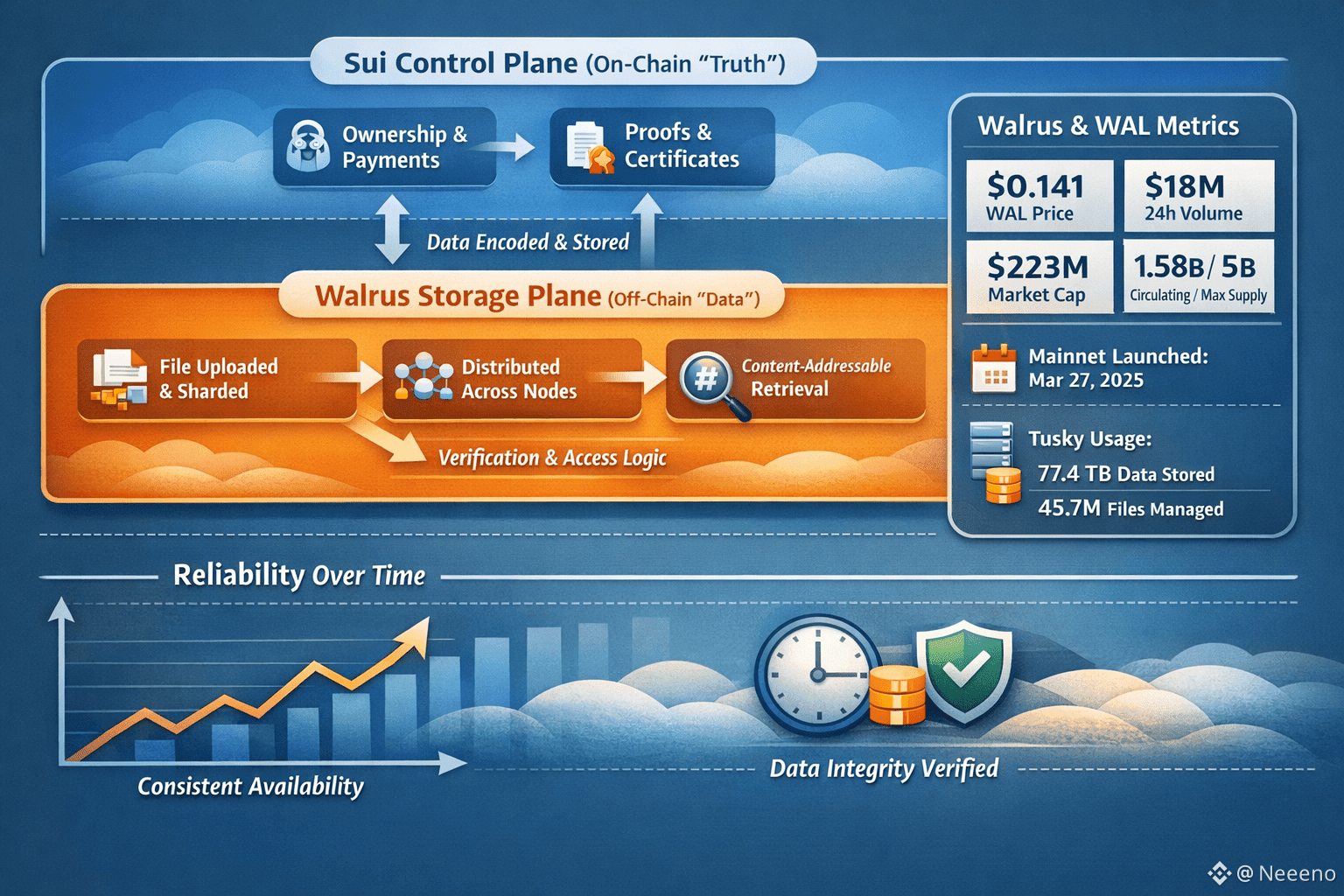
The deeper idea in Walrus is not “store files.” The deeper idea is to separate where weight lives from where truth lives. Walrus lets the weight live off-chain, spread across many independent operators, while keeping the truth legible on-chain through Sui: what was committed, who paid, who has rights, and what the network is willing to vouch for. That split is not a technical preference. It’s a psychological one. It’s the difference between hoping something will be available later and building a system where availability has a public cost and a public record. Walrus’s own design docs frame that relationship directly: users interact with Sui to acquire storage resources and submit certificates for stored blobs, while storage nodes watch chain events to coordinate their behavior.
Once you see that split, you start noticing what it protects you from. It protects you from the soft failures that ruin trust without anyone needing to be evil. A project changes priorities. A server bill doesn’t get paid. A cloud bucket gets reconfigured. A link breaks. A compliance team removes a file “just to be safe.” These are not dramatic hacks. They’re slow, boring forms of disappearance. Walrus is built around the assumption that disappearance is the default state of data unless you create a system that pays for persistence and punishes neglect.
When data enters Walrus, the network doesn’t treat it like a single object that must survive intact in one place. It treats it like something that should be survivable even if parts of the network behave badly, go offline, or simply drift away. The file is broken into pieces and wrapped in enough redundancy that recovery is still possible when some pieces are missing. Walrus’s own materials emphasize availability and reliability even under Byzantine conditions, which is a polite way of saying: “assume some participants will fail in the worst ways at the worst times.”
But the part that changes how you feel as a user is what happens next. Walrus doesn’t ask you to remember where your data lives. It asks you to remember what your data is. Retrieval is tied to an identifier derived from the content itself, so the network can prove you got the same thing you stored, not just “a file with the same name.” This sounds dry until you’ve lived through a dispute where everyone swears they uploaded the right document and the only thing that matters is whether the bytes match what was promised. In those moments, a content-derived identifier is not a feature. It’s emotional safety: a way to stop arguments from becoming endless.
The most underrated part of Walrus is that it doesn’t treat availability as a one-time ceremony. It treats availability as something that must be reaffirmed, because time is what breaks systems. Walrus has described an on-chain availability certificate on Sui that creates a public record of data custody and the start of storage service. Again, this isn’t about sounding formal. It’s about making custody auditable. When the proof is public, “we still have it” becomes something you can verify rather than something you must trust someone to say.
That is where WAL stops being decoration and starts behaving like discipline. Walrus’s token design makes a simple point that traders often ignore: storage is a long obligation, so incentives have to be long too. Walrus explains WAL as the payment token for storage, with a payment mechanism designed to keep storage costs stable in fiat terms and to distribute prepaid fees across time to those actually providing the service. That choice is quietly important. It acknowledges the uncomfortable gap between user expectations and token volatility. Users want predictable costs and predictable persistence. Operators need compensation that remains meaningful even when the market mood changes. WAL is the bridge that tries to keep those needs from tearing each other apart.
This is also where Walrus feels like it was built by people who have been burned before. A lot of networks behave as if the main risk is an attacker. Walrus behaves as if the main risk is boredom. When things go wrong, the failures are usually not cinematic. They are administrative. They are human. They are “no one noticed this was breaking.” A system that relies on constant attention is not a reliable system. Walrus tries to bake attention into economics instead: operators stake WAL to participate, and the network ties ongoing rewards to ongoing service, with penalties implied by the structure of eligibility and accountability. The Walrus team’s own explanation of incentivized availability makes this link explicit: custody becomes a verifiable trail, and the incentives come from staking and rewards funded by user fees and protocol support.
If you want to understand Walrus in real life, don’t start with a demo. Start with a situation where people disagree. A tokenized invoice gets challenged. A dataset used for a model output gets questioned. A media file gets accused of being swapped. Under pressure, users don’t ask for elegant architecture. They ask for something blunt: “Can you prove it?” Walrus is designed so the on-chain world can point to off-chain weight without pretending the weight belongs on-chain. The chain stays a place for commitments, payments, and coordination, while Walrus stays a place for the hard part: keeping the bytes retrievable and the identity of those bytes stable over time.
That coordination is also where mistakes tend to happen, because it’s where humans touch the system. People upload the wrong thing. They mis-handle permissions. They assume a link is permanent because it worked yesterday. They underestimate how quickly teams rotate, how quickly laptops get wiped, how quickly institutional memory disappears. Walrus doesn’t eliminate those failures. It reduces how catastrophic they become. If the content identity is stable and the custody record is verifiable, then a human mistake doesn’t automatically become an unrecoverable loss or an unresolvable dispute. It becomes a problem with a boundary.
In late 2025, the clearest signal that Walrus is being used as more than a theory came from the kind of place that usually tells the truth accidentally: an app that has to handle ordinary users every day. Tusky reported that it had uploaded 77.4 TB of raw data and actively manages 45.7 million files on Walrus, and that in the previous 30 days it saw 3.7 million files uploaded across 47,000 distinct uploading accounts. These are not “announcement numbers.” They’re operational numbers, the kind you only publish if the system is actually carrying weight.
Walrus Sites is another angle where the human consequence becomes obvious. The promise is simple: a website that doesn’t disappear because a hosting provider changed terms or because a bill didn’t get paid on time. Walrus’s own docs describe sites as owned by addresses on Sui and updated through on-chain logic, which turns “hosting” into something closer to custody and ownership. For builders, that changes the emotional texture of shipping. You still have to write good software. But you stop carrying the constant fear that the most basic layer of your product can be quietly revoked.
None of this means Walrus is “safe.” It means Walrus is honest about where safety actually comes from. Safety comes from incentives that don’t need constant hype to stay credible. Safety comes from accountability that survives team turnover. Safety comes from storage operators who can’t hand-wave away missing data because the network expects ongoing proof, not just a one-time claim. And safety comes from users being able to verify integrity without having to trust someone’s dashboard.
WAL lives inside that honesty, and it also lives inside the market’s uncertainty. On January 10, 2026, WAL is around $0.141 with roughly $17–18M in 24-hour trading volume, and a market cap around $223M, with many trackers reporting ~1.577B WAL circulating against a 5B max supply. The numbers are close across major listings, but not perfectly identical, which is its own small lesson in “messy reality.” Some venues report a slightly different circulating supply figure, which usually comes down to methodology and timing rather than deception. Even in token data, you learn that certainty is something you build, not something you assume.
Zooming out, Walrus didn’t appear out of nowhere. Mysten Labs announced Walrus as a developer preview in mid-2024, and Walrus later launched mainnet on March 27, 2025. In the run-up to that launch, Walrus disclosed that it raised $140M in a token sale led by Standard Crypto, which matters less as a flex and more as a sign that serious capital understood what kind of bet this is: not a consumer app, but infrastructure that has to keep working when nobody is excited.
Token distribution also tells you what Walrus thinks will keep it alive. Public breakdowns of WAL tokenomics commonly describe a majority allocation to community uses (including reserves, user distribution, and subsidies), alongside allocations to contributors and investors. The important part isn’t the percentages by themselves. It’s the intention: Walrus is acknowledging that storage supply has to be nurtured early, and that demand takes time to become real.
The honest risk for Walrus is not that people will decide storage doesn’t matter. It’s that developers will choose what’s familiar when deadlines hit, and Walrus will have to earn its place through quiet reliability rather than flashy narrative. That’s why the most meaningful “updates” for Walrus are not the loud ones. They’re the ones that show ongoing use, like Tusky’s operational metrics, and the ones that deepen the network’s ability to make availability verifiable on-chain.
If you live inside this ecosystem, you start to see Walrus as a kind of moral posture disguised as engineering. It’s the posture that says: if you’re going to build systems people rely on, you don’t get to hand-wave the heavy parts away. You don’t get to treat data as a side quest. You don’t get to pretend the world is neat. You build for churn. You build for conflict. You build for the day someone comes back with a lawsuit, a hack, a broken relationship, or a simple need to prove what happened.
That’s why Walrus keeps pulling the conversation away from “storage as a product” and toward “storage as a promise.” WAL is the token that makes that promise expensive to break, for both users and operators. Sui is the place where the promise becomes legible, so the system can coordinate around it without guessing. The network of storage operators is where the promise becomes real, because bytes don’t care about narratives. They care about being served intact, later, when someone needs them.
In the end, Walrus is not asking to be loved. It’s asking to be trusted, which is harder and slower and usually quieter. If Walrus succeeds, it will succeed in the way the best infrastructure succeeds: people will stop talking about it because it stops surprising them. WAL will keep doing its job in the background, turning time into a bill that gets paid and a responsibility that gets enforced. And when the market is loud again, the most important proof won’t be the chart. It will be the ordinary moment, months later, when someone opens something they thought might be gone and finds it still there unchanged, verifiable, and quietly waiting, exactly as promised.

