
The first time you trace where data really lives in a Sui app, it’s a little unsettling. Logic runs cleanly onchain, but the heavy stuff sits elsewhere. Images, game states, long records. You start noticing the seams. That’s where Walrus enters the picture, not loudly, but with purpose.
Below the surface, it occupies a different rung in the data availability stack than most people expect.
Traditional Storage Layers, in Plain Terms
Most blockchains were never meant to be filing cabinets. They’re notebooks for rules and receipts. So traditional systems lean on external storage layers like cloud servers or generalized decentralized storage.
Think of these as rented warehouses. They’re flexible, familiar, and efficient, but they live outside the chain’s native environment. Access is indirect. Guarantees depend on extra trust, bridges, or assumptions layered on top.
They work, but they feel separate.
Where Walrus Actually Sits
Walrus is closer to the house.
Built specifically for Sui, it acts as a native data layer designed for availability, not execution. Smart contracts don’t store bulky data themselves, but they know exactly where it lives and how to reference it without leaving the ecosystem.
A simple analogy: instead of emailing files back and forth, Walrus is the shared drive everyone already has permission to use. The address is stable. The rules are familiar. The friction is lower.
This makes Walrus less like a bolt-on storage service and more like a structural beam.
WAL and the Data Availability Stack
WAL, as a token and coordination mechanism, supports how storage is paid for, maintained, and accessed. It doesn’t sit at the execution layer, and it doesn’t try to replace consensus.
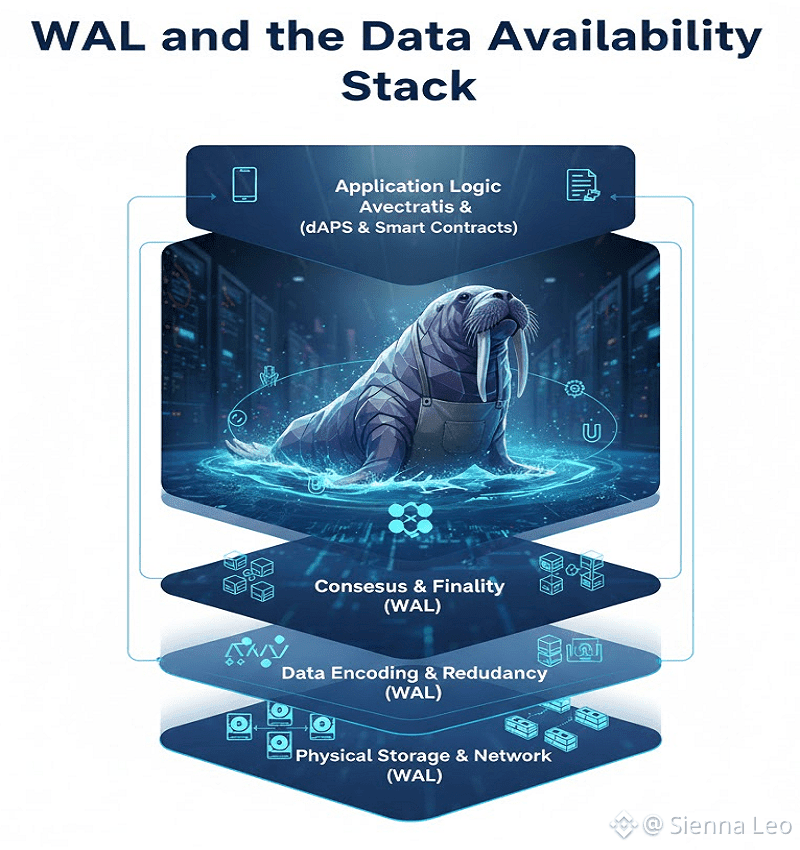
Its role is quieter. WAL helps keep data available, verifiable, and distributed in a way that matches Sui’s object-based model. That alignment matters. Data doesn’t have to be reshaped to fit the chain. It already belongs.
Compared to traditional layers, this reduces translation costs and mental overhead for builders.
What Walrus Does Better, and What It Doesn’t
Walrus shines when applications need persistent, onchain-adjacent data. Games, social apps, media-heavy tools. Anything where losing state breaks the experience.
It’s less ideal for ultra-cheap, throwaway storage or systems that already rely deeply on existing cloud infrastructure. Native alignment brings benefits, but also boundaries.
There are real risks. Storage pricing has to stay reasonable. Retrieval performance must remain predictable. And adoption is not guaranteed just because the tech is cleaner.
Infrastructure can stall quietly.
A Different Philosophy of Availability
Traditional storage layers often optimize for scale first and coherence later. Walrus does the opposite. It prioritizes consistency with Sui’s design, then grows outward.
That choice won’t win every comparison chart, but it does something subtler. It makes applications feel less patched together.
In the long run, users may never know Walrus is there. Things will just load, persist, and stay where they were left.
Sometimes that’s the clearest signal that a layer fits.
@Walrus 🦭/acc

