


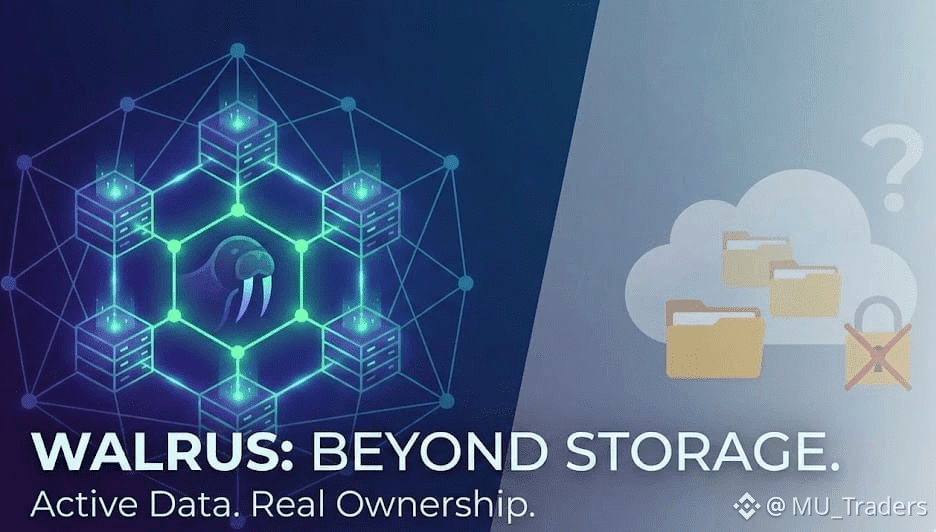
you probably think decentralized storage is already a solved problem in crypto. Files go on-chain, hashes prove integrity, and that’s it. But if you look closely, most systems still treat data as something you upload and forget. Walrus quietly changes that assumption, and the implications reach far beyond storage.
Data that stays alive, not just stored
Most decentralized storage treats data like a static object. You pay to store it, nodes replicate it, and retrieval is the end goal. Walrus treats data as something that remains active inside applications. Data is chunked, verified, and managed in a way that allows apps to reason about it continuously, not just fetch it.
This sounds subtle, but it changes how ownership works. Instead of handing data to an app and trusting it to behave, the data itself becomes part of the application’s logic. Control is enforced by the network, not by off-chain promises or frontends that can change overnight.
Why this matters right now
As apps grow more complex, especially across gaming, social, and AI, data is no longer just content. It shapes behavior. Recommendation systems, in-game assets, user histories, and model inputs all depend on reliable, composable data. Traditional DeFi never had to deal with this. Numbers are easy. Human data is not.
Walrus creates an environment where data integrity and availability are assumed, not patched together. That makes it possible to build applications that react to data over time without rebuilding trust from scratch each time.
Sui connection most people overlook
Walrus benefits from Sui’s object-centric design in a way that is easy to underestimate. On Sui, data is not an afterthought attached to transactions. It is a first-class object with clear ownership and lifecycle rules. Walrus aligns with that model, making large-scale data feel native rather than forced.
This reduces friction for developers and removes entire classes of edge cases. Instead of asking whether data will be there when needed, apps can design around the assumption that it will behave predictably under load.
What this enables beyond typical DeFi
This is where things get interesting. With dependable, application-aware storage, developers can build systems that evolve with users. Think on-chain games that remember state without centralized servers, social apps where identity and history cannot be silently rewritten, or AI pipelines where training data remains auditable.
These are not features. They are shifts in what builders are willing to attempt. That is why Walrus feels less like infrastructure for today’s crypto apps and more like groundwork for applications that do not fit neatly into existing categories.
A quieter kind of progress
Walrus does not ask you to speculate or chase narratives. It asks you to reconsider what data ownership actually means in a decentralized system. In a space where cryptocurrency often focuses on financial abstraction, this is a reminder that long-term value may come from making non-financial data behave as reliably as money.