

Decentralized storage has always suffered from a credibility gap. The underlying protocols often work as advertised, yet the user experience rarely reflects that reliability. Interfaces feel like thin wrappers over complexity, requiring users to understand shards, proofs, epochs, or economic incentives just to perform basic actions. The result is a paradox: systems designed to remove trust end up demanding a great deal of it from users who must believe that unseen mechanisms will behave correctly. Walrus App exists to close that gap, not by simplifying the protocol itself, but by translating its guarantees into interactions people can reason about.
The core contribution of Walrus App is not feature breadth, but abstraction discipline. It deliberately limits what the user is asked to care about. Instead of exposing storage as a fragmented, probabilistic process, the app presents it as a sequence of commitments with observable outcomes. Uploading data is framed as making a promise to the network. Retrieval is framed as the network fulfilling that promise. The complexity does not disappear, but it is contained behind interfaces that reflect intent rather than mechanism. This is a subtle but important shift. People do not want to manage decentralized storage. They want to rely on it.
What makes this possible is Walrus’ insistence on verifiability as a first-class property. The app does not rely on blind trust or optimistic UI design. Every action has a corresponding receipt. Proofs of storage and availability are not buried in logs or external dashboards; they are surfaced as part of the user’s understanding of system state. When something succeeds, the user can see why. When something fails, the failure is attributable. This transparency changes how responsibility is perceived. The system no longer feels like a black box, but like a contract that can be inspected.
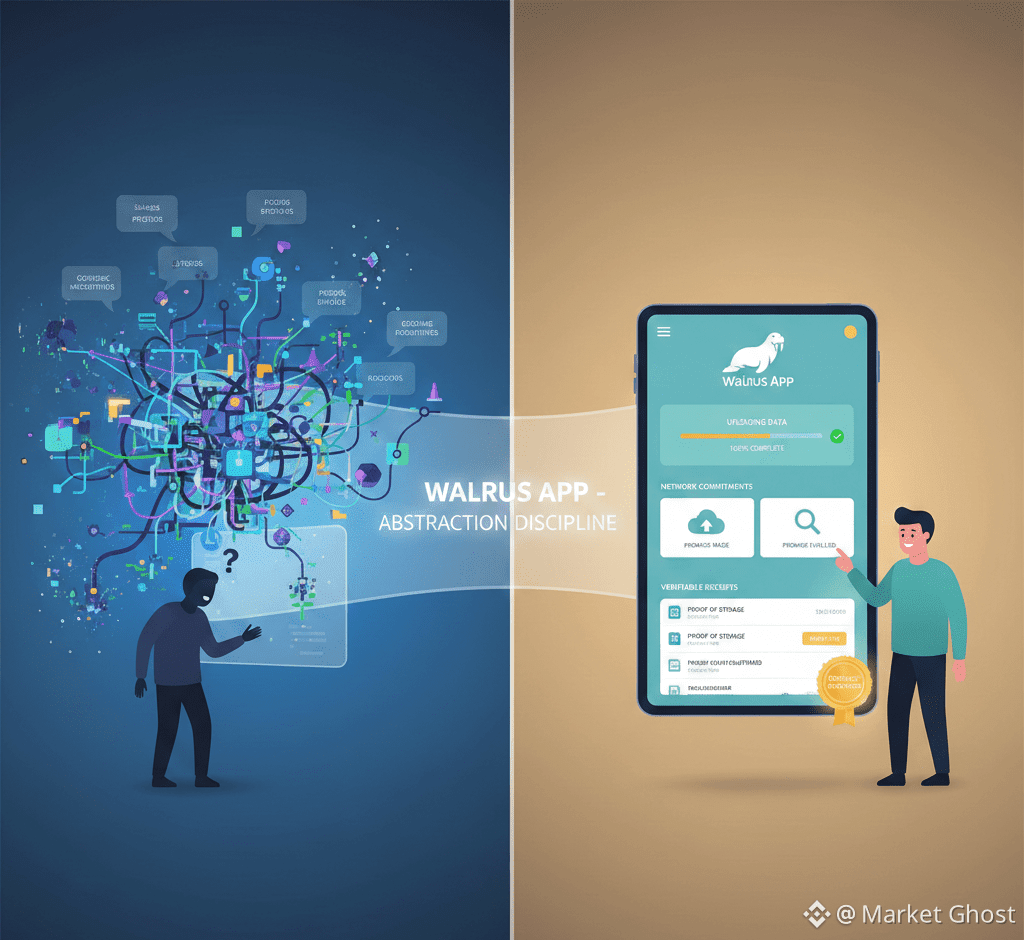
The usability gain here is not cosmetic. It alters behavior. Users are more willing to commit meaningful data when they can observe guarantees being upheld. Developers are more comfortable building on top of Walrus when storage outcomes are deterministic from their perspective, even if the underlying execution is distributed. The app effectively converts cryptographic assurances into operational confidence, which is a far rarer achievement than raw throughput or cost efficiency.
Another underappreciated aspect of Walrus App is how it normalizes economic awareness without forcing financialization. Users are not required to understand WAL’s incentive mechanics to store data, but they are gently informed that storage is not free and that reliability has a cost. This framing encourages responsible usage without turning every interaction into a market decision. Storage feels priced, not speculative. That distinction matters. It keeps the app grounded in utility rather than yield narratives.
The design also reflects an understanding of failure as a normal condition rather than an exception. Distributed systems fail in partial, uneven ways. Walrus App does not pretend otherwise. Instead of masking these realities, it contextualizes them. Delays, retries, or degraded performance are explained in relation to network conditions. This honesty reduces frustration and builds long-term trust. Users are more tolerant of issues when they understand their origin and scope. In that sense, the app functions as a communication layer between human expectations and protocol reality.
Crucially, Walrus App does not attempt to be everything. It does not position itself as a universal file manager, collaboration suite, or content platform. Its ambition is narrower and more credible: to make decentralized storage legible and dependable enough that it can be used without constant cognitive overhead. By resisting feature sprawl, it preserves conceptual clarity. The app’s value comes from consistency rather than novelty.
What emerges is a quiet but meaningful redefinition of usability in Web3 infrastructure. Walrus App does not chase adoption through incentives or spectacle. It earns it by making reliability visible and accountability intuitive. In doing so, it demonstrates that decentralized storage does not fail because the primitives are weak, but because the translation layer between protocol and person has been neglected. Walrus App addresses that neglect directly. It turns storage from an abstract promise into a lived experience, one where users do not have to believe in decentralization to benefit from it. They can simply use it, and over time, trust it because it keeps its word.

