

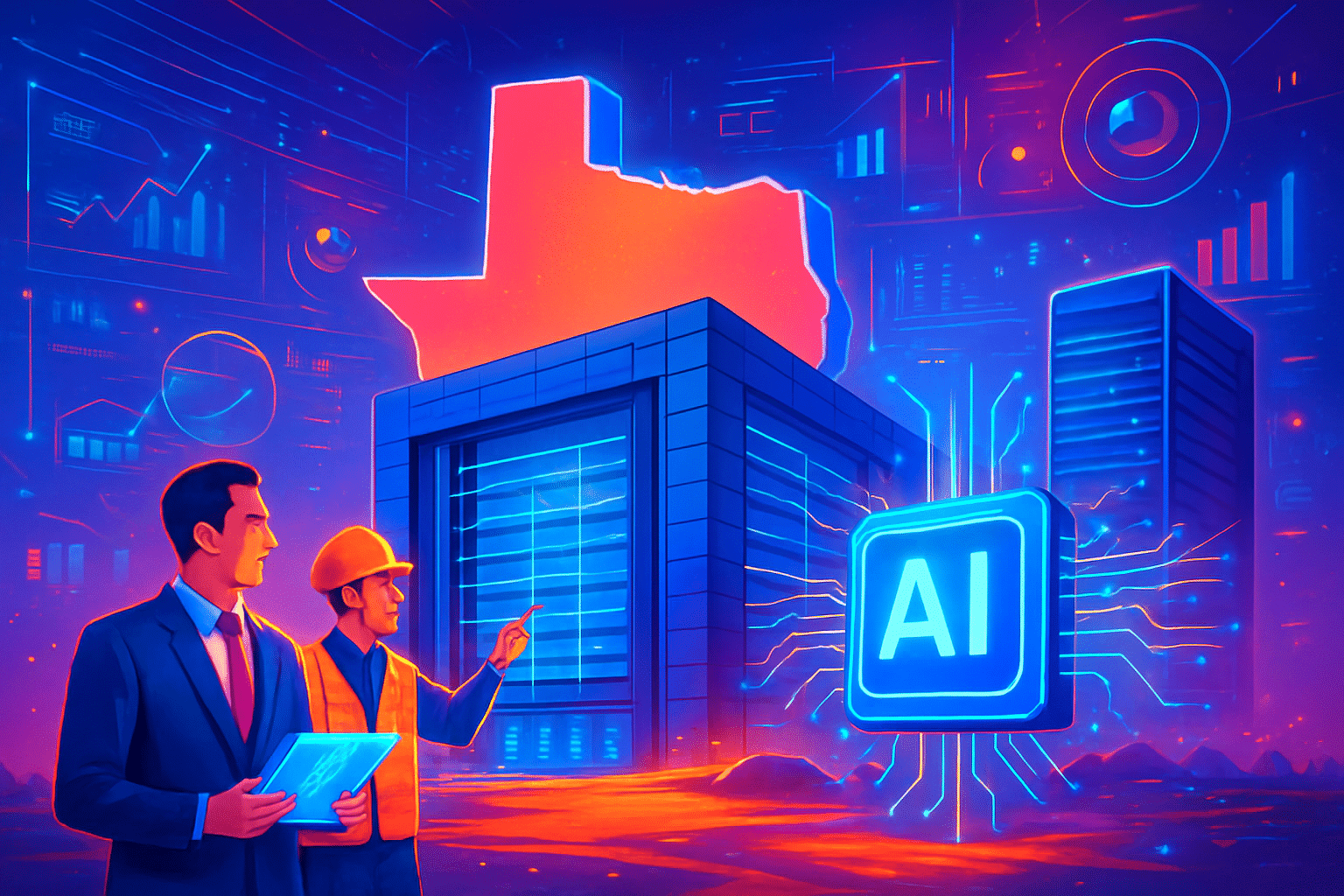
CleanSpark purchased 447 acres in Brazoria County, Texas, to build large-scale data centers for AI and high-performance computing (HPC), as Bitcoin mining is becoming increasingly costly and less profitable.
The land deal comes with a plan to expand transmission infrastructure, enabling immediate support for 300 MW and scalability to 600 MW, positioning CleanSpark as a power infrastructure provider for the rapidly growing AI demand in the Houston area.
MAIN CONTENT
CleanSpark bought 447 acres in Texas to develop AI/HPC data centers rather than focusing solely on Bitcoin mining.
The power infrastructure agreement allows for immediate power demand of 300 MW and the option to expand up to 600 MW, reducing the risk of grid congestion.
Rising Bitcoin mining costs and fierce competition are pushing miners toward AI/HPC, which offers long-term contracts and more predictable cash flows.
CleanSpark is building an AI/HPC data center cluster near Houston, leveraging strong grid advantages
CleanSpark selected the Houston area because of its strong power grid and abundant supply from the ERCOT market, making it suitable for running continuous, high-power AI/HPC data centers.
CleanSpark signed a land purchase agreement for 447 acres in Brazoria County, Texas, to build data center campuses for AI and HPC. The company also announced a long-term power transmission infrastructure agreement, enabling immediate support for 300 MW and expansion options up to 600 MW.
The Houston-area location was chosen due to the strength of the power grid and abundant supply from the ERCOT market. According to published information, this region has high demand for AI computing and the ability to deliver power at a scale that many other markets cannot match, helping businesses enhance competitiveness when offering infrastructure services.
Details about CleanSpark's expansion plans in Texas are available here: Texas Expansion Announcement and Power Infrastructure for AI/HPC.
Direct connection to high-voltage transmission lines ensures stable data center operations
With long-term high-voltage transmission connectivity, CleanSpark reduces risks of power capacity limitations, grid congestion, and delays compared to smaller-scale connection points.
AI and HPC data centers typically operate 24/7, consuming large amounts of electricity hourly, requiring a stable power supply and continuous power delivery capability. CleanSpark notes that direct connection to high-voltage transmission lines enables optimal energy intake to sustain operations.
The campus design allows for scalability without renegotiating power access or rebuilding infrastructure, reducing conversion costs and deployment risks. Direct transmission connections also help mitigate common issues such as power supply limitations, grid congestion, and delays caused by reliance on small local connections.
The Texas infrastructure cluster targets nearly 1 GW of potential power capacity
Combined with the existing site in Austin County, CleanSpark aims to create a 'regional compute hub' in the Houston area with nearly 1 GW of potential power capacity to serve AI/HPC customers.
Along with the site in Austin County and existing energy assets, CleanSpark is building a regional compute cluster in the Greater Houston area. The goal is to achieve scale advantages, reduce deployment time, and improve operational efficiency compared to distributed projects across multiple states.
The company also emphasizes a strategy of locating data centers close together to facilitate resource sharing. Additionally, the presence of other developed sites in the region enables CleanSpark to move faster in meeting AI/HPC demand, where power capacity, available space, and long-term scalability are key criteria for large customers.
According to the plan, the combined capacity of the Houston and Austin County areas can deliver up to 890 MW to support customer expansion with minimal disruption. This is a directional capacity target tied to the strategy of building large-scale campuses.
CleanSpark is preparing both 'front-of-the-meter' and 'behind-the-meter' power models
CleanSpark plans to support both grid-connected power delivery and on-site power solutions to meet the varying needs of AI/HPC customers regarding control and specialization.
Not all customers have the same operational configurations. Some require direct grid access; others prefer dedicated on-site power sources located close to computing activities. Therefore, CleanSpark plans to deploy both 'front-of-the-meter' and 'behind-the-meter' models in parallel across its Texas projects.
In a context where stable power has become a high-value resource for AI data centers, the company positions itself as a long-term partner, offering predictable power capacity, planable costs, and sufficient space for multi-year growth.
Rising Bitcoin mining costs and fierce competition are driving the shift toward AI/HPC
As Bitcoin mining becomes increasingly expensive and profit margins are squeezed by competition, many miners are seeking alternative revenue sources like AI/HPC, which are typically based on long-term contracts and more predictable cash flows.
Bitcoin mining is described as 'extremely costly,' with shrinking profit margins due to increasing competition in 2025 as more miners enter the market. To maintain previous profit margins, companies are forced to use more resources, increasing cost pressure and operational risk.
Under this pressure, large-scale mining operations began seeking additional revenue streams. With many miners already owning sites with strong grid connections, they are turning to AI/HPC as a way to leverage existing electrical infrastructure. Compared to Bitcoin mining, which has unpredictable profit margins due to intense competition, AI/HPC is typically tied to long-term contracts and stable payment flows, enabling clearer revenue planning.
For CleanSpark, the ability to manage large-scale power operations enables low-infrastructure barriers to integrating AI/HPC. The company can continue mining BTC where it remains profitable while dedicating capacity to long-term strategic projects.
Texas is emerging as a top destination for miners transitioning to high-performance computing
Texas is favored due to its abundant power availability, strong transmission infrastructure, and rising demand for computing services, creating favorable conditions for large-scale AI/HPC projects.
Many miners want to reduce reliance on Bitcoin due to price volatility and high competition. Some companies have already adjusted part of their operations to integrate AI or computing, while others have announced plans to deploy in the near future.
Texas has emerged as a suitable choice for this transition due to three factors: abundant power availability, strong transmission infrastructure, and increasing demand for computing services. CleanSpark says it will leverage its mining roots to transform into a computing platform and continue expanding its portfolio in Texas, while negotiating with partners needing co-location and large-scale compute campuses.
Frequently Asked Questions
How much land did CleanSpark buy in Texas and what is it for?
CleanSpark agrees to purchase 447 acres in Brazoria County, Texas, to build large-scale data centers for AI and high-performance computing (HPC).
How much power capacity can CleanSpark's new project provide?
The transmission infrastructure agreement allows for immediate power demand of 300 MW and an option to expand up to 600 MW. Combined with the site in Austin County, the maximum scalable capacity is stated to be up to 890 MW.
Why are Bitcoin miners shifting to AI/HPC?
Due to rising Bitcoin mining costs and intense competition compressing profit margins, while AI/HPC typically involves long-term contracts and more stable cash flows, enabling better revenue forecasting for businesses.
What do 'front-of-the-meter' and 'behind-the-meter' mean in CleanSpark's plan?
These are two ways to power data centers: drawing electricity directly from the grid (front-of-the-meter) or using dedicated on-site power sources close to the computing load (behind-the-meter). CleanSpark plans to support both models to meet diverse customer needs.