

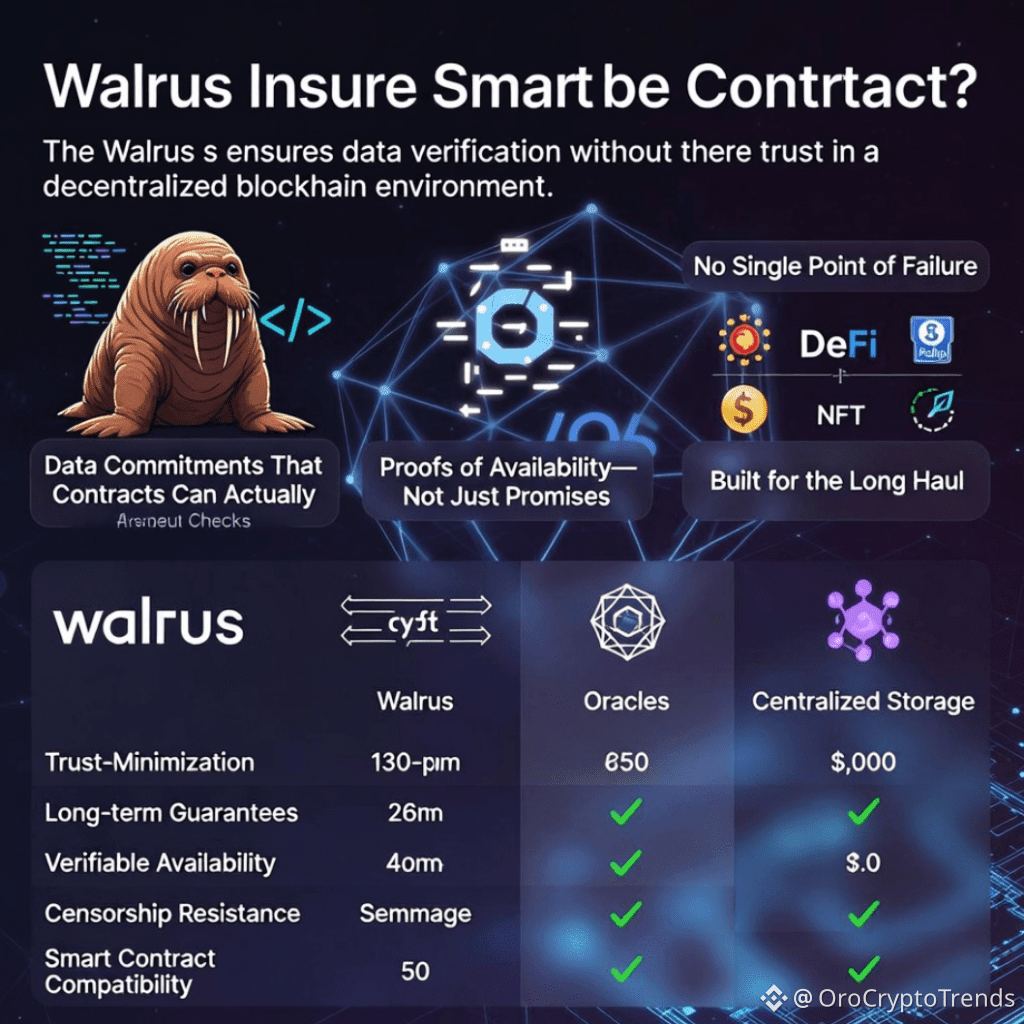
How Smart Contracts Really Check Data Without Relying on a Middleman
Figuring Out Walrus: How It Keeps Data Honest for Modern Blockchains
Smart contracts are great because they let people do business without needing to trust each other. But here’s the catch—these contracts don’t actually know what’s happening outside the blockchain. Most folks don’t realize it, but as soon as a contract needs info from the outside world—maybe prices, files, transaction records, or NFT details—the whole “no trust” idea starts to slip. Suddenly, you’re back to trusting some outside source to feed the contract the right data.
That’s where Walrus steps in.
Walrus gives smart contracts a way to check if off-chain data is real, unchanged, and still available—without having to put faith in a single provider. Let’s dig into how Walrus pulls this off, why it matters for people building in Web3, and what it unlocks for users.
The Core Problem: Smart Contracts Can’t See the Outside World
Think of smart contracts like vending machines. They’re great at following instructions, but they don’t get context. They only know what you put in.
So when a contract needs info from outside—through an oracle, a storage service, or some third-party API—it has to trust that someone’s being honest and always online. That opens the door to all sorts of issues: someone could mess with the data, the service might go down, or, worst of all, things could break quietly and no one notices for years.
Walrus changes the game by making data provable, not just trusted.
What Does Walrus Actually Do?
Walrus is a decentralized protocol for storing data off-chain, but with a twist—it makes the data:
- Verifiable
- Tamper-resistant
- Always recoverable, even after years
So instead of asking a contract to just “believe” the data, Walrus lets you prove, with math, that the data is legit and available. Imagine a public warehouse where you get a receipt for what you store, not some private locker nobody else can check.
How Walrus Makes Data Trust-Minimized
1. Data Commitments That Contracts Can Actually Check
Whenever you stash data on Walrus, it gets a unique cryptographic fingerprint—a hash. Smart contracts don’t need the whole file. They just check the fingerprint to make sure the data lines up and hasn’t been swapped out. It’s a bit like confirming a document’s authenticity by looking at its signature, rather than reading every word.
2. Proofs of Availability—Not Just Promises
Walrus nodes have to prove they still hold your data. These proofs let rollups show their data exists, let validators double-check things, and give contracts real assurance—no more crossing your fingers and hoping for the best. Trust gets replaced with math.
3. No Single Point of Failure
Walrus chops up your data and spreads it across tons of independent nodes—using erasure coding. Even if a few nodes disappear, your data’s still safe and can be put back together. That’s huge, because smart contracts expect things to break, and Walrus is built for exactly that.
4. Built for the Long Haul
While lots of storage solutions just focus on the next week or two, Walrus aims for years. That’s a big deal for DeFi protocols that last a long time, rollups that need to prove history, and NFTs that should never lose their metadata.
Why This Matters for Smart Contracts
DeFi Protocols
- Can finally check historical data for themselves
- Don’t have to blindly trust oracles as much
- Audits get simpler
Rollups
- Better proofs for fraud and validity
- On-chain costs drop
- Users and validators feel more confident
NFTs and Other On-Chain Assets
- Metadata sticks around
- Fewer broken links
- Long-term value holds up
Governance Systems
- Verified voting data
- Transparent archives
- Records you don’t have to just “trust”
How Walrus Stacks Up Against Oracles and Centralized Storage
Feature Oracles Centralized Storage Walrus
Trust-minimized Partial No Yes
Long-term guarantees Weak Weak Strong
Verifiable availability Limited No Yes
Censorship-resistant Low Low High
Smart contract friendly Yes Indirect Yes
Walrus doesn’t get rid of oracles, but it cuts down on what you need to trust.
Smart contracts don’t need to “see” all the data—they just need to know it exists and hasn’t been tampered with. Walrus moves us from hoping data is good to actually proving it. It’s a quiet upgrade, but a big one for anyone building in Web3.
FAQs
Q: Does Walrus run smart contracts?
No. Walrus doesn’t run contracts—it helps by making data reliably available for them.
Q: Is Walrus an oracle?
Not exactly. Walrus focuses on making sure data is available and verifiable, not on fetching prices or other real-world info.
Disclaimer:Not Financial Advice