
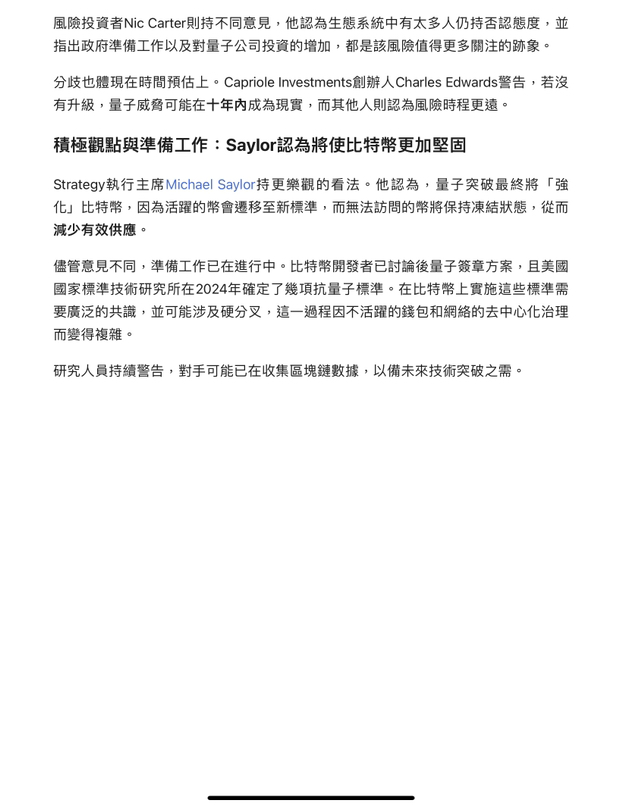
The recent decline may be due to the mention by Coinbase's research director David Duong of "33% $BTC of Bitcoin supply facing quantum risk", leading to some fluctuations in the market.
However, after carefully studying the logic of the report and combining it with market feedback, I believe this is more like an industry risk warning report rather than an immediate disaster forecast. In other words, this is just a 'gray rhino', not a 'black swan'.
The crypto market is extremely sensitive to real crises. If the risk of 6,500,000 BTC is a fact that is 'imminent', what we are seeing is certainly not the slight adjustments of a few points like now. The current trend in the market clearly tells us: this is just a long-term technical alert, not an immediate selling signal.
The report mentions that 33% of the risk addresses are mostly early P2PK or old addresses with exposed public keys. For active users, as long as future simple address migrations (from old standards to quantum-resistant standards) are carried out, the funds are safe. For 'dead' addresses, if these addresses cannot be migrated, they will instead be permanently frozen due to quantum threats. As Michael Saylor said, this effectively reduces the effective supply, and the scarcity of Bitcoin will actually be a long-term benefit.
Quantum computing needs to break SHA-256 or elliptic curve encryption, which still has significant hardware hurdles (requiring millions of quantum bits). Meanwhile, the Bitcoin community is not sitting idly by: NIST has released standards for quantum-resistant algorithms. Developers are already discussing post-Taproot quantum-resistant upgrade solutions.
This is a typical evolution of 'spear and shield.' Although Bitcoin's decentralized governance is slow, it has never faltered at critical moments.
Coinbase, as a global compliance benchmark, publishes such reports mainly for:
1. Urge the developer community to accelerate consensus (to prevent hard fork risks).
2. Conduct institutional-level risk disclosures in advance to fulfill compliance responsibilities.
3. Lay the groundwork for future technological upgrades (which may involve hard forks).
So, don’t feel like the sky is falling just because you see an institution's 'risk disclosure.' If you give up your chips due to such long-term, solvable technological evolution risks, it only indicates that you underestimate the evolutionary capability of Bitcoin.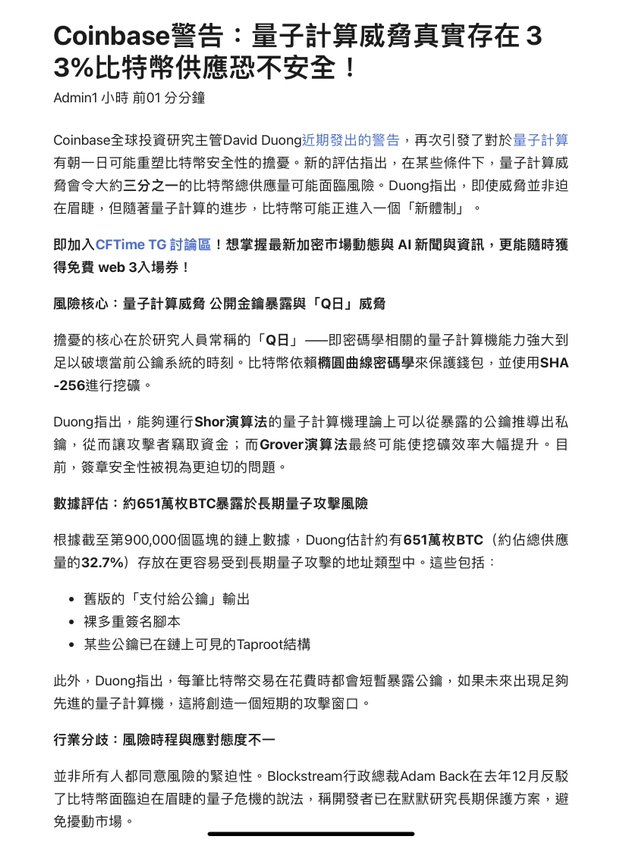
I reiterate: this is currently just a risk warning, not a disaster forecast. Hold onto your coins rationally, focus on technological upgrades rather than emotional noise.