

HELLO TWIN TULIPS FAMILY ON BINANCE SQUARE TODAY THIS POST CAN CHANGE YOU MIND AND CLEAR ALL QUEASTION ABOUT PLASMA COIN
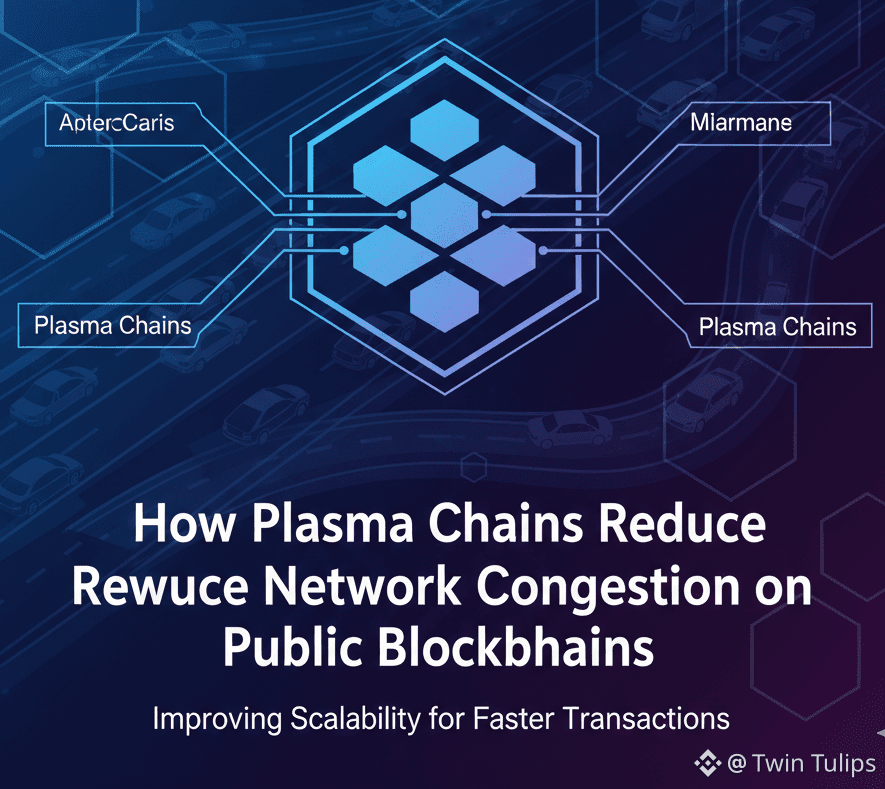
How Plasma Chains Reduce Network Congestion on Public Blockchains
The rapid growth of public blockchains has brought significant challenges in scaling. As more users engage with decentralized applications (dApps), networks like Ethereum often experience congestion, leading to slower transaction times and higher fees. Plasma chains have emerged as one of the most promising solutions to address these challenges, enabling blockchains to scale efficiently while preserving decentralization and security.
Understanding Network Congestion
Network congestion occurs when the volume of transactions exceeds the capacity of a blockchain to process them in a timely manner. Public blockchains rely on nodes to validate transactions and reach consensus. While this ensures security and transparency, it also introduces limitations on throughput. For instance, Ethereum can only handle around 15 transactions per second on its base layer. When demand surpasses this limit, users face delays, and transaction fees, often called gas fees, spike significantly.
Congestion is not just an inconvenience—it can hinder adoption. High fees deter small users, delay dApp interactions, and affect the user experience in decentralized finance (DeFi) and gaming applications. To maintain growth, blockchains must find ways to offload transactions from the main chain without compromising the security and integrity of the network.
What Are Plasma Chains?
Plasma chains are a layer 2 scaling solution first introduced by Vitalik Buterin and Joseph Poon. They are essentially smaller, child blockchains that run alongside a main chain (often called the root chain). These chains can process transactions independently before periodically submitting summaries or proofs back to the main blockchain.
The core idea is simple: instead of congesting the main network with every transaction, Plasma chains handle the bulk of activity off-chain while leveraging the main chain for security and dispute resolution. This hybrid approach allows for significantly higher transaction throughput without sacrificing the core trust guarantees of the parent blockchain.
How Plasma Chains Reduce Congestion
1. Offloading Transactions
The primary mechanism by which Plasma chains reduce congestion is by offloading transactions from the main chain. Users interact with a Plasma chain for their operations, which means the main blockchain only needs to record checkpoints or final states rather than every individual transaction. This dramatically lowers the number of transactions the root chain must process, freeing up capacity for other activities.
2. Faster Transaction Confirmation
Since Plasma chains operate independently, they can achieve faster confirmation times. Transactions on the Plasma chain do not need to wait for global consensus on the main chain. Instead, the child chain can validate transactions using its own consensus rules, allowing users to enjoy quicker interactions for payments, smart contract executions, or asset transfers. Once finalized, the Plasma chain periodically commits a batch of transactions to the main chain for added security.
3. Reduced Fees
Network congestion often leads to higher transaction fees. By handling transactions off-chain, Plasma chains significantly reduce the computational load on the main network. Users benefit from lower fees because fewer resources are required to validate and secure each transaction. This cost-efficiency is particularly beneficial for microtransactions or applications that require frequent small payments.
4. Enhanced Scalability
Plasma chains can be designed to operate in parallel. Multiple Plasma chains can exist simultaneously, each catering to specific applications, geographic regions, or transaction types. This modular approach enhances overall scalability, allowing blockchains to accommodate a rapidly growing user base without sacrificing performance. It also provides developers with flexibility to tailor chains for specific use cases, optimizing both speed and efficiency.
5. Security Through Fraud Proofs
While Plasma chains process transactions off-chain, they are designed to maintain strong security guarantees. Each Plasma chain periodically submits cryptographic proofs to the main chain. If an invalid transaction occurs, users can challenge it through a mechanism called a fraud proof. The root chain then enforces corrections or reversions, ensuring that even though transactions happen off-chain, the system as a whole remains secure and trustless.
6. Flexibility for Different Applications
Plasma chains are not a one-size-fits-all solution. Their architecture allows for customization depending on the requirements of an application. For example, a Plasma chain designed for token transfers may prioritize speed and low fees, while one built for gaming or DeFi could include more complex smart contract capabilities. This flexibility helps reduce congestion across a variety of sectors, rather than just relieving pressure in a single use case.
Real-World Implementations and Benefits
Several projects have implemented Plasma-based solutions to address network congestion. Early examples include OmiseGO (now part of the OMG Network), which used Plasma chains to facilitate high-volume transactions on Ethereum. The results demonstrated a significant improvement in throughput and reduced fees for end users.
For users, the benefits are tangible: faster payments, smoother experiences in dApps, and lower costs. For developers, Plasma chains offer a scalable platform to build applications that can grow alongside a blockchain’s user base without being bottlenecked by network congestion.
Moreover, Plasma chains complement other layer 2 solutions such as rollups. While rollups bundle transactions into a single proof on the main chain, Plasma chains provide a flexible environment where off-chain activity can occur continuously, contributing to a diversified ecosystem of scaling solutions.
Challenges and Considerations@Plasma
Despite their advantages, Plasma chains come with limitations. One notable challenge is exit latency. Because transactions must eventually be confirmed on the main chain, withdrawing funds from a Plasma chain can take time, often several days. This delay is necessary to allow potential fraud proofs to be submitted but can be inconvenient for users who need immediate access to their assets.
Additionally, Plasma chains may face complexity in interoperability. Moving assets or information between different Plasma chains or back to the main chain requires careful coordination to maintain security. Developers must design robust mechanisms to handle these interactions safely.
Finally, as with any layer 2 solution, adoption is key. The effectiveness of Plasma chains in reducing congestion depends on a critical mass of users and developers participating in the ecosystem. Without sufficient engagement, the chains may remain underutilized and fail to deliver the intended scalability benefits.
The Future of Plasma Chains in Blockchain Scaling#Plasma
Plasma chains are part of a broader strategy to make public blockchains more scalable, efficient, and user-friendly. While newer solutions like Ethereum’s rollups and sharding are gaining attention, Plasma chains remain relevant for certain use cases where modular, high-throughput chains are advantageous.
As blockchain adoption continues to grow across DeFi, gaming, and enterprise applications, solutions like Plasma will play a vital role in preventing congestion, reducing fees, and improving the overall user experience. By offloading transactions from the main chain, Plasma chains allow public blockchains to scale organically, maintaining both security and decentralization while accommodating increased demand.
Conclusion
Plasma chains offer a practical, secure, and efficient solution to the persistent problem of network congestion on public blockchains. By moving the bulk of transactions off-chain while retaining strong security guarantees, they enable faster, cheaper, and more scalable blockchain operations. While there are challenges to consider, such as exit latency and interoperability, the benefits make Plasma chains an important tool in the ongoing effort to scale decentralized networks.
For anyone involved in blockchain development, trading, or simply exploring decentralized applications, understanding Plasma chains is essential. They are not just a technical concept—they are a real-world solution that directly impacts transaction speed, user experience, and the cost of participating in public blockchains. As the ecosystem grows, Plasma chains will likely remain a key component of blockchain scalability strategies, encouraging more people to engage with decentralized technologies.

