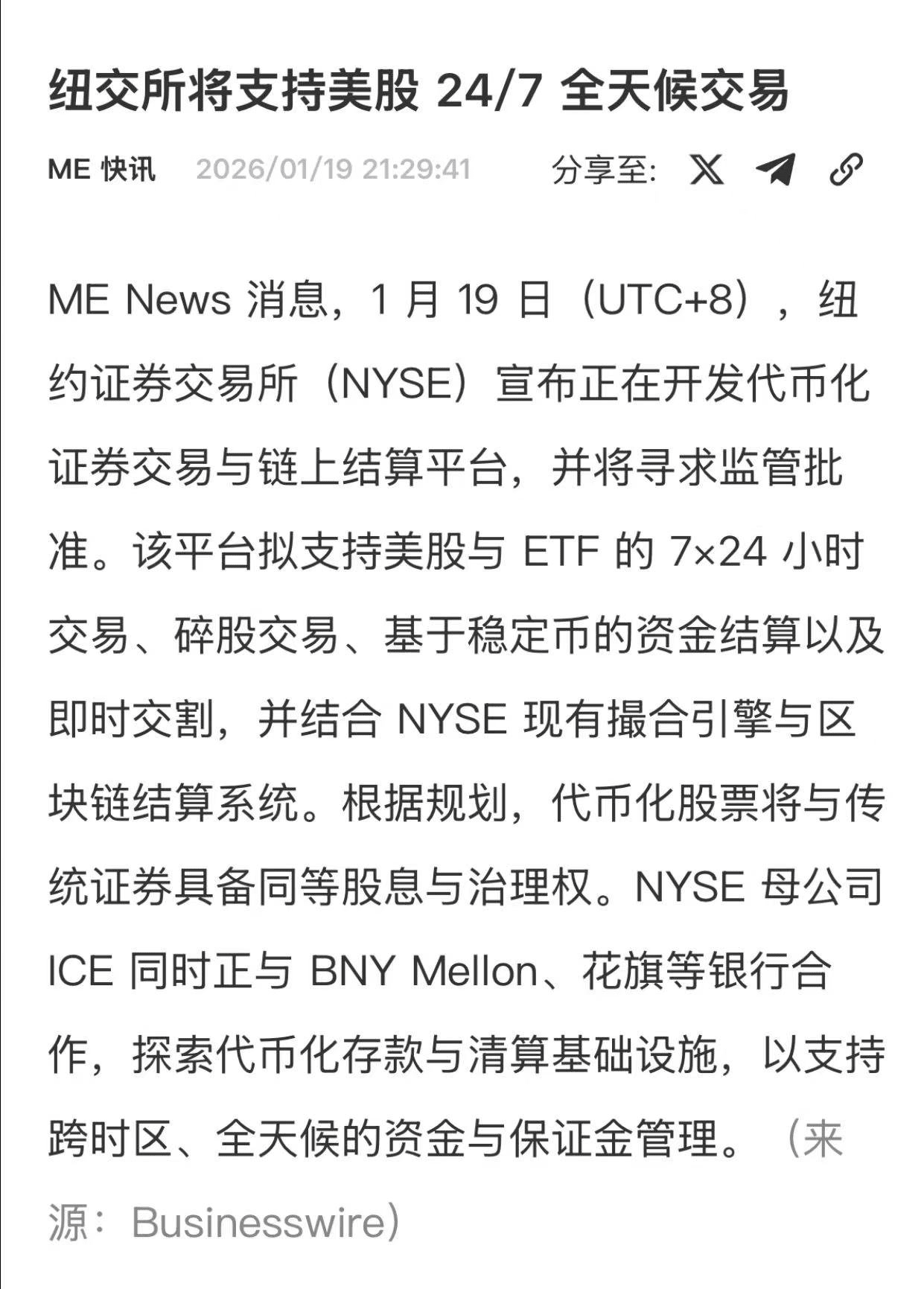
When this message came out, I saw many people asking this question. Some said this is a dimensionality reduction attack by a century-old compliant store. Here are my thoughts:
~~~~~~~~~~
Reputation of blockchain: Positive
The main issue here is how you define 'the cryptocurrency circle.' If you refer to the entire industry based on blockchain technology, then the next-generation clearing infrastructure recognized by the world's largest stock exchange can be considered a validation and endorsement for blockchain.
Many years ago, the Australian Securities Exchange (ACX) specifically built a team to promote the use of blockchain technology to improve the outdated (over a hundred years old) securities trading system. Here in Australia, we occasionally use this to try to establish mutual faith, believing this is the beginning of blockchain changing the world, and we are quite proud of it.
Later, the bear market ended without incident, and now the United States has taken the first step. Australia is indeed always disappointing in this dimension of daring to be the world's first.
~~~~~~~~~~
On the popularization of stablecoins: proactive
If US stock trading requires stablecoins as a settlement medium, the issuance scale of stablecoins (like USDC, USDT, or compliant bank stablecoins) will see a magnitude of growth.
The main use of stablecoins is no longer as ammunition for speculation but to become a truly meaningful 'digital dollar,' which will lead to greater global monetary integration.
In simple terms, this move raises the ceiling of the entire stablecoin market, and the new generation of stablecoin projects should also benefit from a wave of dividends, such as $USD1 and $U.
However, the dominant position of stablecoins USDT and USDC may face competition, especially from USDC, which features compliance.
If in the future mainstream funds settle on the NYSE directly using 'tokenized dollars,' and if such dollars can even be borrowed directly on-chain, then high-net-worth users and institutions will quickly shift from USDC to bank tokens, as the latter offers higher capital utilization and security.
However, every penny of these bank tokens is under strong regulation and KYC; while this meets institutional needs, it goes against the original intention of decentralization and privacy in the crypto space, so retail investors may not favor it.
~~~~~~~~~~~
To the current CEXs: the impact varies.
Last year, we saw that whether it was Binance or Coinbase, Bitget or on-chain Dex, many exchanges were clinging to the narrative of RWA US stock tokens to find growth.
Now that the regular army has entered, at least some compliance users, who are surely attracted by 24/7 trading, will inevitably be exploited; the biggest impact here should be on Coinbase, as the NYSE's move is akin to directly invading Coinbase's core defense zone.
However, for many users who find it inconvenient to trade US stocks, especially Chinese users, the demand to avoid KYC and tax tracking still exists, so the narrative isn't completely lost.
For CEXs like Binance that we are more familiar with, I believe the short-term impact is minimal. The NYSE sells Apple and Tesla, while Binance sells BTC, PEPE, and various altcoins, each selling their own goods without interference.
However, it is necessary to pay attention to a possibility:
The NYSE news clearly mentions support for 'fractional trading,' which means ordinary retail investors can buy Tesla tokens on the NYSE with $10 and can gamble 24/7.
Small funds, 24/7 continuous gaming was previously exclusive to the crypto space, but now there are places being diverted.
~~~~~~~~~~~
Which coins benefit?
Oracle sector$LINK / $PYTH
Just a few days ago (January 14), the Chainlink ETF from Bitwise and Grayscale was listed on the NYSE. Chainlink is the leader in oracles and if adopted by the NYSE, it will definitely take off.
As an oracle that focuses on high-frequency pricing of financial assets, if the NYSE platform involves more high-frequency trading of stock tokens in the future, low-latency oracles like PYTH will also be a focus for institutions.
On-chain DeFi sector$AAVE / $PENDLE
With the tokenization of US stocks and ETFs, the demand for yield trading on these assets will surge, AAVE will increase lending, while Pendle, as a yield stripping protocol, will have applications that can extend from crypto assets to traditional securities yields.
Underlying settlement and infrastructure public chain $ETH
The NYSE mentioned it will support 'multi-chain settlement and custody'; other chains are not yet known, but the vast majority of institutional RWA assets (like BlackRock's BUIDL fund) currently prefer Ethereum.
The NYSE's settlement system will likely be highly compatible with the Ethereum ecosystem.
~~~~~~~~~~~
But to be honest, I looked at some of the coins I've been playing with recently, and if they're not meme coins, they're AI infrastructure or zk, one is in the sky and the other is underground compared to what NYSE is going to do.
Although they are all called blockchains, the fork is getting larger and larger. If it really has to be transmitted to us, the road is still long, and the so-called dimensionality reduction strikes are not really that severe.