
There’s a quiet moment that happens when a technology stops being exciting and starts being serious. It’s not announced. There’s no launch event. It shows up in the questions people begin to ask. Not “can this work,” but “can this be trusted when it matters.” Blockchain is reaching that moment, especially in finance, and the answers are no longer theoretical.
For years, crypto lived comfortably in an experimental space. Transparency was celebrated, anonymity was romanticized, and speed often mattered more than structure. That environment produced innovation, but it also avoided responsibility. Real financial systems do not operate in a vacuum. They operate under law, oversight, risk management, and accountability. When blockchain began approaching that world, many of its assumptions stopped holding up.
This is where Dusk Foundation enters the picture, not as a rebellion against finance, but as an attempt to make blockchain compatible with it.
One of the biggest misunderstandings in crypto is the idea that transparency automatically creates trust. In reality, trust in finance is built through controlled disclosure. Banks, funds, and institutions do not expose everything to everyone. They disclose the right information to the right parties at the right time. This is not secrecy for its own sake. It is how risk is managed and how systems remain stable.
Public blockchains broke that model entirely. Every transaction, every balance, every interaction became visible to anyone willing to look. That openness worked for experimentation, but it became a liability when real value entered the system. Institutions hesitated not because they feared decentralization, but because they could not operate responsibly in an environment with no privacy boundaries.
Dusk starts from that reality instead of ignoring it.
Rather than layering privacy on top of an existing transparent system, Dusk builds confidentiality into the foundation of the network. Transactions can remain private while still being provable and auditable when necessary. This distinction is critical. It means compliance does not require exposure, and verification does not require surveillance.
I’m seeing Dusk as part of a broader shift in how blockchain defines decentralization. Early narratives treated decentralization as visibility. The newer understanding treats decentralization as control without unnecessary disclosure. Those are very different ideas. One exposes everything. The other distributes authority while respecting information boundaries.
This difference matters most when blockchain intersects with regulation. Regulation is often framed in crypto as an external threat, something imposed from outside. In reality, regulation exists because financial systems affect real people, real economies, and real livelihoods. Ignoring it does not make it disappear. It only delays the consequences.
Dusk does not treat regulation as an afterthought. It treats it as a design condition. By doing so, it avoids the fragile compromises that appear when projects try to retrofit compliance later. This approach makes Dusk slower to hype but stronger in structure.
Another important aspect of Dusk is its attitude toward adoption. It does not assume that institutions will abandon existing systems overnight. Instead, it focuses on creating infrastructure that can integrate gradually. Tokenized assets, compliant DeFi, and institutional settlement are not speculative ideas anymore. They are active areas of exploration. But they require systems that behave predictably under scrutiny.
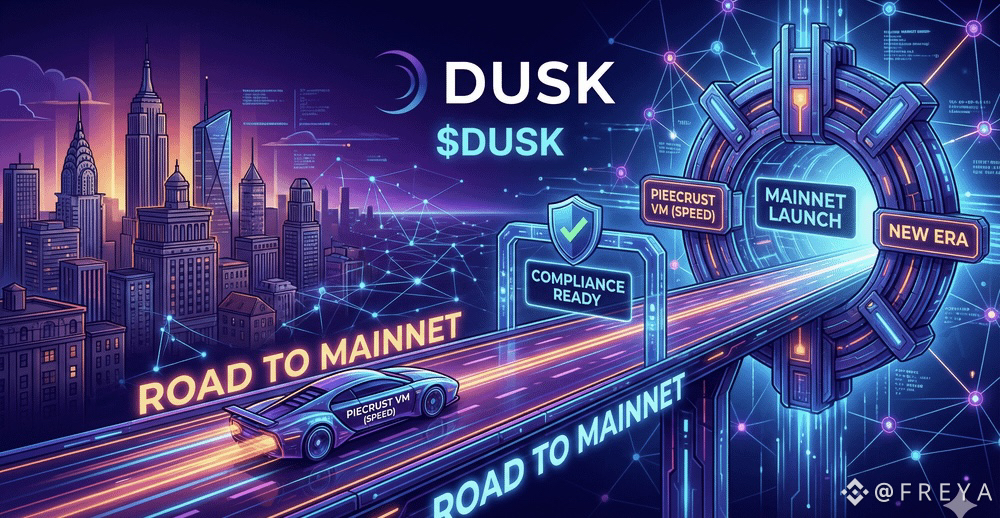
Dusk is built with that expectation.
I’m noticing that projects like Dusk appeal to a different type of participant. Not those chasing rapid returns, but those thinking in timelines measured in years. Builders who understand that financial infrastructure is judged by what happens during stress, audits, and edge cases, not during ideal conditions.
There is also a subtle maturity in how Dusk positions itself. It does not claim to replace finance. It does not claim to disrupt everything at once. It focuses on making blockchain usable where it previously was not. That restraint is often overlooked, but it is one of the strongest signals of seriousness.
As blockchain continues to evolve, the industry is learning that openness without structure is not enough. Systems that handle real value must protect participants while remaining verifiable. Privacy is not a weakness in that context. It is a requirement.
Dusk represents a vision of blockchain that has grown past experimentation. A version that understands the responsibilities that come with handling real economic activity. A version that does not confuse exposure with honesty.
If blockchain is going to move from being an alternative system to being part of global financial infrastructure, it will need projects that accept complexity rather than denying it. Dusk is building quietly in that direction, without shortcuts and without pretending the path is simple.
Sometimes progress looks less like disruption and more like alignment. And in finance, alignment is often what determines whether something lasts.
